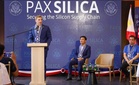
ONE of the most frustrating things about the months-long exercise in sialorrheic self-congratulations that the Marcos administration has engaged in about the Philippines having joined the MAGA regime’s “Pax Silica” initiative is that the actual memorandum of understanding (MOU) that started it all in early February has not been made available to the public, at least until now. Even then, it is only obtainable through indirect channels. The Department of Foreign Affairs (DFA) deigned to provide it upon the request of Congress (more than one request, I heard, but I am not certain) earlier this month in connection with hearings on the 2027 budget. That’s enough of a crack in the Wall of Silence for a sticky-fingered busybody like me, but it’s not really doing a service for the average citizen who has a right to know if his government is selling him out.
Is that in fact what this MOU does? Well, the short answer to this question is “yes,” although the scale of the sellout is only going to become clear when the formal agreement is finalized, presumably sometime in November, according to the government. As this is only an MOU, and therefore non-binding – and it does say so clearly – the Philippines is not necessarily committed yet to having its mineral resources pillaged, its trade policy dictated, and its institutional processes and environmental protections steamrolled by the United States. However, the importance of the MOU is to establish the base terms on which the final agreement will be negotiated, and these are all in favor of the US and detrimental to the Philippines.
It is worth noting what is not in the MOU, given the furor the “Pax Silica” arrangement has raised here in the Philippines. It confines itself to “critical minerals” only, although those are not in any way defined, and makes no mention of artificial intelligence (AI) data centers, nor does it suggest development of related industries, such as computer chip and semiconductor manufacturing. It does mention mineral processing, but only mentions it; the commitment to develop downstream industries to add value (as well as the “millions of jobs” some shallow-thinking advocates seem to think will result from this deal) is at best vague and qualified.
The MOU is deceptively short, only about three-and-a-half pages long, with the entire first page consisting of the “whereas” clauses that justify the agreement. Business groups and academics who have glommed onto the agreement as an announcement of a bright new day for the Philippine economy have apparently been fooled by the tone of equity and reciprocity written into these clauses, which present the understanding as one that gives equal partners equal access to each other’s “critical minerals” sectors. Diplomatic hoo-hah is not that difficult a language to read for those who apply critical thinking; but it will make victims of those who choose to apply wishful thinking instead.
Alarming details
There are two sections to the MOU, Section 1 “Critical Minerals and Rare Earths,” and Section 2 “General Provisions,” and there are nasty little traps distributed throughout both of them. Under Section 1, part 1 “Securing supply,” the MOU expresses the objective to “increase the competitiveness of the Philippines’ critical minerals and rare earths sector,” which sounds benign enough, and is followed by the proviso that, “cooperation should prioritize development of domestic processing industries and value chains.”
The big problems here are that later in the MOU, it is made clear that “competitiveness” actually means “sale to the US market, or to other markets the US deems acceptable.” Beyond that, “should prioritize” is a weak aspiration, not a commitment, and the MOU conveniently omits the identification of whose “domestic processing industries and value chains” are to be developed. This is an indicator of poor negotiating on the Philippines’ part.
In Section 1.2, mining and processing projects are to be “jointly identified” to “address gaps in priority supply chains.” As the Philippines does not have these “priority supply chains” as yet, this means US decision-making on what is to be mined and processed. This is reinforced by what is actually one of the most appalling surrenders of Philippine sovereignty in the entire document, Section 1.8 “Geologic mapping,” where the Philippines is to agree to share strategic information about the country’s mineral and rare earth resources exclusively with the US.
This particular clause stood out because it is not the direction in which other mineral-rich countries are moving. In recent news, Congo’s government has just clamped down on sharing of geologic information in that country, which is several orders of magnitude richer in “critical minerals” than the Philippines, deeming that information critical to national security. Kenya is moving to do the same, having just ordered the giant Tata Group of India out of the country for failing to provide its promised processing industry and jobs; Kenya is a key source of trona, which is used to make, among other things, glass for solar panels.
The MOU also provides the US the right of first refusal on potential development projects (Section 1.2c); calls for the shortcutting of approval and regulatory processes for projects under the eventual formal agreement (Sec. 1.3); and makes financing of projects contingent on the US being an exclusive export destination for mining products and their derivatives (Sec. 1.2b).
Supporting that notion, Section 1.4a “Price mechanisms” prohibits the Philippines from any measures the US deems to be “non-market policies and unfair trade practices,” and limits the export of Philippine resources to “high standard marketplaces” as determined by the US. Sections 1.5 “Asset sales” and 1.7 “Third-party cooperation” put further limits on who the Philippines may do business with; this is probably where the already-announced US edict that “Pax Silica” participants may not trade in “sensitive” goods with China will find its expression in the final agreement.
America first
A wishful-think read of the MOU may see provisions that are supportive of Philippine industrial policy, and that could develop new industries and jobs. Even if that best-case scenario is realized, however, the framework only does so under terms that are wholly supportive of the US economy and tech industry. What it says in essence is that, “the Philippines will tell the US what minerals it has, will allow the US to decide in what manner it wants them developed, and then sell them or their derivatives solely to the US, or other markets it designates.” To add insult to injury, the US doesn’t even intend to pay for all of this itself; under Sec. 1.2b of the MOU, both “participants” are committed to “provide significant contributions to implement projects,” which means either direct government financing participation, or investment by Philippine industries in a single-customer market that can dictate their revenues and returns.
ben.kritz@manilatimes.net
Bluesky: @benkritz.bsky.social
Website: www.badmannersgunclub.com