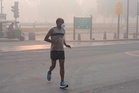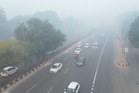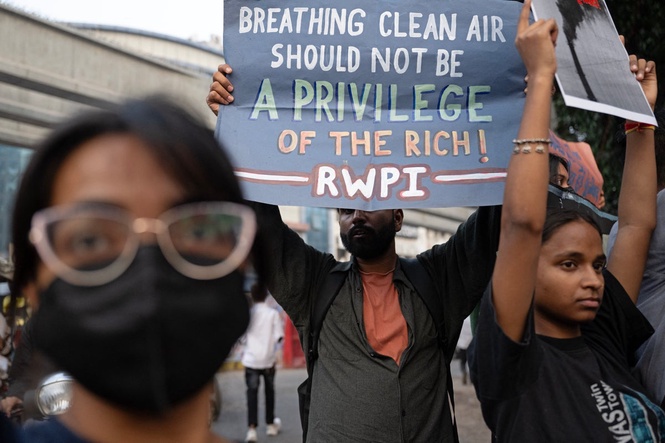
Police stopped a youth-led march against severe air pollution in Delhi on Wednesday evening even as the Indian capital remained shrouded in a toxic haze.
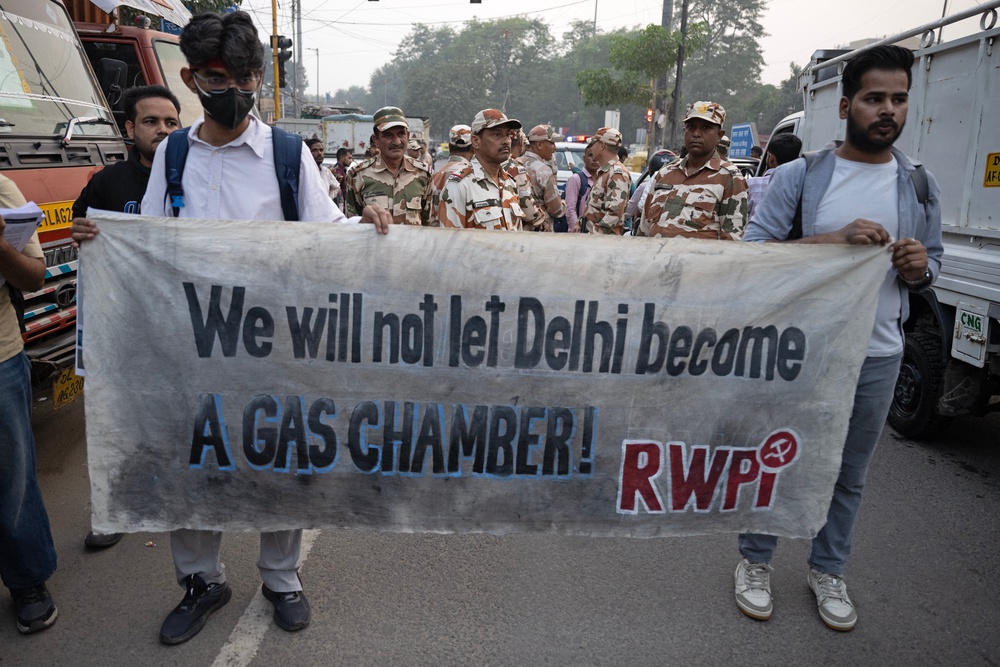
Marchers set out from Turkman Gate in Old Delhi for Jantar Mantar in the heart of the city but were halted after they had walked 300-400m.
They were mobilised by the Revolutionary Workers' Party of India, the Disha Students' Organisation, Naujawan Bharat Sabha, Scientists for Society, and Stree Mukti League.
The protesters said that they were seeking to draw attention to Delhi’s deteriorating air quality after Diwali, the Hindu festival of lights marked by the bursting of fireworks, and to demand stricter enforcement of pollution-control measures.
The Revolutionary Workers' Party said police confined many of its members to a children's library it runs in Karawal Nagar, in northeast Delhi, to prevent them from joining the march. The group claimed there were several children inside when police arrived and told everyone there they could not leave.
Supporters of the Revolutionary Workers' Party and the Disha Students' Organisation had similarly marched from Ramlila Maidan towards Jantar Mantar on 1 November, only to be stopped on Minto Road, according to the Daily Pioneer. At least 22 of them were detained and taken to police stations in Dwarka and Jafarpur Kalan but released around 2am the next morning.
On 2 November, police filed a formal complaint under the provisions of the criminal code related to disobedience of orders, assault on public servants, obstruction, and criminal conspiracy.
Last year, police detained 23 people, including a juvenile, at a "Delhi for Clean Air" protest in the city. Police alleged that some of the protesters shouted slogans in support of a Maoist commander killed by the security forces days earlier. Scientists for Society, one of the organisers of the protest, denied the allegations.
The air stayed heavily polluted the morning after the march. Delhi's air quality index stood at 321 at 7am on Thursday, in the "very poor" category, according to the Central Pollution Control Board. The index runs to 500, and readings above 400 are classed as "severe". A monitoring station at IIT Delhi read 414, while 39 of the city's 57 stations reported "very poor" air quality and 16 "poor".
Delhi's average index reached 376 on Diwali day, the worst reading on the festival since 2021, and average concentrations of PM2.5 hit 493.17 micrograms per cubic metre of air by 11pm that night. PM2.5 refers to particles smaller than 2.5 micrometres across, tiny enough to lodge deep into the lungs.
The Centre for Science and Environment, a research group in Delhi, reported that PM2.5 in the week before Diwali averaged 236 micrograms per cubic metre, nearly double the 120 recorded in the same week in 2025. India's Supreme Court had allowed only "green" fireworks for Diwali, within set time windows on Saturday and Sunday.
The WHO guideline for PM2.5 is 15 micrograms per cubic metre over 24 hours. A study published in the Lancet Planetary Health in July 2024 found that 7.2 per cent of the deaths, around 33,000 a year, across 10 Indian cities, including Delhi, between 2008 and 2019 were linked to short-term exposure to PM2.5 above that guideline. Daily deaths rose by 1.42 per cent for every 10 microgram increase in short-term PM2.5, according to the study.
Air pollution is a persistent problem in Delhi, especially in winter when cooler temperatures and low wind speeds keep pollutants from dispersing. The environment ministry attributes 23 per cent of the city’s winter pollution to vehicles and 20 per cent to the burning of biomass, including crop stubble in the neighbouring states of Punjab and Haryana.
Read MoreExperts sound the alarm as post-Diwali air becomes ‘unfit for human survival’
Animal welfare activist stabbed to death after brawl over Diwali fireworks
Pakistan says pollution from Diwali firecrackers in India worsened Lahore’s smog
Delhi wakes up to post-Diwali smog amid reports of air quality index crossing 2,000
Oxford museum returns 39 ancestral skulls to Indian tribal community
Award-winning young farmer arrested for smuggling drugs hidden in bananas