Population growth in England and Wales has slowed to its lowest rate since the Covid-19 pandemic, figures show.
The slowdown is largely due to the ongoing fall in net migration to the UK, which has dropped sharply since hitting record levels in 2023.
There has also been a slight fall in natural change – the difference between the number of births and deaths.
Around one in four local areas saw a fall in their population in the year to mid-2025, according to estimates published by the Office for National Statistics (ONS).
The population in Wales dropped for the first time in a decade, while the total for London fell slightly due to more people moving out of the capital to live elsewhere.
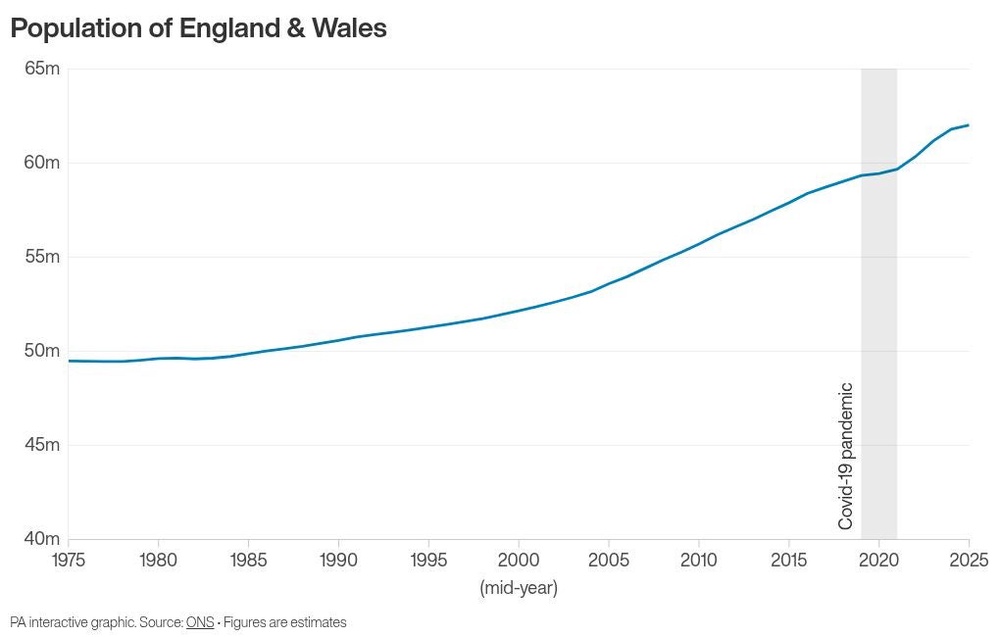
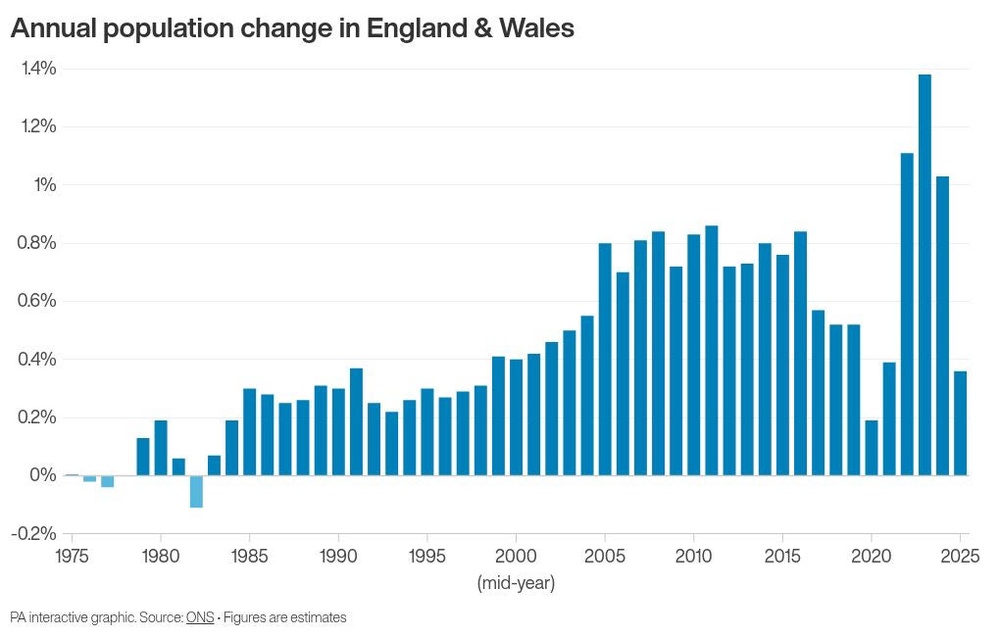
The overall population of England and Wales was an estimated 62.0 million in mid-2025, up by 224,900 – or 0.4% – from 61.8 million in mid-2024, the ONS said.
This is the lowest rate of increase since mid-2020 and follows a run of much steeper jumps, including 1.4% in 2023 and 1.0% in 2024.
Net international migration to England and Wales, the difference between the number of people immigrating from outside the UK and those moving abroad, was 211,700 in the year to mid-2025, down from 612,500 in the previous 12 months.
There were 588,000 births and 568,400 deaths, meaning natural change contributed an increase to the population of just 19,600.
The number of births was the lowest since mid-1978, while deaths were their lowest since mid-2019.
Nigel Henretty, head of population statistics at the ONS, said: “Migration has been the main driver of population change in England and Wales for the past quarter of a century.
“While that has continued to be the case, the recent fall in migration has led to the smallest population growth since the height of the pandemic.
“London saw the first population decrease since 2021 and the population of Wales fell for the first time in a decade.”
Some of the largest cities in England and Wales saw their estimated population fall between mid-2024 and mid-2025, including Leeds (down 0.3%), Birmingham (down 0.5%), Swansea (down 0.5%), Leicester (down 0.9%) and Nottingham (down 1.5%), the ONS figures show.
Both Liverpool and Manchester saw their populations fall slightly, by nearly 0.1%.
In London, more than two-thirds of local authorities (23 out of 33) saw a drop in population, the largest being Camden (down 1.8%), Westminster (down 1.5%) and Southwark (down 1.5%).
Camden and Westminster had the biggest percentage falls of any area in England and Wales except for the Isles of Scilly, where the population is very small, which saw a drop of 3.5%.
In total, a quarter of local authorities (78 out of 318) saw a population decrease from mid-2024 to mid-2025, compared with around one in 20 during the previous 12 months (19 of 318).
Rugby in Warwickshire had the largest increase (up 2.4%), followed by Mid Suffolk (2.1%), Tewkesbury in Gloucestershire (2.0%) and South Derbyshire (1.9%).
London was the only region of England to see a fall in population in the latest figures.
Although the capital saw more births than deaths and net international inward migration, this was “more than offset by net outward migration to other areas of the UK,” the ONS said.
As a result, London’s population decreased by 0.3% in the year to mid-2025, the first fall since the year to mid-2021.
North-west England had the highest regional rate of population growth (0.7%), caused mainly by international migration and people moving into the region from other areas of the UK.
The North West was one of six regions that saw more deaths than births, along with the North East, Yorkshire & the Humber, the East Midlands, the South East and South West.
This reflects “a long-term decline in fertility and an increasing number of deaths because of the growing proportion of older people”, the ONS added.
The population of Wales in mid-2025 was an estimated 3,175,181, down slightly from 3,177,949 in mid-2024 and the first drop since mid-2015.
The total population of England and Wales has increased each year since 1982, with the biggest jump occurring in the year to mid-2023 (1.4%).
Migration has contributed the most to population growth since mid-1999, with net international migration “by far the largest component”.
Read MoreAnthony Fauci pleads the Fifth and refuses to respond to ‘unhinged’ senator
UK heatwave live: Drought declared in half of England as temperatures to hit 34C
Mapped: Half of England in drought as another heat warning issued
Andy Burnham refuses to commit to raising defence spending
Burnham makes emotional pledge to end care crisis that has ‘gone on too long’
Oscar-winning Irish musician Glen Hansard dies in motorcycle crash in Dublin