The clearest signal that it’s time to convert your enterprise (sole proprietorship) into a Sdn Bhd isn’t your revenue, your ego, or what your competitor down the street is doing. It’s your net profit. Once your business consistently nets around RM250,000 a year or more, the personal income tax you pay as a sole proprietor usually climbs past what a Sdn Bhd would pay in corporate tax, and that gap is the real financial trigger to restructure, not a vague feeling that you’ve “made it.” This article walks through how to read that number, what else should factor into the decision, and what the upgrade actually involves.
TL;DR
- Net profit, not revenue, is the number that should trigger an enterprise-to-Sdn-Bhd conversion decision.
- Around RM250,000 in sustained annual net profit is a commonly used threshold where a Sdn Bhd’s tax treatment starts to outperform sole proprietor income tax.
- A Sdn Bhd adds compliance obligations (company secretary, SSM filings, and the need to appoint an auditor if you fall outside exemption criteria) that a sole proprietorship doesn’t have.
- Many smaller Sdn Bhd companies can file financial statements without a full statutory audit, which lightens the compliance load.
- Profit threshold aside, liability exposure, fundraising plans, and franchise or contract requirements can justify an earlier switch.
About the Author:
Boss Boleh is an online company secretary that has supported the incorporation and ongoing compliance of Sdn Bhd companies across Malaysia, including a steady stream of enterprise owners converting from sole proprietorship. Our team regularly works with business owners deciding exactly when their numbers justify the switch, which is why we built a free “Enterprise vs Sdn Bhd” webinar around this specific question.
Why does net profit matter more than revenue when deciding to upgrade?
Revenue tells you how much money moved through the business. Net profit tells you how much you actually kept, and it’s what gets taxed. A sole proprietorship (what Malaysians commonly call an “enterprise”) isn’t a separate legal entity. Its profit is simply added to your personal income and taxed at Malaysia’s progressive individual tax rates, which climb as your income rises. A Sdn Bhd, on the other hand, is a separate legal person. It pays corporate tax on its own profit, with SMEs taxed on a tiered scale (15% on the first RM150,000, 17% on the next portion up to RM600,000, and 24% above that), and you only get taxed personally when you draw a salary or dividend from it.
Here’s the mechanism in plain terms: progressive tax rates mean every additional ringgit of personal income gets taxed at a higher rate than the ringgit before it. The SME corporate tax scale caps out at 24% once profit passes RM600,000, and it doesn’t keep climbing the way personal income tax does. So as your sole proprietorship’s profit grows, there’s a point where the enterprise structure starts costing you more in tax than a Sdn Bhd would, simply because one rate keeps climbing and the other levels off. That crossover point is roughly where net profit of RM250,000 a year and up sits for many owners, though your exact number depends on your personal reliefs, other income, and how you’d structure salary versus dividends inside the Sdn Bhd.
THE ACTION TO TAKE
Pull your last two years of net profit (not revenue) from your accounts, and if you’re consistently north of RM250,000, that’s your cue to run the comparison properly rather than guess.
What exactly changes when you move from enterprise to Sdn Bhd?
Building on the tax trigger above, the harder question is what you’re signing up for operationally once you cross that line. The comparison below covers the core differences.
| Feature | Enterprise (Sole Proprietorship) | Sdn Bhd |
| Legal identity | Same legal person as the owner | Separate legal entity from its shareholders |
| Liability | Unlimited personal liability | Liability generally limited to share capital |
| Tax treatment | Progressive personal income tax rates | Tiered corporate tax rates on company profit for SMEs (15% / 17% / 24%) |
| Compliance load | Minimal; business name renewal with SSM | Annual Return, Beneficial Owner filing, financial statements, qualified company secretary |
| Credibility for funding/contracts | Limited; harder to raise equity or get larger contracts | Easier to bring in investors, apply for grants, or win corporate tenders |
| Minimum paid-up capital | Not applicable | RM1 under the Companies Act 2016 |
Registering a Sdn Bhd through SSM registration online (via the MyCoID portal) is generally completed within one to three working days once all documents are in order. Boss Boleh’s own process gets a new Sdn Bhd incorporated in 2 days, fully online with eKYC and digital signatures, no branch visits needed for the bank account either, since it can be opened online or a banker can visit you.
Does the RM250,000 profit threshold apply the same way to every business?
Not quite. The profit number is a strong general signal, but a few situations justify incorporating earlier even if you haven’t hit that figure yet, and a few justify waiting even if you have.
- High liability exposure: if your business carries real risk of lawsuits, large contracts, or equipment financing (common for dental and aesthetic clinics needing to finance machines), limited liability protection matters regardless of current profit.
- Fundraising or investor plans: investors generally cannot take equity in a sole proprietorship. If you’re planning to raise capital or bring in co-founders, you need a Sdn Bhd structure first.
- Franchise or government incentive eligibility: some franchise brands and incentive schemes, including Malaysia Digital status for tech and AI startups, require a Sdn Bhd to qualify.
- Volatile or seasonal profit: if this year’s RM250,000 was a one-off spike rather than a sustained pattern, it’s worth watching two to three years of numbers before committing to the extra compliance load.
A related but distinct question is whether the compliance cost of a Sdn Bhd outweighs the tax saving. That’s where audit exemption changes the calculation.
How does audit exemption change the compliance math?
A Sdn Bhd doesn’t automatically need a full statutory audit. Many smaller Sdn Bhd companies can file financial statements without a full audit, which lightens the compliance burden. This matters directly for the profit-threshold decision: a business sitting around RM250,000 in net profit is very likely to qualify for this lighter reporting route, meaning the extra compliance burden of incorporating is lighter than owners often assume.
To be clear on what this means: it decides whether your financial statements need a full audit. It does not remove your obligation to appoint a qualified company secretary (Companies Act 2016, Section 235), keep proper accounting records, or lodge your Annual Return and financial statements with SSM on schedule. You’ll need to appoint an auditor only if you don’t qualify for the exemption, and you can use your own external auditor or tax agent even as Boss Boleh handles the secretarial side.
What should you actually do once your numbers cross the line?
Once you’ve confirmed the profit threshold and ruled in any of the earlier-trigger scenarios above, the conversion itself follows a fairly standard sequence:
- Incorporate the Sdn Bhd through SSM registration online via MyCoID, with a company name search and the standard constitution documents.
- Appoint a qualified company secretary within 30 days of incorporation (Companies Act 2016, Section 236(2)); the appointment must then be notified to SSM within 14 days (Section 58).
- Open a company bank account, which can be done online or with a banker visiting you, no branch trip required.
- Transfer or wind down the enterprise, including settling existing contracts, licences, and tax obligations under the old business name.
- Set up accounting, tax filing, and e-invoicing software for the new entity, since your reporting obligations as a Sdn Bhd differ from what you did as a sole proprietor.
- Submit Beneficial Owner (BO) information to SSM, identifying the individuals who ultimately own or control the company.
This isn’t a weekend project, and getting the sequencing wrong (especially around tax clearance for the old enterprise) can create avoidable headaches. If you’re at this stage, it’s worth working through the specifics with a company secretary or our free Enterprise vs Sdn Bhd webinar before you file anything.
Frequently Asked Questions
Is RM250,000 a legal threshold I must follow?
No. It’s a commonly used financial benchmark based on where personal income tax rates generally overtake corporate tax rates, not a figure set in law. Your actual break-even point depends on your personal tax situation.
Can I keep my enterprise running alongside a new Sdn Bhd?
Technically yes, but most owners converting for tax reasons wind down the enterprise and move operations, contracts, and clients to the new Sdn Bhd to avoid running two sets of books and two tax filings.
Does a Sdn Bhd always need a full audit?
No. Many smaller Sdn Bhd companies can file financial statements without a full audit, as long as proper accounting records and other filings are maintained.
What’s the minimum capital needed to start a Sdn Bhd?
Under the Companies Act 2016, the minimum paid-up capital is RM1.
Do I need a company secretary from day one?
Yes. Every Sdn Bhd must appoint a qualified company secretary within 30 days of incorporation under Section 236(2) of the Companies Act 2016.
Will converting to a Sdn Bhd help with e-invoicing compliance?
A Sdn Bhd, like any business, will need e-invoicing software malaysia-compliant to handle its invoicing workflow as part of its broader compliance setup.
Does incorporating affect my eligibility for grants or Malaysia Digital status?
Yes, for tech and AI businesses specifically. Malaysia Digital status, which unlocks certain government grants and tax incentives, requires a Sdn Bhd structure, not a sole proprietorship.
ABOUT BOSS BOLEH
Boss Boleh is an online company secretary and online incorporation platform built for first-time entrepreneurs and enterprise owners weighing the switch to a Sdn Bhd. Beyond company secretarial work, it also offers a one-stop compliance solution for entrepreneurs, including accounting, tax planning and tax filing services. We handle Annual Return and Beneficial Owner submissions to SSM, standard corporate resolutions for director changes and bank account opening, all fully online with digital signatures and eKYC. Our free Enterprise vs Sdn Bhd webinar walks through exactly the profit-based decision covered in this article, and our team supports clients in Kuala Lumpur, every other state, and Malaysians living overseas.
References
- Companies Act 2016 (Act 777), Sections 58, 235, and 236(2)
You’re welcome to join our community group to get exclusive and latest trend of business insight!
Want to learn more about managing your business structure the right way?
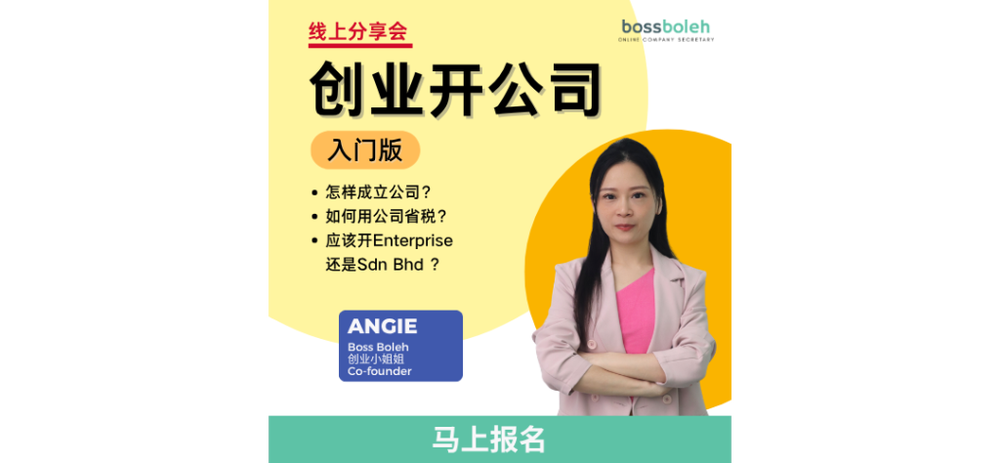
Join our FREE webinar! We’ll walk you through compliance essentials and how to convert from Enterprise to Sdn Bhd with confidence.
For more details, feel free to WhatsApp us!
WhatsApp: 018-7678055