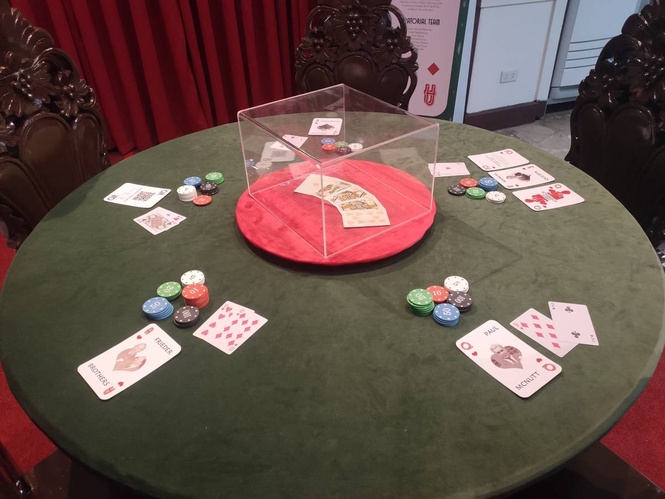
MANILA, Philippines — Poker cards of the late president Manuel Quezon are on display in an exhibit showing his hand in the rescue of over a thousand European Jews from the Holocaust.
The exhibit, called Artifact in 360: Gamble of Compassion, was opened at the National Historical Commission of the Philippines' (NHCP) Quezon Memorial Shrine in Quezon City on Thursday by the NHCP Metro Manila cluster of Historical Museums.
"For the uninitiated, the exhibit may simply showcase the collection of poker cards...of former president Manuel L. Quezon. However, if you dig deeper, the featured artifacts showcase his so-called open door policy," Foreign Affairs Assistant Secretary Indhira Bañares said at the exhibit's opening.
Quezon "made a massive political and diplomatic gamble when he allowed European Jews fleeing the Holocaust to find a safe haven in the Philippines...when the country was still under American occupation," she said.
There was opposition from certain foreigners and locals.
Bañares said that despite this, he argued "that by permitting the refugees to come to the country, the Philippines is showing the world the kind of people who we really are: hospitable, just, and humane."
Information displayed in the exhibit states that the idea of the rescue was conceived while Quezon, then-United States (US) High Commissioner Paul McNutt, and then-Colonel Dwight Eisenhower who later became US president, and the Frieder brothers "were gathered around a poker table."
"Around 1,300 European Jews who sought refuge in Manila benefited from his humanitarian policy," Bañares said, adding that this policy "would eventually shape the Philippines' human-centric and...human rights-based diplomacy towards refugees and other forcibly displaced people."
She said that since then, the Philippines "has provided asylum and protection to" republicans who fled after the Spanish Civil War, refugees following the Vietnam War, Palestinians, and other people.
"The government of the Philippines continues to uphold the humanitarian tradition across all international and multilateral platforms," she said.
"Amidst these volatile and turbulent times, the Philippines shall not waiver from its commitment to protecting refugees and advancing durable solutions for refugees and other forcibly displaced populations. Filipino diplomats will continue to champion a world that respects the rights and dignity of every individual regardless of nationality or legal status, guarded by the conviction that our common humanity transcends borders," she said.
The cards are on display until year-end at the shrine which is open Tuesdays to Sundays from 9 a.m. to 4 p.m. Entrance is free.
Bañares quoted Quezon as saying, "It is my hope, and indeed my expectation, that the people of the Philippines will have in the future every reason to be glad that when the time of need came, their country was willing to extend a hand of welcome."
"The current and future generations of Filipinos should be inspired by Quezon's legacy of defending human rights whenever they are threatened, confronting all forms of hatred and ending the vicious cycles of violence and persecution...," she said.
"May this legacy continue to remind us that offering refuge is not merely an act of compassion but an affirmation of our shared humanity," she said.