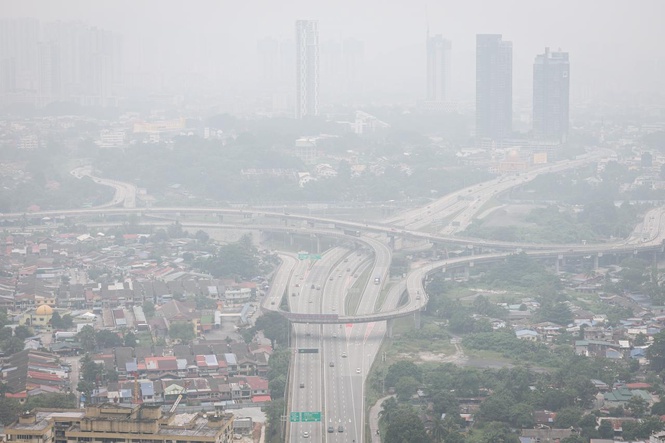
KUALA LUMPUR — Almost daily downpours may offer temporary relief from the haze, but they cannot guarantee clean air while forest and peatland fires continue to pump smoke into the atmosphere, environmentalist Mohd Fadhil Mohd Din has warned.
Speaking to Scoop, Fadhil said rainfall could remove some airborne particles, but its effectiveness depended on the intensity, duration and geographical coverage of the rain, as well as whether fires continued to generate smoke.
“Both explanations are possible, and they often occur together. Fine smoke particles can remain suspended for days, while continuing emissions replenish particles removed by rain,” he said.
He said heavy rainfall in a Malaysian town did not necessarily mean sufficient rain had fallen over the areas where fires were burning or along the routes taken by smoke travelling towards the country.
Fadhil pointed to Singapore’s National Environment Agency’s observations on October 20, when afternoon showers occurred while residual smoke from Kalimantan continued drifting towards Singapore.
He said rainfall removed airborne particles through a process known as wet deposition, in which particles were incorporated into cloud droplets or captured by falling raindrops.
However, the effectiveness of this process depended on several factors, including rainfall intensity, duration, coverage, and the size and composition of the particles, he added.
Fadhil cited a field study in Beijing that recorded an average reduction of about 51 per cent in PM2.5 concentrations during heavy rain, compared with about five per cent during light rain, although the findings varied and should not be treated as removal rates applicable to Malaysia.
He warned that even heavy rain could provide only temporary relief if winds subsequently carried another plume of smoke into an affected area.
“Rainfall at the receiving location cannot reliably compensate for continuing forest and peatland fires elsewhere,” he said.

Fadhil, who is also the Director of the UTM Campus Sustainability Office (UTMCS), said the persistence of haze despite rainfall was consistent with transboundary pollution, but stressed that this alone was insufficient to establish where the smoke originated.
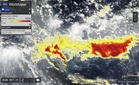
He said scientists needed to combine satellite observations of fires and smoke plumes with atmospheric modelling, ground-level pollution measurements and chemical analysis to identify potential sources.
“Scientists combine several independent sources of evidence,” he said, adding that wind patterns and atmospheric modelling could help establish links between potential sources of smoke and affected monitoring stations.
Fadhil also said Malaysia’s Air Pollutant Index (API), which uses a 24-hour running average for particulate pollution, could remain elevated even after conditions began to improve.
“An elevated API immediately after rain does not necessarily mean that rainfall removed nothing,” he said.
He added that weak winds, a shallow atmospheric mixing layer and temperature inversions could restrict the dispersal of pollutants, allowing them to accumulate near the ground.
Wind direction also mattered, he said, as stronger airflow could carry smoke into an area instead of clearing it.
Fadhil said lasting improvement required a reduction in smoke emissions, the removal or dispersal of existing pollution and cleaner air moving into affected areas.
“Malaysia should not rely on rainfall alone. Sustained improvement requires smoke emissions to fall, existing pollution to be removed or dispersed, and incoming air to carry less smoke,” he said.
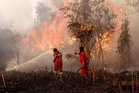
He stressed that extinguishing forest and peatland fires was essential, particularly because peat fires could continue smouldering beneath the surface even when rain fell.
He added that preventing new fires, restoring peatlands, controlling local emissions and strengthening regional cooperation were crucial to reducing the risk of recurring haze.
Fadhil said cooperation under the Asean Haze-Free Roadmap 2023–2030 should translate into shared monitoring data, early warnings, coordinated responses and sustained action to address the sources of smoke.
He said a reliable assessment of when haze would clear needed to consider fire activity, rainfall over affected source areas and predicted smoke movement, rather than rainfall alone.
Sustained improvement in official air-quality readings, rather than the appearance of a clearer sky immediately after a downpour, would provide a more reliable indication that conditions were recovering, he added.
Air quality continued to improve in most parts of the country this morning, with only Samalaju in Sarawak recording an unhealthy API reading.
The API reading in Samalaju, about 60km northeast of Bintulu, stood at 152 as of 9am. Bintulu recorded the second-highest reading at 94, followed by Serian at 90 and Sibu at 89.
Other areas in Sarawak with moderate air quality were Sri Aman (83), Samarahan (82), Sarikei and Kuching (81 each), Mukah (75), Kapit (72) and Miri (63).
In Kuala Lumpur, Batu Muda recorded an API reading of 82, while Cheras registered 57.
In Johor, Kluang recorded a reading of 81, followed by Batu Pahat (79), Pasir Gudang (70), Larkin (67), Segamat (62), Pengerang (60), Kota Tinggi (58) and Tangkak (57).
In Negeri Sembilan, Nilai and Seremban both recorded readings of 69, while Port Dickson registered 51.
In Selangor, Johan Setia recorded an API reading of 65, followed by Klang (57), Shah Alam (53) and Petaling Jaya (52).
Other areas with moderate air quality included Keningau (73), Tawau (65) and Sandakan (57) in Sabah; Seberang Perai in Penang (64); Rompin (62) and Balok Baru (56) in Pahang; and Tasek Ipoh (61), Seri Manjung (58) and Pegoh (53) in Perak.
Paka in Terengganu recorded an API reading of 57, while Alor Gajah and Bukit Rambai in Melaka both registered 56. Labuan recorded 56 and Putrajaya 54.
API readings of between zero and 50 are categorised as good, 51 to 100 as moderate, 101 to 200 as unhealthy, 201 to 300 as very unhealthy, and readings above 300 as hazardous. - October 27, 2026
The post Rain cannot wash away Malaysia’s haze as forest and peat fires keep fuelling pollution appeared first on Scoop.