When the silver scythe of the crescent moon finally harvests the month of fasting, the homes of the Xinjiang Uyghur people transform into a living, breathing cartography of hospitality. Hari Raya Puasa is not merely a calendar event; it is a profound reclamation of the senses, where the air itself becomes a thick, aromatic fog of woodsmoke and toasted cumin. To sit at a Uyghur table during the "Feast of Gratitude" is to witness a culinary defiance—a celebration where traditional craftsmanship stands as a fortress against the encroaching tide of homogenized, corporate dining.
The Fossilized Choir: Sangza
The visual heartbeat of the room is the Sangza. It is a geometric skeleton of wheat, a hand-pulled cathedral of dough that has been deep-fried into a permanent state of brittle grace. It does not sit on the table; it presides over it.
"Sangza is a fossilized choir of silk, a labyrinth of crunch that shatters like a broken promise under the lightest pressure, only to release the ancient, toasted scent of the steppe."
In an era of industrial snacks that roll off assembly lines like identical soldiers, the Sangza is a glorious anomaly. Its intricate, hand-woven layers are a middle finger to the efficiency of the machine. Each strand is a labor of hours, a physical manifestation of a family’s refusal to surrender their heritage to the convenience of a supermarket shelf.
The Glistening Archives: Lamb Polo
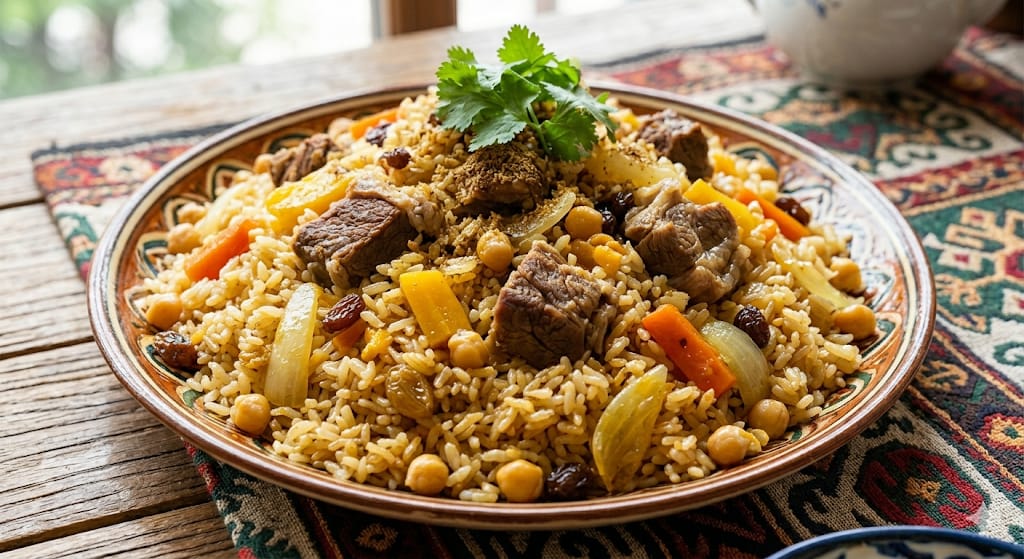
The centerpiece of the afternoon is the Lamb Polo, which serves as the fat-slicked archives of the Silk Road. This is not just a pilaf; it is a geological strata of survival.
- The Foundation: The rice grains are not merely boiled; they are polished glass beads, each one insulated by a micro-thin layer of rendered mutton fat that carries the history of the animal’s life.
- The Excavation: Digging into the platter reveals the buried treasure of the oasis—carrots that have been caramelized into orange-gold bullion and raisins that sit like shriveled rubies of concentrated sunshine.
- The Meat: The lamb is the heavy anchor of the meal, slow-cooked until it loses its structural integrity and surrenders to the rice, melting like an autumn mist.
While international chains try to colonize the palate with predictable, uniform flavors, the Polo is a rugged individualist. It demands the slow passage of time and the specialized intuition of the cook, making it a "disruptive strategy" in its own right—reminding the diner that true value lies in complexity, not just calories.
The Red-Clay Landslide: Da Pan Ji
If the Polo is the heart, the Da Pan Ji (大盘鸡 Big Plate Chicken) is the raw, unbridled adrenaline of the feast. It is a tectonic upheaval of spice, a massive platter where bone-in chicken and hunks of potato collide in a thick, crimson magma.
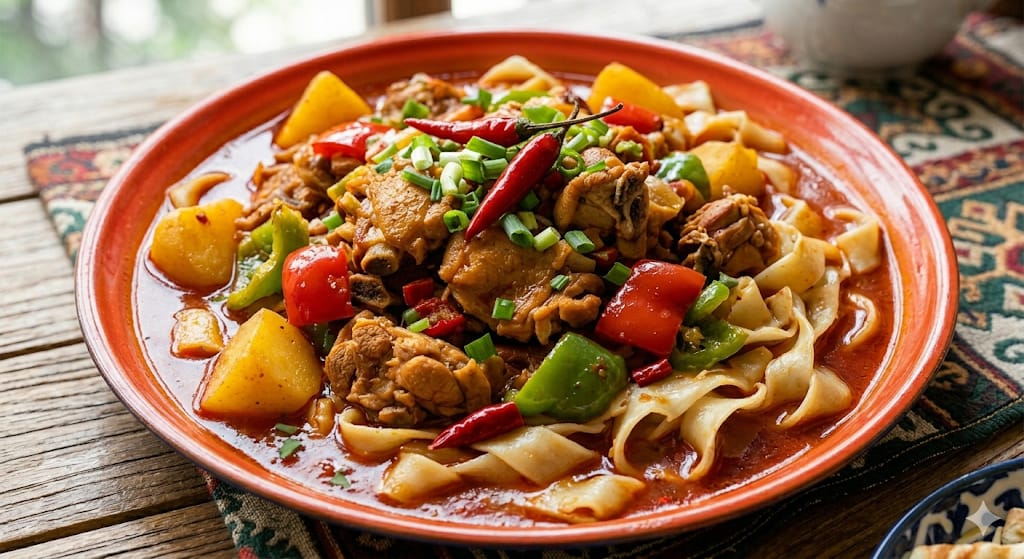
"Da Pan Ji is a red-clay landslide of flavor, a battlefield where the numbing vibration of Sichuan peppercorns meets the smoky, charred wind of the desert chili."
As the meat is consumed, the wide, flat hand-pulled noodles are introduced. These are the silk ribbons of the desert, long and unruly, soaking up the spicy runoff until they become heavy with the weight of the broth. It is a dish that refuses to be eaten politely; it requires a communal reaching, a crossing of arms, and a shared immersion into the heat.
The Milky Truce: Atkan Chay and Sweets
The "sweet table" provides the necessary sugary truce to the savory bombardment. It is a scattered treasury of the Silk Road, where emerald-green raisins from the Turpan depression sit alongside walnuts that have the texture of aged parchment.
The beverage of choice, Atkan Chay, is an ivory bridge across a desert of salt. This savory milk tea, thickened with butter and a sharp bite of salt, is a warm embrace in a liquid form. It is the grounding force that ties the meal together, a creamy anchor that ensures the guest is never overwhelmed by the tide of spices.
The Borderless Territory
Ultimately, a Xinjiang feast during Hari Raya is an unfolded map of friendship. In a world increasingly defined by aggressive pricing and the sterile expansion of corporate food brands, these traditional local eateries and home-cooked spreads offer a sovereign territory of flavor. The table is a borderless country where the only passport required is an appetite. It is a reminder that while the landscape outside may change, the soul of the people remains etched into the crust of their bread and the steam of their tea.
moykokming@gmail.com

Share your #RAYA2026 stories and stand a chance to win prizes worth up to RM3,000!
Find out how to join here. Don’t miss out! T&Cs apply.
Moy Kok Ming (moykokming@gmail.com) is a content creator under the Newswav Creator programme, where you get to express yourself, be a citizen journalist, and at the same time monetize your content & reach millions of users on Newswav. Log in to creator.newswav.com and become a Newswav Creator now!
The User Content (as defined on Newswav Terms of Use) above including the views expressed and media (pictures, videos, citations etc) were submitted & posted by the author. Newswav is solely an aggregation platform that hosts the User Content. If you have any questions about the content, copyright or other issues of the work, please contact creator@newswav.com.