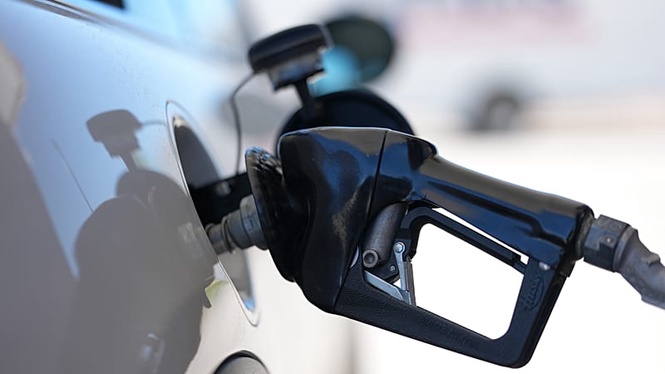
Portugal woke up to another rise in fuel prices which, in the case of diesel, reached an all-time high. This time, the price increase, which has been occurring throughout the year, was marked by protests on the country's roads.
In the morning, drivers staged a mass horn protest on the 25 de April Bridge, the crossing that links Lisbon to the city of Almada on the south bank of the Tagus river.
At the same time, further south, a go-slow march towards Galp's refinery in Sines, the Portuguese multinational energy corporation, was getting under way. The protest, organised via WhatsApp and social media, was still ongoing after lunchtime and had no scheduled end time.
Images on social media showed cars with Portuguese flags on their bonnets, sounding their horns. According to the Lusa news agency, protesters were also carrying placards reading "Enough of rising fuel prices" and "families cannot take it any more".
The National Republican Guard told the agency that between 60 and 100 vehicles took part in the protest.
Petrol at highest level since Ukraine invasion
According to projections by the Automobile Club of Portugal (ACP), diesel rose on Monday by 15 cents (to 2.169 euros per litre) and petrol increased by 12 cents (to 2.142 euros per litre).
These amounts do not take into account the reduction in the Tax on Petroleum Products (ISP), applied by the government on an exceptional basis, which set the increases at 12 cents for diesel and 9 cents for petrol.
This is the biggest jump in fuel prices in the last four years and the highest diesel price ever, according to calculations by the Portuguese financial outlet Dinheiro Vivo. In the case of petrol, it is the highest level since the energy crisis triggered by Russia's invasion of Ukraine in 2022.
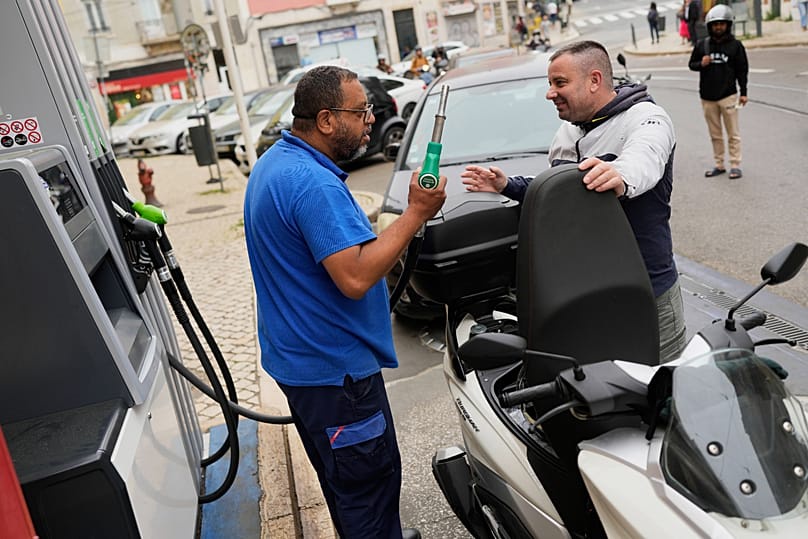
Fuel prices have been rising across Europe throughout the year. In Germany too, the newspaper Frankfurter Allgemeine explains that fuel prices have hit a record high, with petrol surpassing the previous record of €2.203 per litre, set in March 2022.
However, Portugal is among the countries with the highest fuel prices.
On Monday, Portugal ranked as the third European country with the most expensive petrol. Only France and Denmark had higher prices. As for diesel, Portugal's position improved with the UK, Italy, France and Denmark ahead.
Portuguese energy minister says rises are in line with Europe
The Portuguese Minister for Environment and Energy, Maria da Graça Carvalho, held a press conference on Monday evening. Maria da Graça Carvalho said that the increase in fuel prices is in line with the rest of Europe, drawing a comparison with France and presenting Spain as an exception.
The minister listed the government's measures to soften the rise in fuel prices, namely the reduction of ISP, the extension of the solidarity gas cylinder scheme and support measures for the agricultural and social sectors.
Responding to the secretary-general of the opposing Socialist Party (PS), Maria da Graça Carvalho also said that "the government is not profiting from this fuel crisis".
Previously, the rise in prices had led the minister to request a study from the Energy Services Regulatory Authority (ERSE). But the study, published in mid-August, found "no evidence of operators taking advantage". It also said that no "rockets and feathers" phenomenon was observed, with prices that rise quickly and fall slowly.
"The results therefore do not support the view that price decreases are passed through persistently more slowly or less fully than price increases," the study says.
ERSE also explained the price difference with Spain by pointing to taxation. But it stressed that in Portugal the tax burden has remained constant, "in line with most countries in the European Union and the eurozone".
Hormuz and refining capacity
The rise in fuel prices in Europe has been linked to the conflict in the Middle East and the blockage in the Strait of Hormuz, which has had a disruptive effect on trade routes.
But experts also point to limited refining capacity, even when crude is available. This situation mainly affects diesel.
In terms of taxation, an extraordinary tax on oil companies' profits is now on the table.
According to AFP, the ministers of Portugal, Germany, Italy, Austria, Poland and Spain have sent a letter to Ireland's finance minister so that the issue can be discussed at the next meeting of finance ministers.
The meeting is scheduled for 18 and 19 September in Ireland, which holds the rotating presidency of the European Union.
This text was translated with the help of artificial intelligence. Report a problem : [feedback-articles-en@euronews.com].