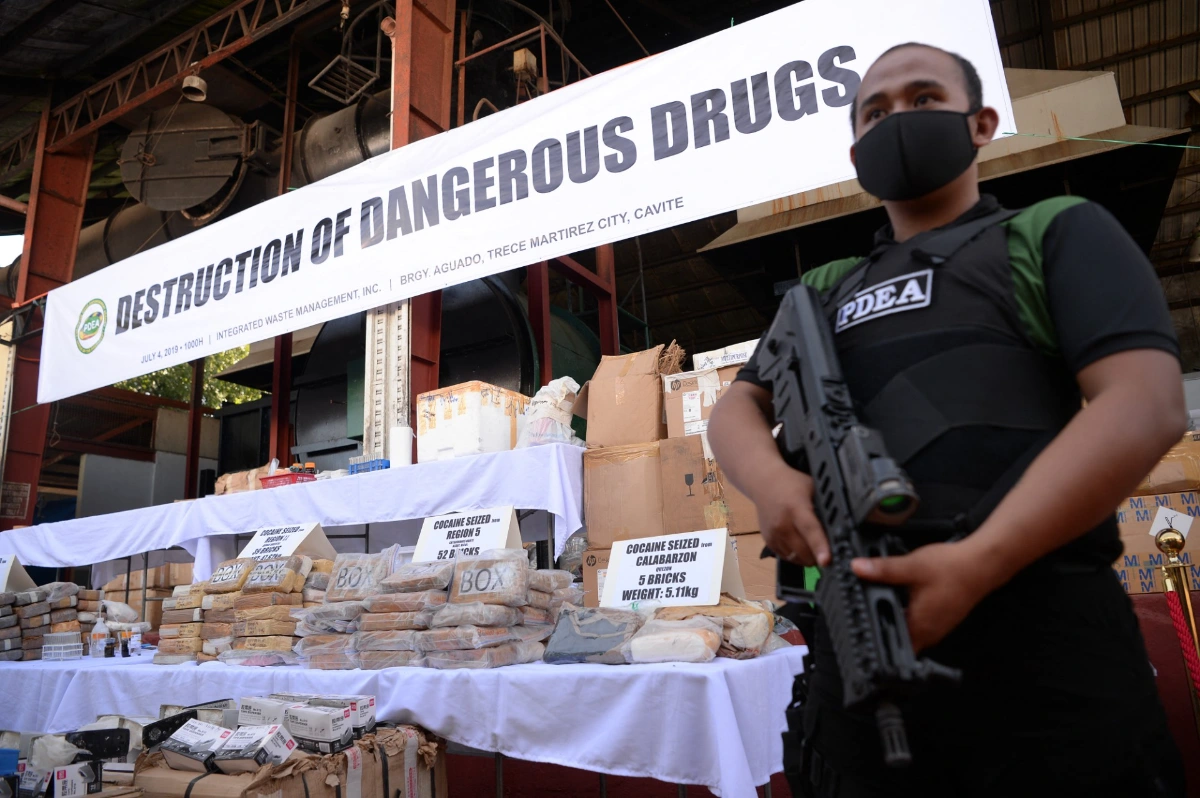
LAST Wednesday, Nov. 4, a shipment of 200 kilograms of shabu from Laos worth P1.36 billion was seized by Customs authorities at the Manila International Container Port.
The shipment had taken a roundabout route, passing through Haiphong port in Vietnam and Hong Kong before proceeding to Manila.
Vietnamese antidrug enforcers had tipped off Philippine officials on the contraband, resulting in the interception, said the Bureau of Customs.
Almost a month earlier, an attempt to bring in half a ton of shabu worth P3.5 million was foiled after the Filipino pilot of a private plane that was to deliver the shipment was detained in an airport also in Laos. Implicated as the financier and mastermind of the operation was a former member of the Bangsamoro Autonomous Region in Muslim Mindanao parliament.
The botched smuggling efforts strongly suggest that the illegal drug market in the country is thriving and continues to defy government efforts to dismantle it.
There are an estimated 1.47 million drug users in the country. The figure is lower than the 1.67 million users recorded in 2019, but it doesn’t mean that the drug problem has waned.
International monitoring agencies consider the Philippines not only as a major drug destination market, but a key transshipment hub, as well.
Transnational traffickers use maritime corridors that link the southern Philippines to neighboring Malaysia and Indonesia to transfer their cargo from ships to smaller vessels. Part of the contraband is destined for local consumption, but the bulk is shipped to other markets such as Australia and Japan.
The syndicates apparently have expanded their operation, and now employ private aircraft and shipping containers in moving their illicit merchandise.
According to the Philippine Drug Enforcement Agency and the Philippine National Police, at least five big transnational drug groups operate in the country. The most prominent is the Sam Gor syndicate, an alliance of Chinese triads that controls up to 70 percent of the shabu in Southeast Asia.
There is also the Mexican Sinaloa Cartel, which wants in on the Asian action, and West African traffickers who rely mainly on drug mules to get shipments past airport screening.
Shabu has become the traffickers’ illegal substance of choice. The United Nations Office on Drugs and Crime (UNODC) figures show that between $48.1 billion and $74.8 billion worth of shabu is traded annually. One reason for shabu’s popularity is that, unlike cocaine or opium, it’s synthetic and can be produced on an industrial scale in clandestine laboratories that dot the Golden Triangle.
Governments across the region have chalked up gains in fighting drug trafficking, but the syndicates have been adapting by stepping up money laundering operations and developing new transit routes.
Cracking down on drug trafficking requires shifting the overall strategy from low-level street arrests to dismantling financial networks and supply chains, and going after corrupt officials who are in league with drug syndicates.
The UNODC is advocating a comprehensive approach that combines aggressive regional intelligence with domestic institutional reforms.
It requires a drastic shift from rounding up neighborhood pushers and seizing shipments to hitting drug traffickers where it hurts most.
Criminal syndicates have to launder billions of cash to keep financially viable. The new objective must be to trace the laundered assets and freeze them, disrupting the flow of the drug syndicates’ finances.
The shell companies and logistics firms that the syndicates use as fronts must be exposed and shut down.
Governments must also tighten their watch on chemical firms that manufacture the precursor chemicals, such as ephedrine, and prevent them from reaching shabu labs.
The Philippines, Malaysia and Indonesia must increase and intensify joint border patrols of common sea lanes to prevent the syndicates’ ships from transferring their cargo to local handlers.
Governments have to crack down hard on narco-politicians who shield and abet traffickers.
There is also a need for the Association of Southeast Asian Nations (Asean) to adopt a zero-tolerance policy in pursuing the vision of a drug-free region. The bloc already has several subsidiary agencies focused on fighting transnational drug trafficking. Chief among them is the Asean Ministerial Meeting on Drug Matters, which oversees a unified approach in addressing cross-border drug threats.
Only if these efforts align could the flagging fight against drug trafficking be reenergized.