.jpg)
By Mihar Dias March 2025
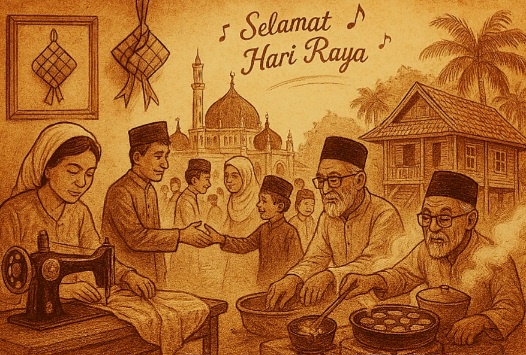
Growing up in the 1950s, Hari Raya was an occasion we awaited with great anticipation. It was a day of pure joy, untainted by politics or modern distractions.
My mother would stay up all night sewing to ensure we looked our best on the morning of the big day.
If the new moon was sighted earlier than expected, sending news that Raya had arrived sooner than planned, my parents would spend the entire night in the kitchen.
With no oven, they baked bahulu over a clay stove fueled by firewood or charcoal placed atop a makeshift metal sheet. They toiled from iftar until dawn, ensuring we children had plenty of kuih to enjoy—not just a single piece, as Saloma sang in her famous Hari Raya tune.
Our chickens, raised in the coop under the house, would not be spared. Raya was one of the rare occasions when Malay families indulged in an abundance of chicken and meat.
In Kedah, buffalo meat was readily available, as these animals were a common sight in the paddy fields, used to plough the land and transport harvested rice to the mills.
On Raya morning, dressed in our brand-new clothes, we would make our way to Masjid Zahir, the beautiful state mosque. My father often reminded us that our grandfather had contributed to its construction, modeling it after a mosque in Aceh, Sumatra.
We would sit on the grand carpets along the red pathway where the Sultan would pass, hoping for the chance to shake his hand after he inspected the guard of honor in front of the mosque.
After prayers, our father would lead us home to visit relatives, but he was adamant about one rule—we were not allowed to go door-to-door collecting duit raya.
Though he readily gave to children who visited our home, he sternly forbade us from what he considered begging. "It is better to give than to receive," he would say. This spirit of giving was instilled in us from a young age, shaping our character and teaching us the value of dignity.
Throughout the day, the air was filled with the sound of Saloma’s timeless Hari Raya song, which we never tired of singing, from the takbir on the eve of Raya until prayer time the next morning.
During our family gatherings, we talked about everything under the sun—our lives, our hopes, our laughter—but never about politics.
Raya was a time of unity, where kuih and laughter were shared with neighbours, regardless of race or background. It was a celebration of community, of belonging, of love.
But those golden years have faded into memory. Most of my family is gone, our kampung swallowed by the march of urbanization.
The songs still play, but the kuih is now mass-produced in kitchens driven by profit rather than the labour of love from parents to their children.
I miss the Raya of my youth, where love, family, and tradition were the only things that mattered.
Mihar Dias is a content creator under the Newswav Creator programme, where you get to express yourself, be a citizen journalist, and at the same time monetize your content & reach millions of users on Newswav. Log in to creator.newswav.com and become a Newswav Creator now!
The User Content (as defined on Newswav Terms of Use) above including the views expressed and media (pictures, videos, citations etc) were submitted & posted by the author. Newswav is solely an aggregation platform that hosts the User Content. If you have any questions about the content, copyright or other issues of the work, please contact Newswav.
