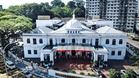
PETALING JAYA: The RM1,000 land premium imposed for the 99-year lease renewal of the Kuala Lumpur and Selangor Chinese Assembly Hall (KLSCAH) should not be mistaken for the property’s actual market value, which remains significant despite restrictions on commercial development.
Universiti Teknologi Malaysia property economics and finance expert Assoc Prof Dr Muhammad Najib Razali said the nominal premium was a government concession to support heritage preservation and should be distinguished from both the land’s market value and the previously estimated RM4.67 million premium.
He stressed that the RM4.67 million figure was not a confirmed market valuation, while the RM1,000 represented the premium approved by the government rather than the property’s actual worth.
KLSCAH is strategically located along Jalan Maharajalela, with selected commercial land transactions in the surrounding Kampung Attap and Maharajalela areas ranging from RM596 to RM781 per square foot.
“While these transactions demonstrate the economic significance of land in the locality, the prices cannot be directly applied to KLSCAH because of differences in land-use conditions, development restrictions, tenure and heritage status,” he said.
Muhammad Najib said the change in permitted land use from commercial to institutional had reduced the site’s development potential, as land restricted to institutional and heritage functions offered less flexibility than sites permitted for high-density commercial or residential projects.
However, such restrictions did not necessarily eliminate the land’s economic value. A proper assessment would need to consider its legally permitted use, tenure, development potential and conservation obligations.
He said questions also remained over how the RM4.67 million premium was calculated, whether the premium for institutional use had been independently assessed and how the final RM1,000 figure was determined.
Equally important, he said, was whether the revised institutional-use conditions and heritage restrictions had been formally reflected in the land title to prevent potential changes to commercial development in the future.
“These concerns deserve clarification, although the absence of publicly available information does not necessarily indicate irregularities in the approval process,” he said.
Muhammad Najib said heritage conservation could also generate economic benefits beyond the property itself, including attracting tourism and cultural activities, strengthening local identity and enhancing the appeal of surrounding neighbourhoods.
He said heritage buildings should therefore not be assessed solely on their commercial development potential, although the wider social and economic benefits of conservation must remain distinct from the property’s market value.
He added that government concessions for heritage, religious, educational, charitable and community institutions were not uncommon in Malaysia, but the KLSCAH decision should be supported by a transparent and consistent framework.
“The central concern should therefore not be whether KLSCAH deserves assistance in preserving its historical and cultural significance.
“Rather, the key question is whether the concession was determined through a transparent, consistent and clearly defined framework that could also apply to other heritage institutions with comparable characteristics,” he said.
He proposed clearer guidelines covering eligibility, valuation principles, conservation obligations, restrictions on future land-use changes and procedures for determining concessions.
He said the KLSCAH case should ultimately be viewed as a question of balancing economic value, heritage preservation and good governance, rather than simply comparing RM4.67 million with RM1,000.
“Greater transparency regarding the original premium calculation, the revised land-use conditions and the basis of the concession would help strengthen public confidence,” he said.