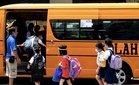
Kota Kinabalu: A total of 1,105 taxi, rental car and school bus drivers in Sabah are eligible for the Government’s one-off RM1,000 special financial assistance to ease their financial burden.
Senator Datuk Phoong Jin Zhe, who is also the Sabah Commercial Vehicle Licensing Board (LPKP) Chairman, said the initiative was part of a nationwide programme benefiting approximately 53,000 transport operators, comprising 38,000 taxi and rental car drivers and 15,000 school bus drivers.
He said 160 recipients attended the symbolic presentation ceremony on Friday, while the remaining eligible recipients would receive their assistance through alternative arrangements, including direct bank transfers and other distribution methods such as vouchers.
“We do not want to burden them by requiring everyone to travel to Kota Kinabalu to collect the assistance, so we will use various methods to ensure it reaches every eligible driver,” he said.
Phoong noted that although the assistance was announced by the Prime Minister on Oct 9 under Budget 2027, the Government had brought forward its distribution, which commenced on Oct 14, with Kota Kinabalu serving as the first distribution point in Sabah.
He said the Government recognised the challenges faced by transport operators, including rising living costs, increasing vehicle spare-part prices, maintenance expenses and intense competition in the industry.
The RM1,000 assistance was funded through revenue generated from the bidding for special H-series vehicle registration numbers, which raised RM91.2 million.
Under the eligibility requirements, taxi and rental car drivers must have valid driver cards, active Public Service Vehicle (PSV) licences and active taxi or rental car vehicle permits.
School bus drivers must be appointed by a licensed school bus operator, hold an active PSV licence and be listed under an operator with a valid school bus operating licence or permit.
“The assistance may not be enough to resolve all the challenges faced by operators, but it reflects the Government’s commitment to supporting you and your families,” Phoong said.
He said the Government would continue supporting all segments of the public transport industry to strengthen the overall transport ecosystem and ensure no group was left behind.
Separately, Phoong said LPKP had approved an optimisation plan to improve Pink Bus services in Kota Kinabalu, including introducing new destinations and bus stops at locations with high public demand.
He cited Hospital Likas, which was previously not covered by the service, and Klinik Luyang as among the locations identified for improved connectivity.
“We want to ensure the service reaches areas where residents genuinely need public transport, rather than maintaining routes that do not adequately reflect public demand,” he said.
However, implementation would take time as the proposals were still undergoing financial and administrative procedures due to existing contractual obligations, including obtaining approval from the Ministry of Finance.
He said the Pink Bus service had recorded cumulative ridership of 600,000 passengers, reflecting growing use of public transport among Kota Kinabalu residents.
He also highlighted the Teksi Madani programme, which was introduced to help taxi operators replace ageing vehicles, as another initiative to strengthen the public transport ecosystem and improve services for the public.