
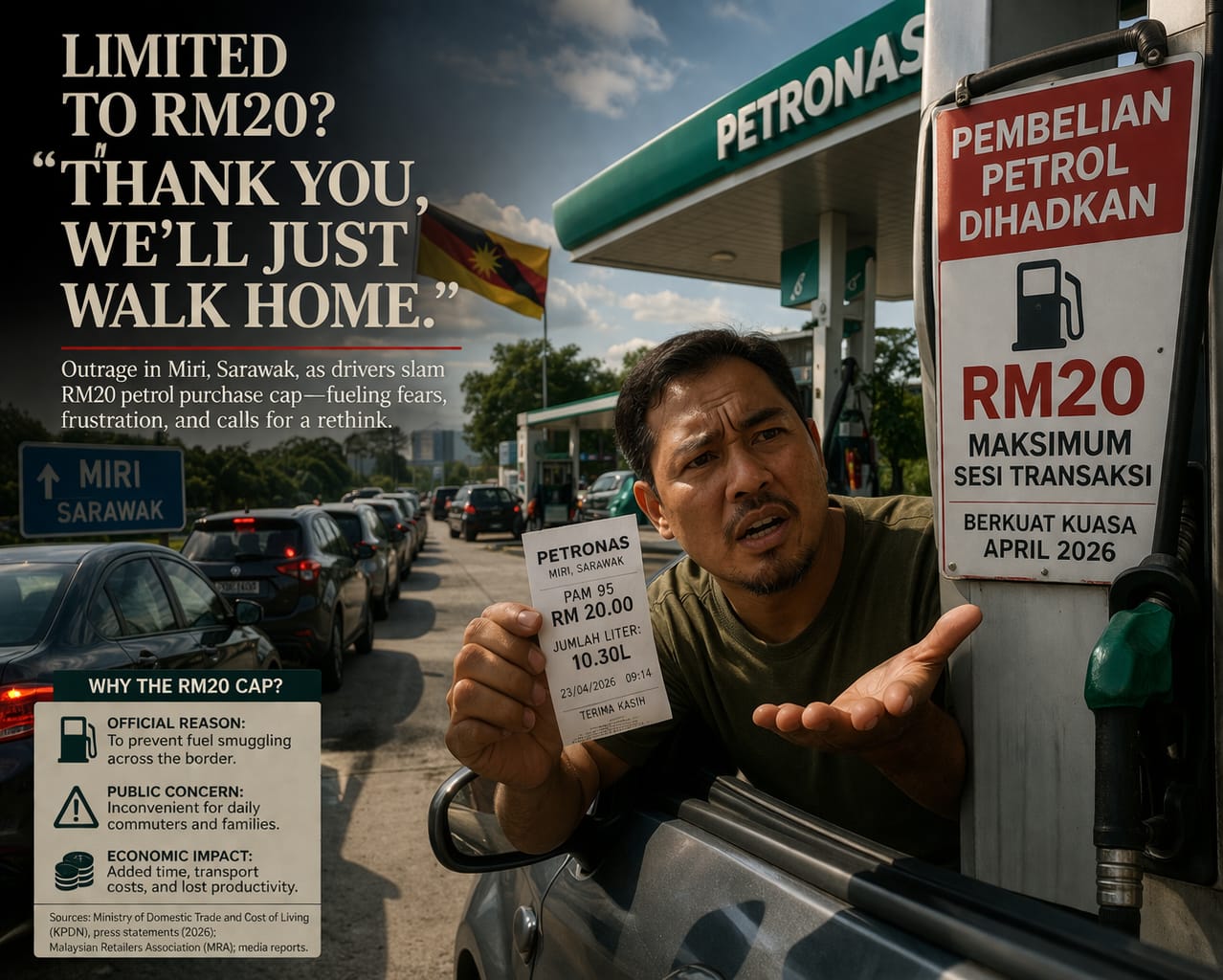
In March 2026, drivers in Miri, Sarawak erupted in frustration after they found themselves restricted to petrol purchases worth just RM20 at some petrol stations. The episode highlights deeper tensions in Malaysia’s ambitious fuel subsidy overhaul, called BUDI MADANI 95 or BUDI95. This reform aims to target fuel subsidies to Malaysian citizens and reduce waste, smuggling, and abuse. However, the implementation has sparked confusion, anger, and practical problems on the ground in East Malaysia.(@berita.757)
Local motorists, gig drivers, and small businesses in Miri say the move feels abrupt and poorly communicated, especially as petrol remains a daily necessity in a region where distances are great and alternatives few.
A Quota, Not a Price Cut: The New Fuel Reality
Malaysia’s government introduced BUDI95 late in 2025 to shift from blanket fuel subsidies for all buyers to a targeted system where Malaysian citizens with valid MyKad and driving licences pay RM1.99 per litre for RON95 petrol. The rest pay market rates around RM2.60 per litre. (TRP)
Under this system, each eligible individual could buy up to 300 litres per month at the subsidised rate. This cap was meant to reduce massive public spending on petrol subsidies an estimated RM20 billion annually and to curb smuggling and misuse. (Kapit Portal)
But late in March 2026, authorities cut the BUDI95 quota from 300 litres to 200 litres per month effective 1 April, citing rising global oil prices and risks of subsidy leakage amid geopolitical tensions. (JPSFA)
This lower quota means an average private motorist, whose household typically uses around 100 litres per month, may not be hit hard. But in Miri and across East Malaysia, where many journeys are long and public transport sparse, the new limits have exposed implementation gaps on the ground. (JPSFA)
“Only RM20 Allowed?” Miscommunication and Confusion in Miri
Across social media and local conversations in Miri, motorists shared bewilderment after petrol pumps abruptly restricted transactions to RM20 equivalent to about 10 litres at subsidised rates. Some customers were told the limit was a temporary adjustment per purchase to conserve quota or to prevent hoarding. Others reported system errors causing the pump to display RM20 as the maximum transaction.
While no official federal policy prescribes a RM20-per-transaction limit, news reports indicate the government introduced per-transaction limits for diesel and possibly petrol in parts of East Malaysia to reduce hoarding and control supply. These include caps like 50 litres for private vehicles and higher amounts for commercial vehicles. (DSF.my | Drive Safe & Fast)
However, confusion arises when petrol station terminals or staff interpret these limits differently. Residents in Miri describe scenarios where drivers are stopped after filling little fuel, forced to pay at the higher price, or told they hit the monthly subsidy cap much sooner than expected.
One Miri driver told local outlets that after attempting to fill up to 15 litres, the pump suddenly cut off at RM20 with no clear explanation from staff. Another said staff cited a per-transaction restriction but couldn’t show written policy. Across neighbourhoods, the consensus was a lack of clear communication from both oil companies and enforcement agencies.
Why Miri and East Malaysia Feel the Squeeze
Here’s why Miri’s motorists are particularly sensitive to fuel policy shifts:
- Distance and Transport Patterns: East Malaysians often travel long distances for work, supply runs, and access to services. Petrol is core to daily life, not just a cost.
- Fewer Alternatives: Public transport networks are limited, making car use essential.
- Border and Smuggling Context: Sarawak’s proximity to Brunei and Indonesia has historically made fuel subsidies in Malaysia attractive targets for smuggling or cross-border use, complicating enforcement.
- Infrastructure and Station Gaps: Some rural corridors have few stations, complicating quota tracking if drivers need larger fills at once. (Reddit)
For many, the RM20 limit felt like a policy punishment rather than rational quota control. Residents argue it slows travel, adds time to daily routines, and introduces anxiety about being cut off mid‑trip.
Government Response: Intent Versus Impact
Officials in Kuala Lumpur say the tightening of quotas and per‑transaction limits is not meant to inconvenience regular citizens. The main goals are:
- Reduce abuse and hoarding of subsidised petrol.
- Prevent smuggling to neighbouring countries with higher fuel prices.
- Protect national finances as global oil markets remain volatile. (JPSFA)
Prime Minister Anwar Ibrahim has emphasised that most Malaysians consume less than 200 litres monthly, so the revised quota should not hurt everyday drivers. E‑hailing and gig drivers enjoy a higher quota of up to 800 litres per month to support enterprise. (JPSFA)
Yet even willing motorists report poor rollout at petrol stations. Queries about remaining quota, vehicle registration mismatches, and malfunctioning MyKad scanners are common. Experts say these are implementation problems, not flaws of the policy itself and they can erode public confidence fast.
Economic and Social Ripples Beyond Miri
Cost of Living and Local Economy
In communities like Miri, small business owners and delivery workers are particularly vulnerable to fuel policy changes. For many, petrol costs are a significant share of monthly expenses. If subsidy benefits become harder to access, operational costs rise and these pressures can push up delivery or service prices.
A goods transporter told regional news that even a small mistake at the pump like getting unsubsidised petrol by accident could increase monthly fuel costs by tens of ringgit, squeezing already thin margins.
Weaker Confidence in Policy Execution
Economists warn that unclear enforcement creates uncertainty. When citizens aren’t sure how much fuel they can buy or what limits apply at a given station, they may reduce travel, delay economic activity, or resort to informal markets for petrol.
One transport analyst told journalists that targeted subsidies, if communicated well, can improve equity and reduce waste. But “poor signalling and inconsistency at the pump can quickly turn policy into public resentment.”
Moreover, regional voices in Sabah and Sarawak argue that East Malaysia’s unique logistical challenges require tailored solutions, not one‑size‑fits‑all quotas designed primarily with Peninsular traffic patterns in mind.
Lessons in Policy Design and Public Trust
The BUDI95 experience shows how technically sound policy goals can hit obstacles when:
- Public communication lags. People are unclear on what applies where.
- Front‑line staff lack guidance. Petrol station attendants may improvise rules without an official playbook.
- Systems and technology misfire. Digital MyKad readers and quota tracking systems need reliable infrastructure.
In countries with large rural populations or long travel distances, fuel policy changes must come with intensive public outreach, simple systems, and safeguards to ensure drivers feel informed and respected.
What Do You Think? I’d Love to Hear Your Opinion in the Comments Section.
The RM20 petrol limitation in Miri is more than a quirky policy glitch. It reveals deeper friction in Malaysia’s ambitious fuel subsidy transformation. While the BUDI95 programme seeks to protect national finances and ensure fairness, its rollout especially in regions with unique transport patterns has left everyday drivers confused and frustrated.
Real‑world policy success requires clarity, consistency, and responsive execution. Without that, even well‑intentioned reforms can feel like rationing or punishment to those dependent on regular petrol access.
AM World (tameer.work88@gmail.com) is a content creator under the Newswav Creator programme, where you get to express yourself, be a citizen journalist, and at the same time monetize your content & reach millions of users on Newswav. Log in to creator.newswav.com and become a Newswav Creator now!
The User Content (as defined on Newswav Terms of Use) above including the views expressed and media (pictures, videos, citations etc) were submitted & posted by the author. Newswav is solely an aggregation platform that hosts the User Content. If you have any questions about the content, copyright or other issues of the work, please contact creator@newswav.com.

