
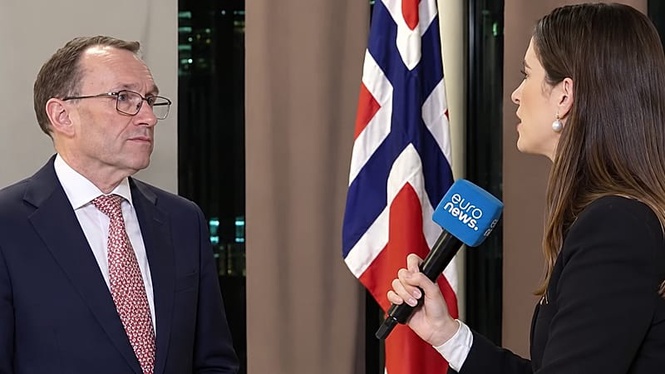
Norwegian Foreign Minister Espen Barth Eide has warned that Russia cannot have any say over NATO's military activities within its own territory, pushing back against Moscow's demands to reshape Europe's security order as diplomatic efforts to end the war in Ukraine gather pace.
Speaking to Euronews, Barth Eide insisted that Europe's existing security architecture did not need to be renegotiated and that sovereign countries must remain free to choose their own alliances.
“We're not happy about this language about architecture,” he said. “We believe that we have a European security architecture. There was nothing wrong with it until Russia violated it.”
Barth Eide added that no deal should be imposed on Kyiv without Ukraine’s consent. “There should be nothing about Ukraine without Ukraine."
He said discussions with Moscow following a ceasefire could address arms control, verification mechanisms and confidence-building measures, drawing on precedents established during the Cold War.
Bild has reported a leaked version of Russia's alleged maximalist demands from last week's ceasefire talks. Russia, crucially, wants to maintain occupied Ukrainian territory, such as the Donbas region.
Moscow also allegedly wants Finland's to rescind its membership to NATO — an alliance it joined in 2023, after the full-scale invasion — as well as preventing NATO from operating its bases in the Baltics. Both notions have been rejected by Baltic and Finnish leaders.
Negotiators from the EU and the E5 nations will meet on the sidelines of the Coalition of the Willing meeting on Thursday in Berlin to discuss the substance of what the continent would want to come out of any ceasefire talks.
The meeting coincides with a trilateral meeting attended by Chinese President Xi Jinping, US President Donald Trump and Russian President Vladimir Putin on the sidelines of a summit of Asia Pacific leaders hosted by China.
The trilateral has been compared to the 1945 Yalta Conference, which was a meeting attended by Winston Churchill, Franklin Roosevelt and Joseph Stalin in Crimea that reshaped reshaped the world order.
Asked whether Thursday's summit is Yalta 2.0, Barth Eide said he is "not suggesting" that carving up spheres of influence would happen, however it is something "we don't want to see".
“The last thing we want would be an agreement between great leaders to divide the world between them,” he said. “These kinds of spheres of interest should be a thing of the past.”
In late-October, Finnish President Alexander Stubb, Norwegian Prime Minister Jonas Gahr Støre and Russian President Vladimir Putin spoke on the phone for 90-minutes.
The call was extremely divisive, and prompted criticism from the leaders of Sweden and Denmark, representing a break of Nordic unity.
"We don't think it was divisive," Barth Eide said, adding that the comments from Danish Prime Minister Mette Frederiksen were "behind us".
"What is most important is to underline that we need somebody to speak for Europe, Finland and... Norway did not pretend to speak for all of Europe."