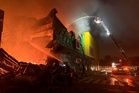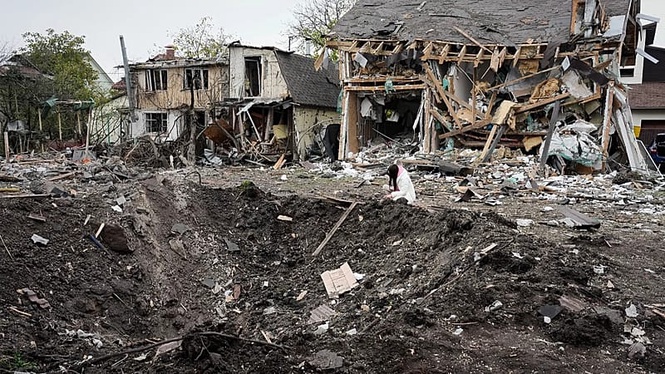
Russian forces struck Kyiv overnight with three ballistic missiles carrying cluster warheads designed to inflict maximum casualties across densely populated areas, Ukrainian President Volodymyr Zelenskyy confirmed on Thursday.
One of the missiles struck Pechersk, the Ukrainian capital's historic centre, hitting an area between the Kyiv-Pechersk Lavra and the Holy Presentation Monastery, damaging religious buildings, homes, shops, cafés and other civilian infrastructure.
The missiles were designed to detonate in the air as they approached their targets, dispersing explosive submunitions across an area 400 metres in diameter, Zelenskyy said.
Serhii Beskrestnov, Ukraine's presidential adviser known by his callsign "Flash", earlier identified one of the missiles as an Iskander equipped with a K5 cluster warhead.
At least two dead and dozens injured
"This warhead detonates above the ground and is used specifically for inflicting maximum harm to people and equipment over an area of 400 by 400 metres," Beskrestnov said, adding that its 58 bomblets explode in the air.
Zelenskyy accused Moscow of deliberately targeting civilians in Kyiv's historic centre, insisting that the choice of both weapon and location was intentional.
"This is another extraordinarily revealing strike – revealing because it was no accident. The choice of weapon was deliberate, the choice of target area was deliberate, and so was the intent to inflict as much loss and damage on civilians as possible," he said.
"There was no military target nearby, not even in theory, and the weapon was designed to cause widespread destruction."
The strike was part of a large-scale Russian aerial assault on the Ukrainian capital and surrounding region overnight on 21–22 October.
At least two people were killed and 34 others injured, including five children, across the affected areas, according to Zelenskyy.
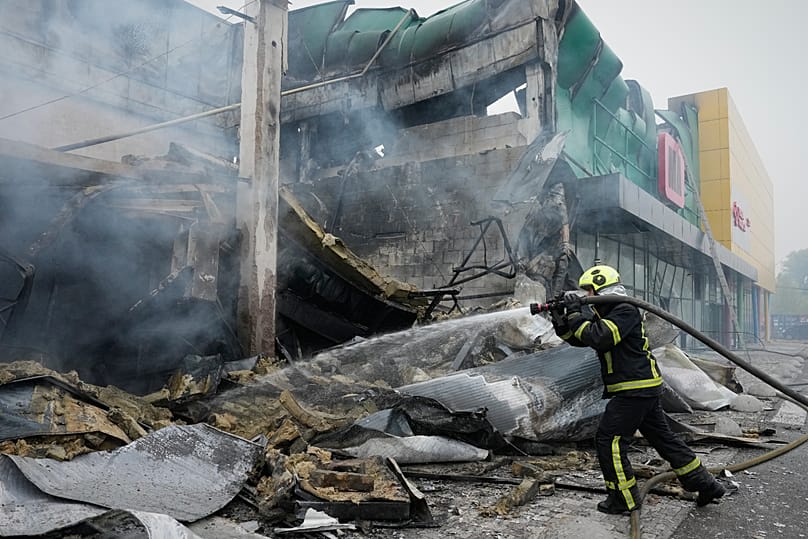
The bombardment came in several waves, with ballistic missiles and drones striking residential neighbourhoods, transport facilities and medical infrastructure across the capital.
Kyiv authorities reported damage in the Holosiivskyi, Obolonskyi, Pecherskyi, Sviatoshynskyi and Dniprovskyi districts.
Ukraine's Air Force said Russia had launched 210 drones, including 110 jet-powered variants, alongside Iskander-M, S-400, Zircon and Onyx missiles.
Ukrainian air defences intercepted or suppressed 181 drones, including 87 jet-powered variants, while strikes were recorded at 32 locations and falling debris at another eight.
Zelenskyy said Russia had fired 21 missiles in total during three waves of ballistic strikes on Kyiv.
The attacks continued throughout Thursday, with further strikes reported in Kharkiv, Dnipro, Marhanets, Mykolaiv and Kherson, as well as several other regions. In Kharkiv, a commuter train was hit, according to the Ukrainian president.
Zelenskyy said Russia had carried out more than 170 strikes against critical energy facilities since 11 October, despite Ukrainian air defences intercepting significant numbers of drones and some missiles.
He warned that Ukrainian intelligence identified Russian priorities for further attacks in the coming weeks, accusing Moscow of exploiting delays in Western air defence supplies.
"Russia is clearly taking advantage of the slowdown in air defence supplies from our partners," he said, calling for the accelerated delivery of military assistance already approved by Ukraine's allies.
View the post on X
The overnight bombardment came just hours after US special envoy Steve Witkoff met Russian President Vladimir Putin in St Petersburg as Washington sought to revive negotiations to end the war.
During the visit, Witkoff described Putin as a "humanitarian", despite the Russian president being wanted by the International Criminal Court over the alleged unlawful deportation and transfer of Ukrainian children.
Zelenskyy said on Wednesday that Ukraine was ready to accept literally any form of truce, on any aspect of the war, that Russia would be willing to agree to.
But following the latest attacks, the Ukrainian president questioned Moscow's willingness to pursue peace.
"Russia has not changed the way it wages this war, and it is taking no steps that would signal a genuine desire to end it," he said.