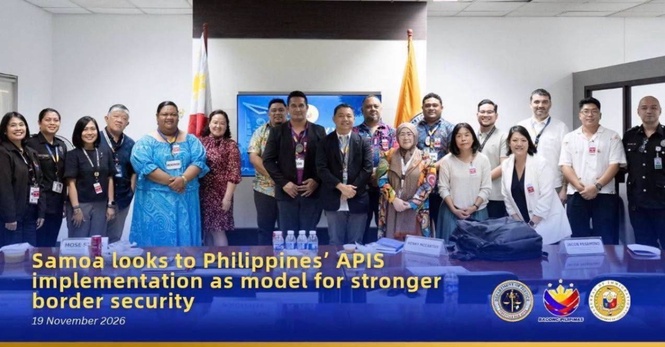
SAMOA is keen on adapting the Philippines’ Advance Passenger Information System (APIS) as a border security measure.
A five-member Samoan government delegation visited the Bureau of Immigration’s APIS Operations Center at the Ninoy Aquino International Airport Terminal 3 to learn how the Philippines uses the system to monitor incoming and outgoing passengers and assess potential security risks.
APIS is an electronic border management tool that allows airlines to transmit passenger information to government authorities before a flight arrives or departs. By collecting and analyzing passenger data in advance, immigration and security agencies can identify individuals who may require closer scrutiny, flag potential threats and prepare appropriate responses before passengers reach immigration counters.
APIS helps authorities streamline immigration procedures, improve coordination among law enforcement agencies and facilitate legitimate travel while strengthening border controls.
During the two-day study visit, APOC Chief Melvin Mabulac and his team briefed the Samoan officials on the system’s operational framework, technological requirements, passenger information processing and role in proactive border protection and risk assessment.
The discussions covered how the system supports intelligence-driven immigration operations, allowing authorities to identify potential security concerns before passengers arrive at their destination.
The delegation was led by Jacob Pesamino, with support from the International Organization for Migration, headed by Yuko Tomita. Vugar Allahverdiyev of the United Nations Office of Counter-Terrorism also accompanied the group.
Other BI offices took part in the knowledge-sharing sessions, presenting their respective mandates and best practices in immigration operations, intelligence gathering, passenger facilitation and border protection.
Commissioner Joel Anthony Viado welcomed Samoa’s interest in the Philippine experience, saying the bureau remains committed to sharing its expertise and strengthening international partnerships.
The initiative is aligned with President Ferdinand Marcos Jr.’s push to expand international cooperation through strategic partnerships and knowledge exchange.
Viado said the engagement underscores the importance of cross-border collaboration and technology-driven solutions in addressing evolving security challenges while ensuring safer and more efficient international air travel.