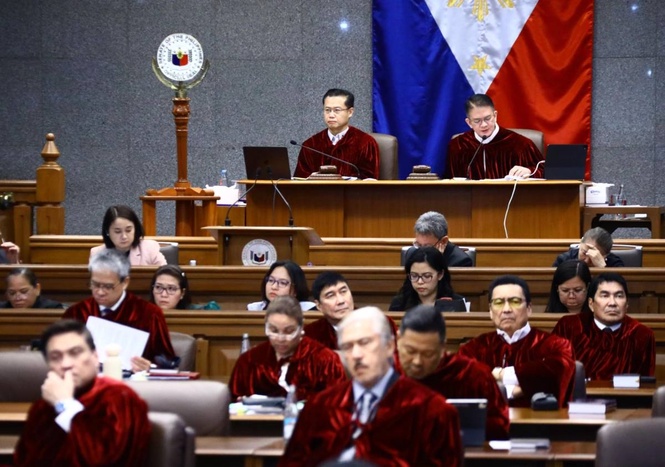
MANILA, Philippines — A petition filed with the Supreme Court (SC) on Thursday asked the tribunal to strike down the Senate impeachment court’s new formula for determining the votes needed to convict Vice President Sara Duterte, arguing that the Constitution requires two-thirds of all 24 senators—or 16 votes—regardless of their participation in the trial.
In a 24-page petition filed Thursday, former executive secretary Atty. Victor D. Rodriguez, sought certiorari and prohibition, along with a temporary restraining order and writ of preliminary injunction, to block the implementation of the Senate impeachment tribunal’s Sept. 23, 2026 ruling on the required two-thirds vote for conviction.
The Senate impeachment court voted 13-1, with six senator-judges not participating, to adopt a rule under which the two-thirds requirement would be computed only from senators deemed “legally and factually capable of participating” in the proceedings.
Under the new rule, senators who are detained, suspended or otherwise legally restrained from performing their functions, whose whereabouts are unknown, physically or medically incapacitated, beyond the Senate’s coercive processes, or “similarly situated” may be excluded from the voting denominator.
Rodriguez, through his lawyers, argued that the move impermissibly changes the meaning of Article XI, Section 3(6) of the 1987 Constitution, which states that no person may be convicted in an impeachment proceeding without the concurrence of two-thirds of all the Members of the Senate.
The petition stressed that the Constitution does not say “two-thirds of the senators present,” “two-thirds of participating senators,” or “two-thirds of senators legally and factually capable of participating.”
For Rodriguez, the distinction is crucial because a 24-member Senate produces a fixed constitutional requirement of 16 votes. Under the Senate’s new interpretation, however, the denominator could shrink depending on which senators are considered capable of participating.
The petition gives hypothetical examples: if only 20 senators are counted, two-thirds would be 14 votes; if 19 are counted, 13 votes; and if 18 are counted, 12 votes.
Rodriguez argued that this creates a “variable constitutional threshold” and effectively gives the impeachment tribunal the power to determine how many votes are constitutionally necessary to remove an impeached official.
“This is not merely a change in procedure,” the petition said in substance, arguing that the ruling changes the operative constitutional threshold for conviction.
The petitioner further argued that the Senate’s rule-making authority over impeachment proceedings does not include the power to amend the Constitution. Under his theory, any substantive change to a constitutional provision must follow the amendment or revision mechanisms under Article XVII, including congressional or constitutional-convention processes and ratification by the people.
The petition also challenged the Senate tribunal’s declaration that its new interpretation would operate pro hac vice, or only for the present proceeding. Rodriguez argued that the Constitution contains no provision allowing a temporary or case-specific alteration of its requirements.
The case comes after the Senate impeachment court reversed Presiding Officer Francis “Chiz” Escudero’s July 6 ruling that 16 votes were required to convict based on the 24-member Senate. The September 23 ruling followed arguments over whether senators who have been unable to participate in the trial should remain part of the denominator.
The dispute has drawn competing interpretations. House prosecutor Chel Diokno argued before the impeachment court that the Constitution’s two-thirds requirement does not automatically mean a denominator of 24, raising the question of “two-thirds of how many?” Senate President Sherwin Gatchalian, meanwhile, said the tribunal did not lower the two-thirds requirement but addressed which senators should be included in the voting base when some cannot participate.
Rodriguez’s petition asks the SC to issue an immediate TRO preventing the Senate tribunal from conducting, completing or implementing any conviction vote under the September 23 ruling.
He also asks the Court to declare the ruling null and void insofar as it permits incumbent senators to be excluded from the denominator merely because they are absent, unable to participate or otherwise deemed similarly situated.
Ultimately, Rodriguez wants the Court to declare that “all the Members of the Senate” means all legally constituted members, unless a Senate seat has legally become vacant or the Constitution itself provides otherwise.
He is also asking the Court to reinstate the July 6 interpretation that, with a legally constituted 24-member Senate, 16 affirmative votes are required for conviction.
The petition invokes the SC’s power to review government action for grave abuse of discretion. Rodriguez argues that the Court would not be deciding Duterte’s guilt or innocence, but only determining whether the Senate impeachment tribunal is operating within the constitutional limits imposed on its impeachment power.
The petition cites the Court’s April 2026 ruling in Generillo Jr. v. Senate of the Philippines, which addressed the judiciary’s review of Senate action in an impeachment-related controversy. In that case, the Court said the Senate’s actions as a co-equal constitutional body are generally beyond mandamus, while grave abuse of discretion remains relevant to judicial review.