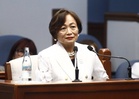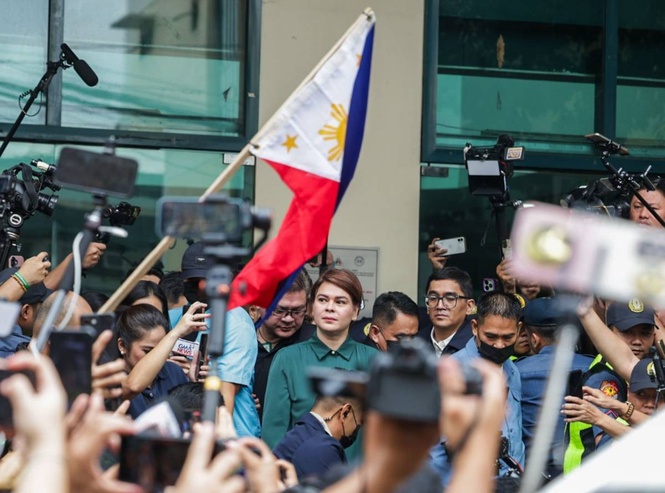
AN official of the Securities and Exchange Commission (SEC) and two other witnesses are expected to testify on Vice President Sara Duterte’s declared business interests and possible government contracts as the impeachment court continues to tackle unexplained wealth allegations against her.
Senate Presiding Officer Francis Escudero has granted the House prosecution’s requests to subpoena SEC Company Registration and Monitoring Department Director Gerardo Del Rosario, Civil Service Commission (CSC) Assistant Commissioner Ariel Ronquillo, and the Department of Budget and Management’s (DBM) Philippine Government Electronic Procurement System Division chief Rendell Sopeña for this week’s impeachment hearings.
Del Rosario is expected to shed light on companies in which Duterte declared financial interests, while Ronquillo is expected to explain the statement of assets, liabilities and net worth (SALN) filing guidelines.
Sopeña has been directed to produce procurement records involving contracts between Gencorp and government agencies from 2020 to the present.
Gencorp is among the companies in which the Vice President reportedly declared a financial interest in her SALNs.
The witnesses’ expected testimonies form part of the prosecution’s shift from the vice president’s own wealth declarations to independent corporate and government records under Article 2 of the Articles of Impeachment.
Article 2 alleges, among others, that Duterte failed to divest and continued participating in businesses while serving as vice president.
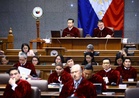
Still on Duterte’s impeachment trial, Sen. Panfilo Lacson said senator-judges may need more time to decide on the voting threshold for conviction.
Lacson said that while they were enlightened by the insights of three former Supreme Court justices who appeared before the impeachment court, they still have to consider the oral arguments of the prosecution and defense on the issue.
“I’d like to think we would be given more time to sleep over it so we can dissect everything discussed during the oral arguments. It may not be enough to vote immediately after the oral arguments. But that is the schedule we agreed upon at least for now,” Lacson said in a radio interview on Saturday.
“I’d rather wait for the oral arguments on Wednesday because the prosecution and defense will share their ideas and arguments. It is better to listen to them to broaden the basis of our decision,” he said.
The senator-judges are to hear the oral arguments on Sept. 23 before deciding whether to retain or modify the ruling of Presiding Officer Francis Escudero that 16 votes are required for conviction.
Asked if senator-judges may appeal to the presiding officer to defer the voting to the week after, Lacson said it is possible.
“If some of us may still need more time, a motion may be made to defer the voting to the following week,” he said.
Lacson reiterated that he was enlightened by the insights of former Chief Justice Reynato Puno’s discussion of “textual vs. contextual” interpretation, retired Chief Justice Artemio Panganiban’s emphasis on “truth and fairness,” and retired Associate Justice Adolfo Azcuna’s interpretation of the phrase “all means all” in determining the threshold.
The three former magistrates appeared before the court last Wednesday, while former Chief Justice Hilario Davide Jr. sent his memorandum that was read during the proceedings.
Lacson said he has also sought inputs from other legal luminaries, including another former chief justice who gave insights on a possible “automatic acquittal” if 16 votes cannot be obtained for conviction even if there are situations where nine senator-judges could not attend the impeachment trial.
He also said the consultation with the amici curiae (friends of the court) should debunk claims that the court acted with grave abuse of discretion.
“I believe we exercised prudence and due diligence by consulting with legal eagles. You cannot downplay the importance of three former chief justices and one former senior associate justice,” Lacson said.
Lacson also said he does not see any connection between the investigation of Senators Camille and Mark Villar over alleged questionable joint venture agreements entered into by PrimeWater Infrastructure Corp. and the impeachment trial.
“We do not have any influence over the actions of the Ombudsman or executive branch, or the judiciary, in this case the Sandiganbayan or the RTC (regional trial court). We don’t think this is connected with the impeachment trial,” Lacson said.
“As far as we are concerned, we look at the testimonies of witnesses, documents, arguments, and the inputs of the amici curiae,” he said.
Lacson added that Sen. Ronald dela Rosa can still participate in the impeachment trial, so long as he comes out and takes his oath.
Dela Rosa “has to take the risk when he comes out to participate. It may not be like last May’s leadership change when he got into the Senate and managed to leave. It’s up to him but we welcome his participation. Once he takes his oath, he becomes within the coercive jurisdiction of the Senate,” he said.
Lacson reiterated his position that the Senate and impeachment court should not interfere in the bids of Senators Rodante Marcoleta and Jinggoy Estrada to take part in the impeachment trial.
“If we will be asked to comment, it would be better not to because we may be misinterpreted as putting undue pressure on the Sandiganbayan. It would be better for the Senate and impeachment court not to interfere,” he said.
Lacson expressed the need for senators to discuss the issues about the trial informally in a caucus next week.
Duterte is facing allegations of misusing confidential funds, unexplained wealth, bribery and grave threats.