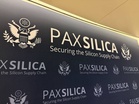
I WOULD like to direct everyone’s attention to The Manila Times editorial of Sunday, Oct. 4, which was titled “Defending Pax Silica.” This, of course, refers to the much-discussed US-led initiative to build up a “non-China” supply network for critical minerals, semiconductors and other such paraphernalia related to the tech industry, including but not limited to artificial intelligence (AI).
In previous editorials, at least one or two that I can think of, we have expressed skepticism about the Pax Silica initiative, and so at first Sunday’s editorial might seem to be a contradiction. It is not. Rather, it is a thoughtful recommendation to the government in this context: If Pax Silica is a good thing that will create jobs for Filipinos, boost the country’s industrial development and increase exports of high-value goods, then this is how it should be sold to the Filipino people. And of course, the follow-on implication to that is that the government must subsequently do what it says it will do in order to make that a reality.
And since I realize, much to my chagrin, that this is a matter of curiosity among some people, I would like to clarify that no, I did not write that editorial. There are quite a few people who are aware that I am part of the editorial board, such as it is, and I am greatly honored by that, but for me it is merely an opportunity to contribute to a collective voice; whether I or one of my other highly experienced and talented editorial colleagues actually do the physical work of putting the words on paper, the views therein are not our own (though we might personally subscribe to them), but an expression of the consensus of close to 200 years of combined expertise.
Thus, to make a long story short, I agree with the basic premise of the Oct. 4 editorial, that being “this is the way for the government to properly handle the Pax Silica initiative to gain public support for it, and to give it the best chance of success.” That does not necessarily clash with my own view of the Pax Silica initiative, which is closer to “this is a bad idea that the Philippines shouldn’t touch with a ten-foot pole,” because the editorial presents a hypothetical scenario under which the scheme might actually work to the country’s benefit.
That being said, one of the common features of most hypothetical scenarios is that they are very unlikely to be realized, and despite the good advice presented in the editorial, that seems to be the case here.
The core message of the editorial is expressed in this passage: “Opposition to Pax Silica focuses on four broad areas, each of which the government and project proponents need to honestly and credibly address: 1) environmental and resource strain; 2) sovereignty and geopolitical neutrality; 3) transparency and accountability; and 4) equity and economic benefit.” Put another way, that could be expressed as, “If the government wants the people to support this, and wants participation in the initiative to result in positive outcomes for the country, then these four concerns must be clearly resolved, and the resolution of those concerns clearly communicated to the public.” The editorial then goes on to suggest solutions to each of those concerns.
In terms of the environmental and resource risks, it recommends that high-density AI data centers that might appear under the initiative build their own or fund the construction of off-grid, clean power, so as not to compromise the already tenuous energy supply situation in the country. Likewise, these should also be mandated to utilize closed-loop, recycled water cooling systems to minimize their impact on fresh water supplies.
To alleviate concerns that the initiative will simply result in extraction of the Philippines’ otherwise irreplaceable mineral resources without there being downstream added value, the editorial also proposes that a recommendation from noted economist Bernard Villegas be followed, to wit, that “the government should present the initiative as one component of a broader industrial policy program that includes a focus on modernizing agriculture and agribusiness, and in manufacturing, on higher-value electronics and semiconductor assembly, with gradual movement into design and testing of advanced and more complex devices.” That of course means that investment approvals under Pax Silica would require binding agreements on downstream value-adding industrial development and fair payment of mineral resource dividends and taxes, so that the government could support agriculture, agribusiness and growth of the manufacturing sector.
The editorial also strongly advocates — as it should — respect for the rights of Indigenous and other local communities that may be affected by industrial development under the Pax Silica, and the broader “Luzon Economic Corridor” initiative of which Pax Silica is intended to be a key component. Initially, the most affected people are the Aeta Indigenous communities in the area of the industrial reservation designated by the Bases Conversion and Development Authority (BCDA) straddling the Pampanga–Tarlac border; the BCDA has downplayed the impact, but the people who actually live there and have every right to consider the territory their homeland, and not the BCDA, are the credible source in this case.
Finally, the editorial advocates that the government should emphasize that Pax Silica is a broad partnership that includes a number of other countries, such as Japan, South Korea, Australia and the United Kingdom, to ease fears that the initiative is a sell-out of the government to US interests. This is the one point where I must vehemently disagree with the view expressed, because it is a lie, although it is a lie perpetrated by the US government and not our editorial. The Pax Silica initiative, and the initial “critical minerals memorandum of understanding” that apparently is intended to get the ball rolling on all of this, so far puts the entire project in the context of a strictly US-Philippines relationship, with the Philippines providing mineral resources and space for industrial development for the benefit of the US market alone, and none of the other 30 or so countries that are supposedly part of the Pax Silica initiative.
My view is that something like the “Pax Silica” could work out positively for the Philippines, but that the initiative as it stands now is exploitative and faithless. Since the anchor of the whole idea is the mineral wealth the Philippines supposedly has, whatever initiative is joined should be on the Philippines’ terms, and not those of the United States — absolutely not under the current US regime, and really, not under any that we might hope will replace it. So far, there is nothing about the current initiative to endorse at all. For example, the aforementioned “critical minerals MOU” was signed last Feb. 3, but only disclosed — to Congress, and not the public — last Sept. 9. While the concept of “Pax Silica” could benefit the Philippines, the whole thing should be shelved until some reasonable and fair conditions are met.
ben.kritz@manilatimes.net
Bluesky: @benkritz.bsky.social
Website: www.badmannersgunclub.com