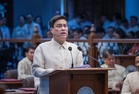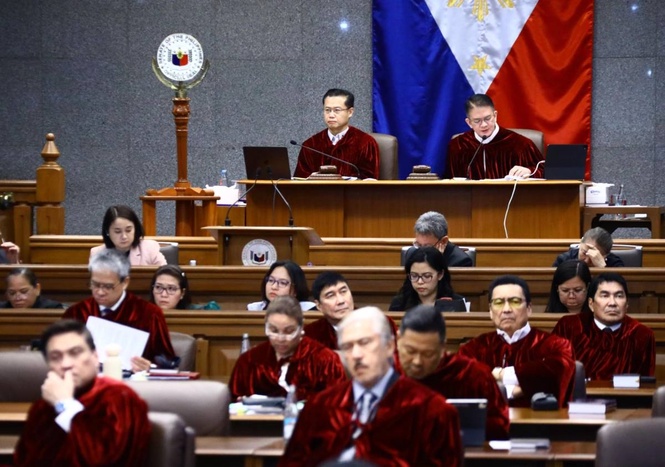
SENATE Majority Leader Juan Miguel Zubiri on Thursday said some senators are considering lowering the vote threshold for convicting Vice President Sara Duterte in her impeachment trial, citing the absence of several lawmakers during the proceedings.
Speaking to reporters, Zubiri said some senators have questioned the threshold of 16 votes and said the issue “may come up sooner or later."
Some of his colleagues had wanted to revisit the threshold even when there were no senators missing, Zubiri said.
“Now, there are some in jail, and one is a fugitive at large," he said.
Zubiri said yes when asked whether some senators hoped that there would be a ruling on lowering the voting threshold.
"Some of the senators have concerns about the threshold. So the best way to do that is to debate about it, seek a ruling from the presiding officer," he added.
Under the 1987 Constitution, conviction in an impeachment trial requires the concurrence of at least two-thirds of all members of the Senate.
Senate Presiding Officer Francis Escudero earlier ruled that 16 votes, or two-thirds of the 24 senators, are needed to convict Duterte.
Escudero cited a Supreme Court ruling in 2000 that counted 16 votes as valid two-thirds concurrence in a treaty even though only 23 senators were then in office.
However, he made it clear that "those who disagree" with his ruling have the right to launch a legal challenge.
“And should the Supreme Court render a different ruling on this question, other than what the chair has stated, this court and this representation shall faithfully abide by that ruling,” Escudero said.
Three senators are currently unable to partake in the trial — Sen. Ronald dela Rosa, who is currently in hiding to avoid arrest by the International Criminal Court, as well as Sens. Jinggoy Estrada and Rodante Marcoleta, who are facing plunder charges before the Sandiganbayan.
Legarda also missing
Meanwhile, Sen. Loren Legarda failed to attend the impeachment proceedings after taking consecutive medical leaves.
Zubiri appealed to the public for understanding over Legarda’s medical leave, noting she is undergoing treatment for a "serious lung illness" and taking strong medication.
"She wants to come home as soon as possible; she'll just finish her tests," he said.
However, Zubiri is unsure when Legarda will return to work.
Legarda first filed a medical leave on Aug. 3, days after Ombudsman Jesus Crispin Remulla announced that she, her son, Batangas Rep. Leandro Leviste, and former Energy secretary Alfonso Cusi were being investigated for plunder and graft.
The investigation concerns projects that Leviste’s solar power company committed to undertake but allegedly failed to accomplish under the franchise awarded by the government.
Since then, Legarda has filed medical leaves on Aug. 3 to 5, Aug. 11 to 12, and Aug. 17 to 19, later extending the last one until Sept. 2.
Witnesses may be recalled
Meanwhile, the spokesman for the impeachment court said witnesses who have already testified may be called on to testify again if crucial matters remain unresolved.
Impeachment court spokesman Regie Tongol said on Thursday the court has the authority, under Supreme Court rulings, to recall witnesses presented by either the prosecution or defense after both sides have completed their cases.
But such requests are not automatic. A party must demonstrate a justifiable reason for recalling a witness and identify additional testimony that was not elicited during the witness’ initial appearance, Tongol said.
The court may reject a request if the evidence on the issue has already been sufficiently established or if recalling the witness would unnecessarily prolong the proceedings.
The trial remains tentatively targeted for completion in December, although Tongol stressed that the timetable is not final and could still change because of canceled sessions or other developments.
The appearance of Edward Fajarda, the former disbursing officer of the Department of Education, also remains uncertain because of his medical condition.
His subpoena remains in effect, but he must secure medical clearance before testifying.
Unmute the video
The House prosecution panel on Thursday said it does not expect supporters of Vice President Duterte to appreciate the evidence and testimony presented in the impeachment trial, with Rep. Terry Ridon urging them to “unmute” the proceedings.
“My advice to them is: my friend, unmute the video,” Ridon said during the prosecution’s briefing.
Rep. Zia Adiong said the evidence presented before the Senate should already be clear to the public, questioning what more would constitute the “smoking gun” demanded by Duterte supporters.
“I think the DDS supporters, we don't expect anything from them as far as appreciating the evidence and the testimony of the witnesses,” Adiong said.
Adiong also accused Duterte supporters of living in an “echo chamber” and “parallel reality” where they only talk among themselves and reinforce their own interpretation of the proceedings.
“The larger Filipino society knows that there really is compelling evidence that has been presented and sufficient reason has been presented by the prosecution panel,” Adiong said.
House impeachment prosecutors also said they are preparing to file a measure aimed at closing gaps in the safeguards on the use of confidential and intelligence funds exposed during the impeachment trial.
Ridon said some members of the panel are studying a Confidential and Intelligence Fund Integrity Bill that would codify Commission on Audit rules and strengthen accountability in handling secret funds.
Ridon said the measure could be submitted within two weeks, after the prosecution concludes its presentation on Duterte’s alleged misuse of P612.5 million in confidential funds under the Office of the Vice President and the Department of Education.
Among the safeguards being considered are clearer rules on the use of aliases for confidential fund recipients and requirements ensuring that their real identities remain disclosed to the agency and verifiable by authorized oversight bodies.
The bill could also tighten rules on who may handle secret funds, including requiring personnel other than designated special disbursing officers to be fidelity-bonded and organic personnel of the agency.