.jpeg)
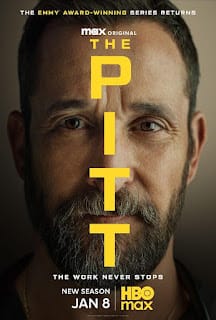
The Pitt (Miniseries, S1-2, 30 episodes)
Creator: R. Scott Gemmill
My partner in crime from secondary school (you know who you are) was influenced to become a man with a stethoscope after being fed a diet of TV series like Marcus Welby, MD, Dr Kildare, and Trapper John, MD. My daughter was probably smitten by George Clooney and his good-looking workmates in ER. Her interest would have been piqued by the carefree lifestyles of the doctors and nurses on Grey's Anatomy.
In these series (except for one or two episodes I had never really watched), they tend to portray the attending doctor as the well-composed guardian angel who would put things in order with the wave of a wand.
Very rarely do they internalise their work or become emotionally disturbed by it. They give the persona of a superhero, moving around, spreading an air of confidence, and flying up, up, and away to solve everyone's problems. Everyone would return happy, having been saved from malady.
As we know, in real life, things are never so straightforward. In my later life, 'House' interested me for a while, until every simple patient presentation became the rarest condition in the fine print of medical books. It soon turned me off.
This mono-series shows an hour-to-hour account of what happens in the Pittsburgh Trauma Medical Centre (ER) during a 12-hour shift. Each season covers a single shift. The timeline between the first and second seasons is 10 months.
Just like how TV Series 'CSI' gave a false impression of what forensic sciences are capable of doing, like solving an entire case from a single strand of hair, 'Pitt' paints a utopian view of what a trauma centre is capable of. Imagine how young doctors and even second-year medical students can perform advanced resuscitative measures to revive severely ill patients. The best thing is that patients recover so fast. The outcome of medical treatment is almost instantaneous. All medical equipment is at their disposal with a snap of a finger. Even thoracotomy, internal cardiac compressions and even perimortem crash Caesarean Sections can be performed in the trauma rooms at the drop of a hat. Most of the time, the doctors do not gown up. Even when they do, they have to look pretty. So, wearing a surgical mask defeats the purpose.
In real life, if the doctors and nurses work the way they do in these episodes, they are definitely going to crash and burn. They work like their lives depend on it, and they internalise deaths as personal defeat.
Sure, everyone joins medicine with big plans to change the world. As the grind starts, health workers realise they are not seen as God's gift to mankind but as mere cogs in the machine. Medical services are no longer an avenue for serving and giving back to society. Still, rather than an art of first, do no harm, playing defensively and dodging adverse outcomes for anything and everything else. Medical practitioners are constantly open to scrutiny, and society is ever ready to tear them apart, squarely blaming them whenever the final outcome is unfavourable. A huge industry prospers on medical misadventures.
Medicine has the uncanny ability to numb the senses and desensitise feelings. I think even Mother Teresa would have realised it along the way.
Farouk Gulsara (asokansham@gmail.com) is a content creator under the Newswav Creator programme, where you get to express yourself, be a citizen journalist, and at the same time monetize your content & reach millions of users on Newswav. Log in to creator.newswav.com and become a Newswav Creator now!
The User Content (as defined on Newswav Terms of Use) above including the views expressed and media (pictures, videos, citations etc) were submitted & posted by the author. Newswav is solely an aggregation platform that hosts the User Content. If you have any questions about the content, copyright or other issues of the work, please contact creator@newswav.com.