.png)
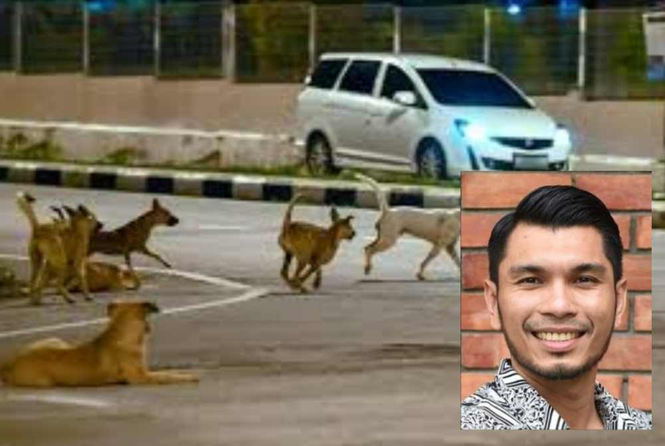
A STRAY dog dies during an operation by a local authority. A video of the incident goes viral on social media and within hours, the online space is flooded with reactions.
Some condemn the authorities, calling the treatment of the animal cruel while others defend the operation, citing public safety.
Elsewhere, residents complain that their children are too afraid to walk to school because of packs of stray dogs. Motorcyclists continue to face the risk of accidents after being chased by the animals.
In Sarawak, the threat of rabies serves as another reminder that the issue is not simply about animal welfare — it can also be a matter of human life.
This raises an important question: who is actually in conflict?
Are humans in conflict with dogs, or are humans actually in conflict with one another because of the failure to manage the issue comprehensively?
The reality is that stray dogs are not the root cause of the conflict. They are merely a symptom of long-standing weaknesses in urban governance that have received insufficient attention.
When an issue is only addressed after it goes viral, we are essentially putting out a fire rather than eliminating the cause of the blaze.
Stray dogs do not appear by accident
The stray dog population does not increase without reason.
It is the result of several weaknesses in the urban management system, including inefficient solid waste management that provides a continuous source of food, lax enforcement against irresponsible pet ownership, uncontrolled breeding and the abandonment of animals when they are no longer wanted.
In urban management, this is known as a system failure.
As long as these underlying causes remain unaddressed, capture operations will only provide temporary relief.
Any gap in the population will eventually be filled through breeding or migration from surrounding areas.
The real question is not how many stray dogs are caught each month, but why the population continues to exist despite years of operations.
Malaysia’s reality is more complicated
In Malaysia, the issue is more complex than in some other countries because of the country's unique social realities.
Perceptions of dogs are shaped by religion, culture and personal experience.
For some Muslims, dogs are associated with issues of religious law and cleanliness, although Islam itself recognises the importance of showing compassion towards all living creatures.
At the same time, many non-Muslims view dogs as pets, companions or part of their local communities.
These differences mean that the same stray dog can carry very different meanings for different groups.
For a mother whose child has previously been bitten by a dog, the animal represents a safety threat. For an animal welfare volunteer, that same dog may be a victim of human neglect.
Both perspectives have legitimate foundations. The problem arises when the two collide without a constructive space for dialogue.
The real conflict is between humans
This is the part of the issue that is rarely discussed.
Whenever an incident involving stray dogs occurs, society typically divides into two broad camps.
The first demands immediate action in the name of public safety. They want capture operations to be accelerated because they fear attacks, road accidents or the spread of rabies.
The second calls for every action to uphold animal welfare principles. They question methods considered cruel and push for the implementation of the Trap, Neuter, Vaccinate and Return (TNVR) programme.
Ironically, both groups are driven by legitimate concerns.
One wants to protect people, while the other wants to protect animals.
But without effective dialogue and coordination mechanisms, these different priorities eventually become a source of social conflict.
Local authorities, meanwhile, are often caught in the middle.
If they act firmly, they face criticism from non-governmental organisations (NGOs).
If they do not act, residents blame them.
Whatever decision they make can attract criticism because the system itself does not provide a comprehensive solution.
Why has co-management not worked?
The concept of co-management is often presented as an ideal solution.
On paper, local authorities, the Department of Veterinary Services, NGOs, communities and academic institutions should work together.
In reality, however, this cooperation has yet to reach its full potential.
This is not necessarily because any party lacks commitment, but because each organisation operates with different mandates, key performance indicators (KPIs) and constraints.
Local authorities are measured by the number of complaints successfully resolved.
NGOs, meanwhile, assess success based on reducing animal suffering. The Department of Veterinary Services prioritises disease control. Residents simply want a safe environment.
When every party is pursuing different objectives, meaningful cooperation becomes difficult to establish.
Worse, most forms of cooperation only happen after an incident goes viral.
Malaysia still does not have a Stray Animal Management Council at the local authority or state level that meets regularly to share data, coordinate action and assess the effectiveness of programmes.
Without a permanent platform, co-management risks becoming a slogan that is only revived during a crisis.
So, what does Malaysia need? In the short term, high-risk areas need to be identified using data and Geographic Information System (GIS) mapping.
Operations should focus on aggressive or high-risk dogs, while expanding rabies vaccination, strengthening standard operating procedures (SOPs) for animal handling and improving risk communication with the public.
But the long-term solution is far more important.
Malaysia needs a National Stray Animal Management Policy to coordinate all local authorities, make pet registration and microchipping mandatory, strengthen enforcement against owners who abandon animals, improve solid waste management and provide dedicated funding to support TNVR programmes.
More importantly, every local authority should establish a functioning co-management platform involving NGOs, the Department of Veterinary Services, the Health Ministry, universities, community leaders and representatives from different communities.
Discussions cannot only take place after a crisis. They need to become part of an ongoing decision-making process. It is time to stop viewing this issue as a choice between human safety and animal welfare.
The two are not mutually exclusive goals.
The real conflict is not between humans and dogs, but between humans who bring different values, experiences and priorities to the table.
Stray dogs are merely the point where multiple weaknesses in urban management converge.
If we continue focusing solely on the dogs, we will keep repeating the same cycle, an incident occurs, anger erupts and the operations are carried out. The issue dies down afterwards and repeat - it happens all over again.
Associate Professor Dr Azlan Abas is an Environmental Management lecturer at Universiti Kebangsaan Malaysia. The views expressed in this article are his own and do not necessarily reflect those of Sinar Daily.