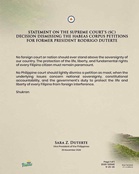
THE Supreme Court’s Nov. 11, 2026, decision dismissing the consolidated habeas corpus petitions over former president Rodrigo Roa Duterte’s arrest and transfer to the International Criminal Court (ICC) is an abomination — a masterclass in judicial evasion that turns the Constitution into a hollow ornament whenever the executive moves fast enough to transport its perceived enemy speedily out of the country.
It is an abdication, even a betrayal of the justices’ sacred duty. The House of Representatives, especially those who pursued Vice President Sara Duterte’s impeachment, the National Bureau of Investigation, the Justice department that has weaponized the law to quickly throw in jail those who would not bow to the president’s wishes, the Senate majority and now the Supreme Court. The degeneration of our institutions under this regime is nearly complete.
In a decision written by Associate Justice Japar Dimaampao, a majority of nine justices hid behind mootness and walked away from the central constitutional crisis of the era. The decision declares that it is not passing judgment on whether Duterte’s rights were violated during his March 11, 2025, arrest and flight to The Hague. But washing its hands in public while an 80-year-old Filipino citizen, a beloved former president at that, sits behind foreign bars — seized without a single warrant issued by a Philippine judge — is not judicial restraint. It is abdication.
How can the controversy be “moot and academic” when Duterte remains detained at the ICC Detention Center in The Hague, and the record shows no Philippine court ever authorized his seizure or removal from Philippine soil? He arrived at NAIA Terminal 3 from Hong Kong on March 11, 2025. Philippine National Police-Criminal Investigation and Detection Group officers took him into custody on the strength of an ICC warrant transmitted through Interpol.
No official warrant was presented at the moment of arrest, no prior complaint or show-cause order issued. He was given a copy of the ICC warrant and read his Miranda rights only after he had already been brought to Villamor Air Base. Hours later, he was on a plane. By the next day, he was in Rotterdam and under ICC custody. No Philippine judge determined probable cause. No Philippine court reviewed the arrest under domestic law before the plane left.
Under the majority’s reasoning, the moment state agents seize a person, bypass local courts and ship them beyond territorial reach, the Great Writ of Liberty becomes powerless. That turns constitutional protection into a footrace the executive wins by speed. The illegal acts occurred on Philippine soil, by Philippine officials, under the coercive power of the Philippine State. Those acts still demand scrutiny.
The five justices who disagreed with the decision vehemently wrote against it, in unusually harsh words. Justice Ramon Paul Hernando dissented “in the strongest possible terms” from the abrupt dismissal of “three of the most consequential petitions to ever reach the Supreme Court in its 125 years of existence” on the ground of mootness, “a pedestrian expediency to say the least.”
Controversy
Justice Henri Jean Paul Inting stated the core point directly: “The case is not moot simply because Duterte is no longer within the Court’s jurisdiction. The case continues to present a controversy on whether he was validly arrested and detained by the Philippine authorities and surrendered to the jurisdiction of the ICC. Under Article 59 of the Rome Statute, arrest and surrender must follow the domestic laws of the custodial State; local courts have primary jurisdiction on that question. The government caused the delivery beyond Philippine jurisdiction; they cannot defeat the Court’s authority by the very act under challenge.”
Inting pointed out the very wrong precedent the Court decision established: “The state in a habeas corpus proceeding could easily avoid litigation simply by delivering the detainee to a place beyond the court’s jurisdiction.”
Justice Hernando dissented in the “strongest possible terms,” condemning the dismissal as a “pedestrian expediency” and a “gross disservice to the Filipino people.” He argued that Section 17 of Republic Act 9851, or the Act on Crimes Against International Humanitarian Law, Genocide and Other Crimes Against Humanity — which mentions “surrender” to an international court without defining it, identifying the decision-maker or prescribing procedures and safeguards — unduly delegates legislative power and should be struck down as unconstitutional.
Hernando pointed out: The decision “conveniently skirted the issue of the legality of Duterte’s ‘surrender’ to the ICC” and “totally disregarded the clear violation of human rights, particularly the right to liberty of a Filipino citizen, a former president no less, and the nonobservance of due process in effecting the surrender.” Hernando would have granted the petition and directed the executive to pursue diplomatic channels for Duterte’s release.
Justice Antonio Kho Jr. in so many words cursed the decision: “The People look to the Court as the final sentinel of their rights and liberties. They rightly expect that the Constitution will not be reduced to a mere parchment barrier whenever executive action is swift enough to outrun judicial review.”
Unconstitutional
He called the transfer an extraordinary rendition that is “unconstitutional per se” in the absence of a valid domestic law and prior judicial authorization. The petitions involved acts “sans any valid warrant of arrest in violation of his constitutional right not to be deprived of liberty without due process of the law ... To hold that jurisdiction is lost merely because the executive hastily relinquished custody of Duterte to the ICC would be to sanction constitutional evasion and reward the executive’s defiance of judicial authority.” Kho warned: “Allowing the executive to outrun review by completing the transfer creates a dangerous template for handing over any Filipino on the strength of a foreign process without prior judicial oversight.”
Justice Amy Lazaro-Javier did not use sanitizing language. “Former president Duterte was arrested, detained and transported to the ICC at respondents’ behest without the protection of any lawful procedure, without even the faintest pretense of compliance with the processes owed to every Filipino citizen. What occurred was not a lawful transfer. It was a seizure followed by a delivery.” To call it surrender “would be to clothe an undeniable violation of rights with the language of legitimacy.”
She pointed out the subsequent transfer of physical custody does not extinguish the Court’s authority to determine whether Philippine officials violated constitutional rights within Philippine territory. The inability to grant one form of relief does not equate with the absence of judicial power to decide whether a constitutional violation occurred. Sweeping the matter under mootness would abdicate the Court’s responsibility as guardian of fundamental liberties.
Senior Associate Justice Marvic M.V.F. Leonen argued: “The situation involves clear, serious and grave constitutional issues that are capable of repetition and would otherwise evade review. Our silence can be interpreted as complicity in a violation of the Constitution, our concurrence with a treaty and the relevant law.” Leonen pointed out: “Article 59(2) of the Rome Statute that established the ICC requires that an arrested person be brought promptly before a competent judicial authority in the custodial State to determine that the warrant applies, the arrest followed proper process and rights were respected. Duterte was not given the opportunity to exercise these rights.”
The government could have obtained a Philippine warrant beforehand or presented him before a regional trial court afterward. It did neither. The principal constitutional defect, Leonen wrote, lay “in the total absence of any judicial review: former president Duterte was taken and flown to The Hague within hours, without any judicial imprimatur sought by his captors.”
Cowards
Leonen practically called his colleagues in the Court cowards: “If we flinch and succumb to the visceral temptation to surrender the former president without following the legal provisions we have sworn to uphold, we will fail to show the courage the Constitution demands of us as the Republic’s legal conscience.”
The Supreme Court was not asked merely to pass judgment on the ICC. It was asked to pass judgment on the conduct of Philippine government officials whose powers emanate from the Constitution and whose actions are subject to its limitations.
That is the essence of judicial review. Duterte’s detention at The Hague is not a hypothetical consequence of an academic controversy. Accountability for alleged atrocities must never be confused with lawlessness in how a person is seized and shipped abroad.
By declaring the petitions moot while a Filipino remains detained overseas following an arrest made without a local judicial warrant, the Supreme Court sent a chilling message: Due process is optional if officials move Gestapo-like fast enough to illegally kidnap a citizen and transport him abroad, which our highest court says is beyond its jurisdiction, and therefore a moot issue. That is why this decision is an abomination.
Facebook: Rigoberto Tiglao
X: @bobitiglao
Website: www.rigobertotiglao.com