DEFENSE Secretary Gilberto Teodoro Jr. is a huge liability for this government that is already imploding, stuck in a downward spiral of allegations of corruption involving billions of pesos, incompetence in managing the economy, and grand theft of taxpayers’ money that is even embedded in the national budget law.
President Ferdinand Marcos Jr. should fire him, if only to lighten his burden. He should listen to the voices of over two dozen organizations of Philippine businesses — the country’s capitalist elite — that have issued statements saying Teodoro’s hostility toward China will pull down our country’s economy, already in near-crisis by several factors, especially the rocketing of fuel prices and the depreciation of our currency.
Teodoro ignored the business associations’ unprecedented plea. Expect him to continue his nonstop tirade against China.
Teodoro is worsening Marcos’ image as a president who can’t even control his officials. The defense secretary, in effect, is defying his foreign policy of being “friends to all, and enemy to no one.”
One column claimed that Marcos is playing a “good cop, bad cop” game. That is ridiculous. A nation’s foreign policy must be viewed by countries as its only policy, supported by the entire government and even by its people. Teodoro’s anti-China stance is telling the world that Marcos is a weak leader who can’t even make his officials toe his line. The role of a bad cop can be taken by nonstate actors, not by a rogue official.
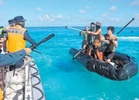
In his three-and-a-half years as defense chief, Teodoro has single-handedly — with the help of his mad-looking megaphone at the Philippine Coast Guard — destabilized our formerly friendly relations with China to a level even worse than what the late president Benigno Aquino III and his foreign affairs secretary Albert del Rosairo did.
Aquino
At least, Aquino was the president authorized by the Constitution as the “chief architect” of foreign policy. He also had to adopt a belligerent policy toward China because he had to hide from the public his monumental blunder in losing Scarborough Shoal in a stand-off with Chinese vessels there in 2012 by claiming that China forced us out of that area. Another factor that had made Aquino hostile to China is the fact tremendous pressure was put on him by the United States, as this was the time when then-president Barack Obama launched his so-called “Pivot to Asia” policy, which, in reality, was a pivot from Europe to contain China’s rise.
In contrast, foreign policy is nowhere in Teodoro’s field of responsibility. Yet, he has been shouting to the world that, for the Philippines, “the biggest threat is China,” even as he had not presented a single iota of evidence for such an accusation, misrepresenting China’s assertiveness on its territorial claims in a small area in the South China Sea — the right of any state — as a superpower bullying us. Teodoro has no independent constitutional mandate to replace presidential policy with his own.
There is a precedent of a bold, principled president upholding his nation’s constitution. In 1951, then-US president Harry Truman fired military leader Gen. Douglas MacArthur, who kept making public statements contradicting his policy of keeping the Korean War limited to Korea, and not escalating it to Chinese territory.
Truman made that bold decision despite the fact that MacArthur was extremely popular in the US: he received a hero’s welcome, had a ticker-tape parade in New York, and even gave an emotional farewell speech to Congress. Filipinos, in contrast, will cheer Teodoro’s firing, which would even push up Marcos’ satisfaction ratings.
I don’t think Teodoro can even occupy any post in government. Nobody occupying or who had occupied a Cabinet post has been like Teodoro: as abrasive as he is arrogant.
Persona
His public persona is marked by a condescending certitude that leaves no room for disagreement, much less genuine debate. His rhetoric on the South China Sea dispute conveys the impression of a man who regards his own interpretation of national interest as the only legitimate one.
Rather than calmly addressing opposing arguments on their merits, he adopts a combative posture, treating dissent not as an opportunity for reasoned discussion, but as something to be rebuked or discredited. His tendency to portray critics of the government’s China policy as disloyal or insufficiently patriotic, risks turning a legitimate debate over foreign policy into a test of national allegiance.
There have been defense secretaries since the 1986 EDSA uprising — the likes of Juan Ponce Enrile, Fidel Ramos, Orlando Mercado, Fortunato Abat, Hermogenes Ebdane, and Delfin Lorenzana. All excelled in statesmanship, and none ever accused people who didn’t share their views as traitors.
What makes this posture particularly troubling in a defense secretary is his confusion between intellectual conviction and intellectual infallibility. Teodoro speaks with the certainty of someone who believes the issues have already been settled and that those who disagree must therefore be ignorant, misguided or acting against the country’s interests. In press interviews on the China issue, he has never appeared calmly arguing his stance, and instead argued on top of his voice, with glaring eyes that Filipinos better describe as “nanlilisik.”
Complex
Yet, the South China Sea dispute involves extraordinarily complex questions of history, international law, diplomacy and strategic calculation, on which even distinguished scholars disagree. Such issues demand intellectual humility, restraint and a willingness to engage contrary evidence. Teodoro’s confrontational style instead projects an intolerance of dissent that is ill-suited to the responsibilities of his office. A defense secretary should be capable of defending his government’s position forcefully without suggesting that disagreement with it amounts to betrayal of the nation.
Teodoro has billions of pesos in confidential funds, yet he has not even commissioned independent research nor a study group to analyze in depth our territorial and maritime disputes with China. He has not even asked for a study from the Department of Foreign Affairs on what our South China Seas disputes with China and other countries, especially Vietnam, involve.
Teodoro still even asserts, with extreme arrogance, that China’s claim in the South China Sea is based on that infamous nine-dash line and that the Philippines vs. China arbitration invalidated Beijing’s sovereign claims — assertions that both pro- and anti-Chinese scholars have, for several years, already debunked.*
Teodoro’s confrontational rhetoric toward China exposes a fundamental contradiction: he talks as though the Philippines were a military power capable of confronting that superpower, when our armed forces are vastly inferior to Beijing’s and our economy depends heavily on Chinese goods and industrial supply chains.
Consider the defense ministers of countries with far greater military capabilities and more immediate security concerns involving China. Even they generally exercise greater restraint in their public language.
Hegseth
United States Defense Secretary Pete Hegseth warned in May 2025 that China’s military threat was real and potentially imminent. Yet, by the following year’s Shangri-La Dialogue, he was emphasizing communication with Beijing. The US possesses the world’s most powerful armed forces, yet its defense secretary recognizes the importance of avoiding unnecessary confrontation.
Teodoro, on the other hand, issued an order that no member of the Philippine military nor the civilian staff of the defense department can communicate with their counterparts in China nor in its embassy here.
I think Teodoro’s behavior points to that of a bitter man, as the only election he could win was the one to represent the first district of Tarlac, the bastion of the late Eduardo “Danding” Cojuangco Jr., whose sister Mercedes is Teodoro’s mother. He ran for president in 2010 and landed in fourth place. For some reason, though, Cojuangco reportedly did not support his bid, a major factor in his defeat. He then ran for the Senate in 2022 but lost, landing in 15th place.
There are rumors that he still lusts for the presidency, and is wooing Marcos to anoint him as a successor. His belligerence toward China will certainly endear him to the Americans. Is his anti-China stance, in reality, his game plan on becoming president?
* (China does not base its claims on the nine-dash line. It asserts sovereignty over four island groups and derives maritime claims from them, which were asserted in laws it had passed many years before the 2000s. The 2016 arbitral tribunal rejected China’s claimed historic rights on the United Nations Convention on the Law of the Sea’s (Unclos) provisions, but it did not invalidate China’s claims of sovereignty over those islands. In pages 1 and 2 of its award, the arbitral panel emphasized: “UNCLOS, however, does not address the sovereignty of States over land territory. Accordingly, this Tribunal has not been asked to, and does not purport to, make any ruling as to which State enjoys sovereignty over any land territory in the South China Sea. None of the Tribunal’s decisions in this Award are dependent on a finding of sovereignty, nor should anything in this Award be understood to imply a view with respect to questions of land sovereignty.”)
Facebook: Rigoberto Tiglao
X: @bobitiglao
Website: www.rigobertotiglao.com