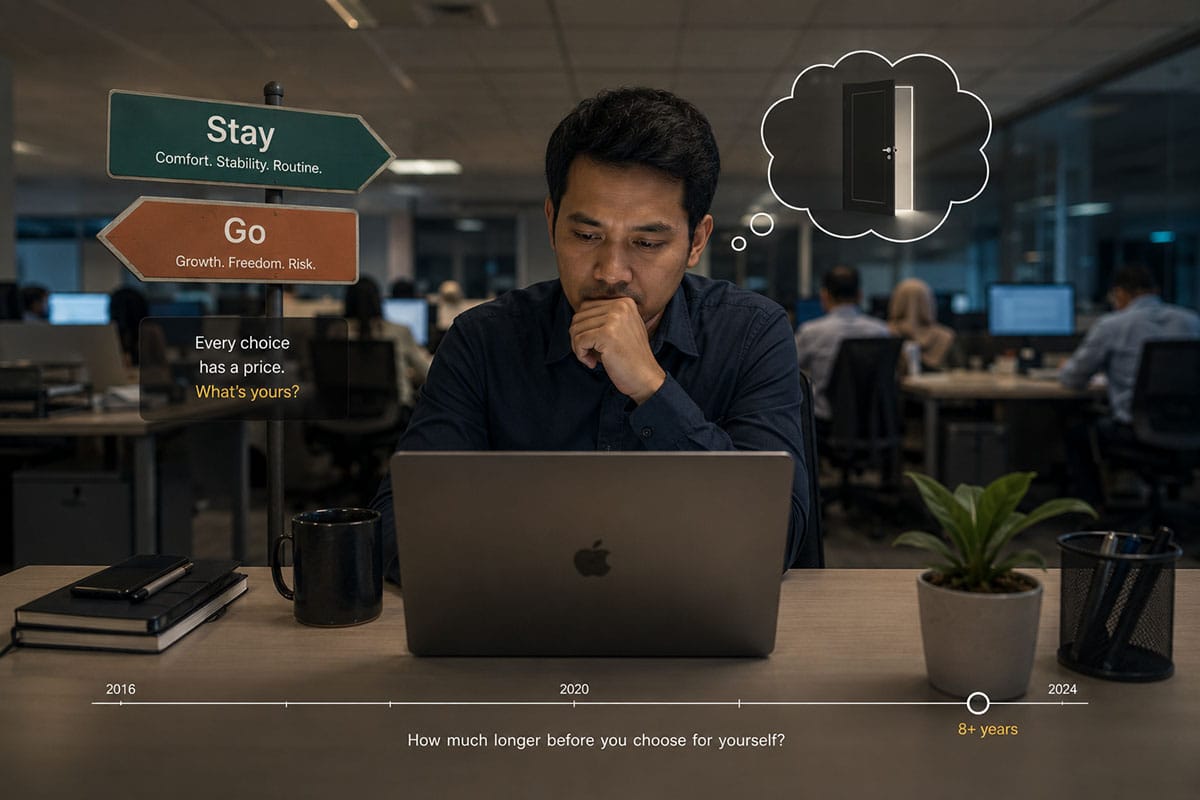
You already know it is time. The hard part is everything after that.
If you are sitting in a job wondering whether it is time to leave, some part of you has already answered the question. The tricky part is not figuring out the answer. It is finding the courage to act on it, and more importantly in Malaysia, figuring out how to afford to.
The Signs You Are Reading But Ignoring
Every job that has run its course leaves a trail of signals before the end arrives. The problem is that most people are very good at explaining them away.
You stop getting invited into conversations that used to involve you. The projects dry up. Your manager goes from engaged to vague. Praise disappears. You find yourself doing the same things in circles with no path forward and no explanation why.
Sometimes the signals are louder. A boss who criticises constantly but never specifically. A team culture built on fear and quiet resentment. Being made to feel like an inconvenience in a place you are supposed to belong. Being frozen out without anyone saying a word about it.
These are not just uncomfortable experiences. They are data. And ignoring them does not make them stop, it just means you absorb more of it before anything changes.
Why Malaysians Stay Longer Than They Should
Here is the number that should not surprise anyone who has been in the workforce here: two-thirds of Malaysian employees are currently experiencing record burnout levels, according to a 2024 Employment Hero survey. Malaysia also ranks second worst for work-life balance among 60 countries globally. Workplace mental health issues alone are costing the national economy RM14.46 billion in lost productivity every year.
And yet Malaysians stay. Partly because EPF contributions take time to build. Partly because the medical benefits are attached to the employer. Partly because the loan instalments keep coming regardless of how Sunday evenings feel.
Financial security is a completely legitimate reason to stay in a job you are unhappy with. Nobody serious will argue otherwise. But there is a difference between staying strategically while you build an exit plan, and staying indefinitely because leaving feels too uncertain to even think about. The first is pragmatic. The second is a slow drain that most people only recognise in hindsight.
A 2025 Randstad Workmonitor survey found that 59% of Malaysians have quit or would quit a toxic workplace, the highest rate in the Asia Pacific region. That number is striking not because it is high, but because it means 41% would apparently stay regardless. Fear is a powerful anchor.
Running Away vs Running Toward
Not all resignations are the same, and this distinction matters more than most career advice acknowledges.
Quitting because a place has become unbearable is valid. Toxic environments are real, they cause real damage, and getting out of one is often the right call even when the timing is not perfect. Nobody should have to earn the right to leave a bad situation.
But there is a different kind of resignation that tends to go better in the long run: leaving because something better is waiting. A promotion somewhere else. A role that actually fits where you want to go. A company whose culture does not slowly erode your confidence. When you quit toward something rather than away from something, you carry momentum into the next chapter instead of relief followed by a long recovery.
Both are sometimes necessary. Some people have to leave a bad situation first before they have the mental space to find a good one. The ideal is to line up the destination before you leave the departure point, but that is not always possible when the current environment has become genuinely harmful.
When the Decision Gets Made for You
There is a third kind of exit that nobody plans for: the one where the company decides before you do.
A retrenchment is a different kind of loss to a resignation. You did not choose it. The timeline was not yours. And it can carry a particular emotional weight even when it had nothing to do with your performance, especially when you had started to see the signs but hoped things would turn around.
The harder version of this is when a good employer delivers difficult news honestly and with respect. That kind of exit stings in its own way because the work relationship was functional and the ending is genuinely not personal. Malaysia's economy has been putting enough pressure on businesses across enough sectors that this scenario has become increasingly common for people at all levels.
Retrenchment is not failure. But it does force the question that voluntary resignation lets you approach on your own schedule: what comes next, and what did you learn about what you actually need from a job?
How to Actually Know It Is Time
The question is not whether you feel unhappy. Unhappiness in a job can be temporary. It can come from a difficult project, a team conflict, or a hard quarter. That is not necessarily a signal to leave.
The real question is whether the problems are structural or situational. Situational problems resolve. Structural problems, a toxic manager, a culture that systematically undervalues people, a role that has been quietly hollowed out, these do not fix themselves. Staying and hoping rarely works when the issue sits in the bones of the organisation.
Ask yourself these honestly: Has anything actually changed in the last six months despite the problem persisting? Do you see a realistic path to the next version of your career staying where you are? Are you protecting your mental health by staying, or sacrificing it?
If the answers consistently point one direction, you probably already know what to do.
My Take
I have been on both sides of this. I have stayed in a job longer than I should have, watching the signals pile up, telling myself it would get better. The boss who never had a specific reason for his dissatisfaction. The tasks quietly disappearing. The feeling of being made invisible in a place I was supposed to contribute. I stayed because I needed the income. I left when it became clear the cost was no longer just financial.
I have also left for the right reasons: a better offer, a step forward, a genuine opportunity to grow. That kind of exit feels completely different. You leave with your head up instead of your energy depleted.
The most important thing I would tell anyone sitting in that uncomfortable middle ground right now is this: work can be found elsewhere. Jobs exist. The market is not perfect but it is not closed either. What is much harder to rebuild, and what nobody talks about honestly enough, is what a prolonged toxic environment does to your confidence, your sense of self-worth, and your mental health. Those take far longer to recover than a job search takes to complete.
Know your worth before the job convinces you otherwise. That is the art of knowing when to quit.
Kamarul Azwan (k.azwan@gmail.com) is a content creator under the Newswav Creator programme, where you get to express yourself, be a citizen journalist, and at the same time monetize your content & reach millions of users on Newswav. Log in to creator.newswav.com and become a Newswav Creator now!
The User Content (as defined on Newswav Terms of Use) above including the views expressed and media (pictures, videos, citations etc) were submitted & posted by the author. Newswav is solely an aggregation platform that hosts the User Content. If you have any questions about the content, copyright or other issues of the work, please contact creator@newswav.com.