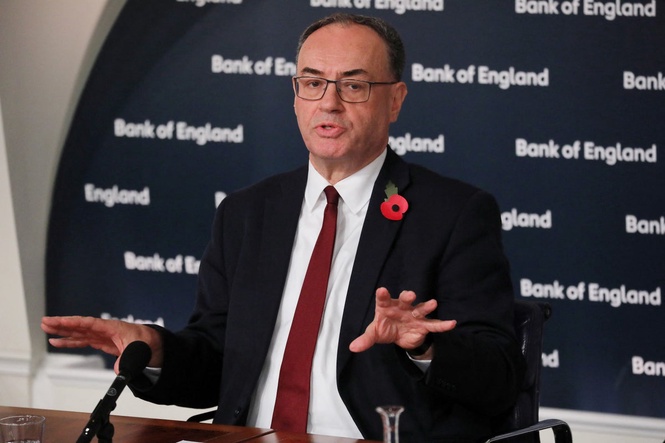
Taken on their own merit, the governor of the Bank of England’s comments about the impact of Brexit on the economy are neither novel nor radical. Indeed, his latest contribution is not much more than a statement of the blatantly obvious: “Would the UK being able to trade more openly with its nearest neighbours, to have that trade, to have that market openness, be beneficial for growth in the UK? My view is yes, it would.”
However, Mr Bailey’s remarks come at a crucial moment, a fortnight before the next EU-UK annual summit, postponed since the departure of Sir Keir Starmer. As in comedy, so in central banking: timing is everything.
The delay seems not to have harmed the likely outcomes: a great relaxation of bureaucracy for food exports, some sort of youth mobility scheme (reportedly snagged on how much the EU want their students to pay for British university fees), participation in the EU energy and emissions trading system, cooperation on irregular migration and on defence. Given that a 1 per cent annual UK growth rate is currently anticipated until 2027, the eventual expected uplift in GDP of 0.4 per cent from these measures alone is extremely welcome.
It surely makes any open-minded objective observer wonder what might flow from even closer links.
For some, the diminution of trade, investment, national income and material standards of living that have occurred since Brexit, compared to what would have prevailed had the UK remained inside the bloc, is a price well worth paying for a purer conception of sovereignty, as well as the opening up of new opportunities, however vague and remote.
For others – the pragmatic majority – the impact of the reduction of British GDP of somewhere between 4 and 8 per cent, and the alienation from our closest neighbours, is the greatest act of self-harm the UK has committed since the end of the Second World War. Yet thanks to the prime minister, a debate that has been frozen since Brexit was formally completed in 2021 has been reopened, and in a forward-looking manner.
It is one of the few major initiatives the UK can take that will move the needle on our economic and security outlook at this present time of renewed uncertainty. Yet on both those fronts, some hope also springs from America after the outcome of the US midterms. On the positive side is the hope that a Democrat-controlled Congress can use the power of the purse and the War Powers Act to get America out of the war in Iran.
Indeed, some influential Republican voices are now calling for just such a move, and financial markets are starting to price in such a scenario – oil is back below $100 a barrel.
It is worth recalling that before the Iran war was fully underway last spring, Rachel Reeves, then chancellor, could point to some signs of economic resilience, and the prospect of lower inflation, a continuing downward trend in interest rates and thus higher growth and healthier public finances.
That has since reversed, but the underlying relative strengths of the British economy remain, and as Mr Bailey indicated a few days ago, would re-emerge with some force if the situation in the Middle East rapidly improved. After the “blue tsunami”, that is more likely, though hardly certain.
The rather less welcome gift carried on the Democrat wave is the correction in global stock markets, a potentially depressing factor for confidence and growth. Once again, this time in his capacity as chair of the international Financial Stability Board, Mr Bailey issued a warning about the potential for financial chaos if the growth in the AI sector faltered and prompted a correction “involving simultaneous disruption across multiple firms”. This is precisely what we may be witnessing now, despite a minor rally in equities.
Given all of that, was it bad timing for the Bank to increase interest rates last Thursday? Just at the moment when an end to the energy crisis may be in sight, and a simultaneous potential liquidity crisis if the tech stock correction accelerates and spreads?
On balance, the small hike in rates is still defensible, because there is a risk, especially in the UK, that the increase in energy costs already feeding through the economy could ignite a domestically generated and more persistent wage-price inflationary spiral next year. It has to be choked off. Besides, peace is far from at hand in the Gulf, and the turmoil in private equity and tech stocks has not yet sparked a broader, disorderly retreat in the markets.
What is really needed in Britain, as ever, is some sense that the government has a way of translating the mantra of “good growth in every postcode” into tangible investment, productivity and jobs. Mr Burnham can’t do much to boost Nvidia shares or stop the Iranian Revolutionary Guard from bombing its neighbours; but he can rebuild our essential economic and defence partnerships on our own continent. The EU summit must be the beginning, not the conclusion, of that process.
I hate to say it, but only Donald Trump can save Britain from more interest rate pain
Justin Welby: Ordinary Britons should not be forced to pay for the evil of slavery
North Korea just stole $6.3bn in crypto. This is how we stop it cashing out
John Healey is putting the brakes on Andy Burnham’s European ambitions
JD Vance is no longer ‘lame-duck’ Donald’s heir apparent
The Democrats have trounced Trump – now they must stop him becoming a Maga martyr