
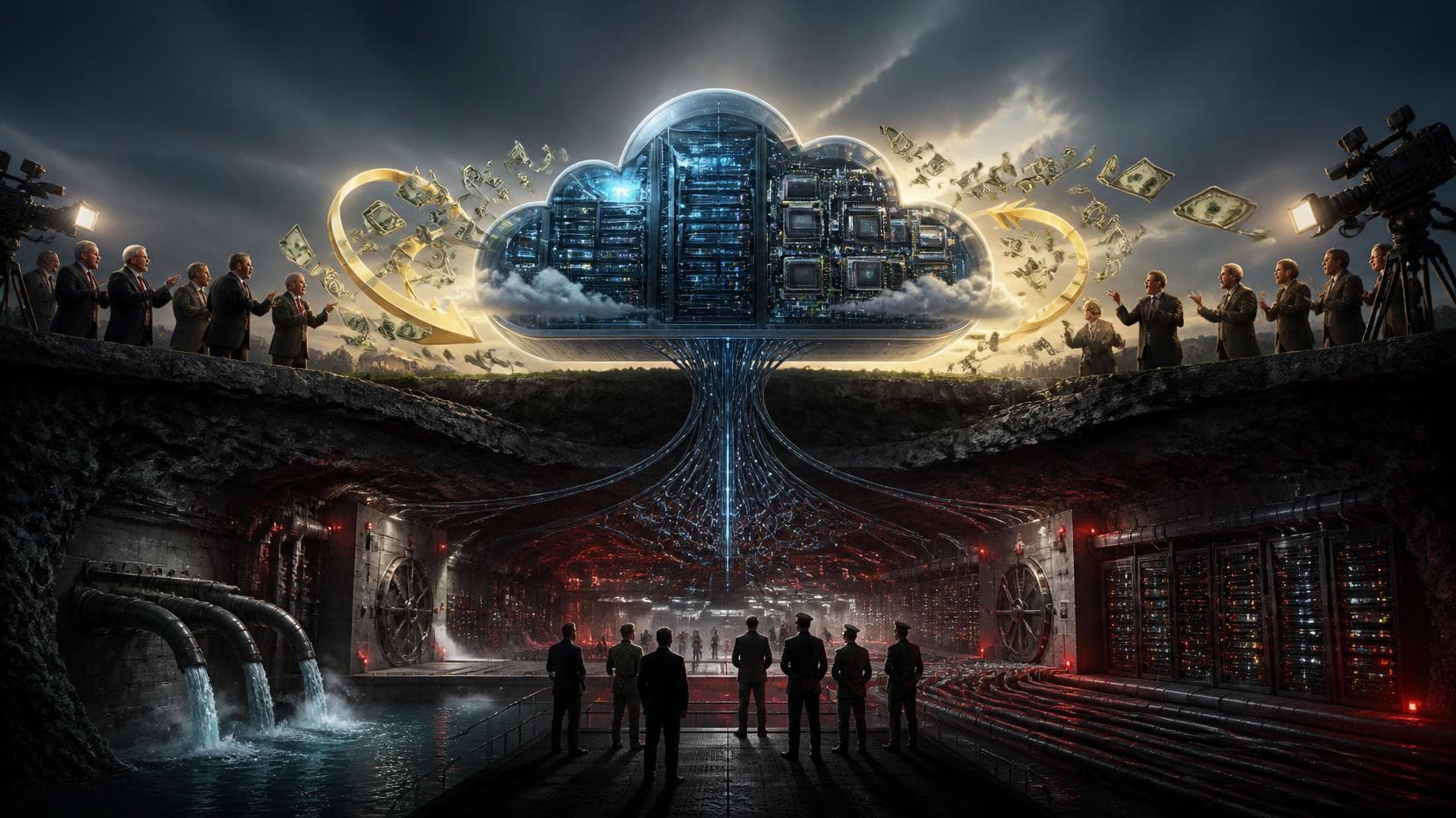
Deep beneath Stockholm’s Södermalm district, behind a 40-centimeter steel door built to withstand a hydrogen bomb, servers hum inside a Cold War civil defense shelter. Hundreds of feet below Pennsylvania, Iron Mountain’s Boyers campus cools its racks with water from a 35-acre underground lake. These facilities predate the AI boom. But they are the architectural template for what the boom is now funding at unprecedented scale — and they point to a more unsettling possibility: the AI bubble is not the real story. It is the distraction.
The Bet Is Civilizational
Global data center capital expenditures surged 57% in 2025 to $726 billion. Dell’Oro Group projects the figure will cross $1 trillion in 2026. Amazon alone spent $131 billion on capex last year, mostly on data centers, and plans $200 billion in 2026. This is not incremental spending. It is a railway-boom-scale construction project — financed on the premise that AI demand will grow forever.
But what if that premise is a cover?
The Hardware Is Sitting Idle
Here is what the industry does not advertise. Technology critic Ed Zitron argues that as much as 75% of the Nvidia GPUs sold — roughly two million units — are “simply awaiting deployment and ‘gathering dust’ ,unable to generate revenue”. A 2026 Cast AI report found average GPU utilization at just 5% across enterprise environments — meaning 95% of provisioned GPU capacity is doing nothing. “A GPU sitting idle costs dollars per hour,” said Cast AI president Laurent Gil. “A CPU sitting idle costs cents. And 95% of GPU capacity is doing nothing”.
Why would companies spend hundreds of billions on hardware they do not use? Because the spending is not really about computation. It is about capital allocation — and about building something else entirely.
The Money Is Circulating, Not Flowing
Where did the money for all this idle silicon come from? Increasingly, from the companies that sell it. Nvidia has backed neocloud providers such as CoreWeave, Nebius, and Nscale through funding rounds and supply commitments. These providers then use the capital — often supplemented by debt raised against Nvidia chips as collateral — to buy more Nvidia hardware. The arrangement has been described as converting a single dollar of Nvidia investment into several dollars of Nvidia purchases.
The Bank for International Settlements identified this dynamic in its 2026 Annual Report as one of the three biggest risks to global financial stability. Nvidia CEO Jensen Huang has publicly rejected the “circular financing” label, but the pattern is hard to ignore: OpenAI committed $250 billion to Microsoft cloud services, deployed tens of billions in AMD chips while becoming an AMD shareholder, and received up to $100 billion from Nvidia to stock its data centers with Nvidia hardware.
This is not a market. It is a spectacle — designed to keep the world watching the wrong thing.
The Water and the Power
The resource footprint is staggering. Global data centers consumed about 222 billion litres of water in 2025, primarily for cooling. Without efficiency gains, that figure could nearly triple to 644 billion litres by 2030. A typical 100-megawatt hyperscale facility consumes around 530,000 gallons of water per day — equivalent to the water use of 6,500 homes. Some large data centers can use up to 5 million gallons a day, roughly the consumption of a town of 50,000 people. Amazon’s data centers alone used 2.5 billion gallons of water in 2025.
Electricity demand is following the same curve. Data centers consumed 448 TWh in 2025, and that figure is projected to double to 980 TWh by 2030. AI-optimized servers will account for 44% of data center power consumption by 2030, up from 21% in 2025. The IEA reports that data centers already consume about 1.5% of global electricity, growing at 12% per year over the last five years. In the United States, data centers are projected to rise from 4% to 7.8% of regional electricity consumption between 2025 and 2030.
In Pennsylvania, water managers have warned that new data centers could strain supply.
These are not abstract numbers. They are freshwater from drought-stricken regions. They are grid capacity that could power homes. Locally, In Johor, Malaysia, residents protested outside a data center construction site in February 2026 over water supply strain. The state later halted approvals for certain data center tiers drawing nearly 200 times more water than smaller facilities.
The Bunker Datacenter Is Already Here
The high end of this buildout has a name: the bunker datacenter. CtrlS, an Indian data center company, describes them as “digitally fortified strongholds, purpose-built to operate under conditions that would cripple conventional facilities”. Their features include military-grade reinforced concrete, EMP shielding through Faraday cage design, and autonomous life-support systems.
Swiss firm Eccus has designed a 2MW data center built in an underground tunnel. The company’s founder notes that “there’s no planning permission required” and “you can build under your existing facility.” The technology to build invisible, permit-exempt underground compute already exists. The question is not whether it is being used, but what event it is being built for.
The Defense Continuum
The line between commercial AI infrastructure and national security infrastructure is being deliberately erased. CoreWeave announced in 2026 that it is teaming up with Leidos to run its platform inside SCIF-accredited data centers for US intelligence and defense agencies — the sealed rooms where classified intelligence is stored and analyzed. When a commercial AI cloud provider builds capacity that meets SCIF standards, it is building a bunker — whether or not the marketing calls it that.
These are not facilities designed for quarterly earnings. They are designed for continuity — for the day after something goes wrong.
The COVID Precedent
The pandemic response was nonsensical and unnecessary. But you are not allowed to say that. Instead, the public debate is consumed by vaccine side effects, germ theory versus terrain, lab leak theories, Senate hearings, and compensation schemes. All of it noise. All of it obscuring the main point: the response itself was the event, and it was used to distract from something else.
The same pattern is now repeating with AI. The hype, the valuations, the endless arguments about whether AI will save us or destroy us — all of it keeps eyes on the spectacle while the real construction continues underground. The bunkers are not being built for AI. They are being built for what comes after the distraction ends.
The Argument, Stated Plainly
The hypothesis is not that there is a secret program to build human habitats beneath ordinary data centers. It is that the AI bubble is funding hardened, bunker-like infrastructure — some of it underground, some of it dual-use, some of it explicitly designed for defense and continuity of government. The 95% of GPUs sitting idle are not a bug; they are a feature of a system where capital seeks safe assets and physical infrastructure outlasts the narrative that funded it. The circular financing is not innovation; it is the financial engineering that inflates a bubble while building real, hardened assets underneath.
And the resource consumption — the water, the electricity, the strain on communities — is not a side effect. It is the visible cost of a project whose real purpose is hidden. While the world argues about whether AI will take jobs or solve climate change, the concrete is poured, the tunnels are dug, and the bunkers are built. They are being built in expectation of an event. What that event is, we are not told. But the preparations suggest it is coming.
Ed Zitron’s assessment is blunt: “This could humiliate the largest companies in the world.” The bubble may burst. The GPUs may become obsolete. But the concrete, the power, the cooling, the fiber, and the security will remain. The bunker beneath the cloud is not a conspiracy. It is the logical endpoint of a boom that has always been about more than computation — and the unresolved questions of the last crisis are being buried beneath the foundations of the next one.
Dr Kavesh (kaveshdr@gmail.com) is a content creator under the Newswav Creator programme, where you get to express yourself, be a citizen journalist, and at the same time monetize your content & reach millions of users on Newswav. Log in to creator.newswav.com and become a Newswav Creator now!
The User Content (as defined on Newswav Terms of Use) above including the views expressed and media (pictures, videos, citations etc) were submitted & posted by the author. Newswav is solely an aggregation platform that hosts the User Content. If you have any questions about the content, copyright or other issues of the work, please contact creator@newswav.com.