By Dr Victor S. L. Tan
Whenever I look at Malaysia’s changing skyline, I see more than concrete, steel and glass. I see the effort of thousands of people who design, build, coordinate, supervise and solve problems every day. The construction industry has helped shape our nation’s growth and quality of life. Yet behind every impressive project, I also see an industry facing growing pressure.
Construction costs have become more volatile. Margins are being squeezed. Competition is intensifying. Unsold properties remain a concern in some segments, even while many families still struggle to buy homes they can afford. Skilled people are not easy to attract or retain. Technology is moving fast. Customers are becoming more demanding. In short, the construction industry is no longer operating in a comfortable or predictable environment.
In my years of working with organisations through uncertainty, I have come to believe that the greatest danger is not merely the rising cost of doing business. It is the rising cost of failing to change. To me, that is the real challenge facing the construction industry today. The question is not simply how contractors and developers can survive these pressures, but how they can transform themselves to become stronger, smarter and more sustainable.
One of the biggest issues is cost volatility. A contractor may secure a RM100 million project with an expected profit margin of 5%, only to find that sudden increases in material, transport or labour costs wipe out the margin completely. That is why a company can win a prestigious contract, report strong revenue and still lose money. Winning more projects does not necessarily mean earning more profits. Unless costs, productivity, risk and coordination are managed more effectively, growth itself can become dangerous.
Traditional contracting arrangements are also being tested. In a more unpredictable world, shaped by geopolitical tensions, supply disruptions and changing input costs, it is reasonable to ask whether risks are being shared fairly. I believe the industry must think more seriously about better collaboration, more transparent cost management and more practical risk-sharing. A contract should not merely determine who is blamed when circumstances change. It should help all parties complete the project successfully when conditions become difficult.
Another concern is the mismatch between supply and actual market demand. We have seen unsold completed units, even while many potential buyers still feel priced out of the market. To me, this suggests that the issue is not just about building more. It is about building what customers genuinely need, value and can afford. Property development and construction must become more customer-centric, more data-informed and more responsive to changing buyer behaviour.
Then there is the human side of the challenge. Construction companies do not succeed merely because they have machines, systems and contracts. They succeed because people think well, adapt quickly, communicate clearly, solve problems creatively and build trust across multiple stakeholders. When mindsets are rigid, communication is weak and problem solving is poor, delays, waste and conflict multiply. In such an environment, even good strategies can fail.
This is why I believe the real way forward is not only technological transformation, but organisational transformation. Yes, the industry must embrace better systems, AI, automation, digital coordination and smarter project management. But the strongest advantage will still come from people who are adaptable, resourceful, customer-focused, solution-oriented and relationally effective. We must build stronger people if we want to build stronger projects and stronger companies.
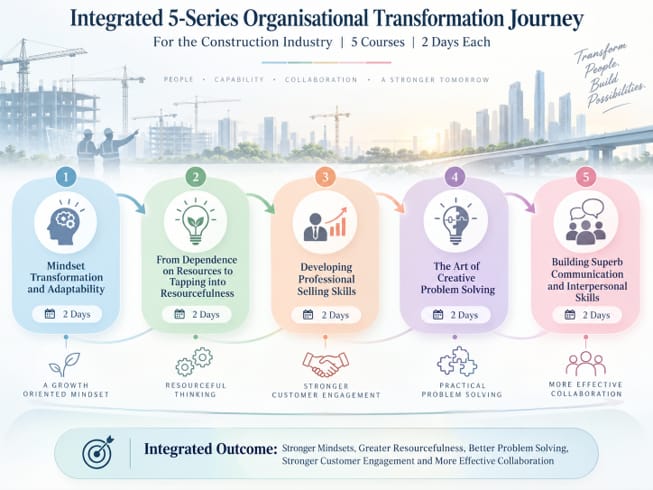
The Way Forward: An Integrated 5-Series Transformation Journey
For this reason, I would strongly recommend that construction companies consider an integrated 5-series organisational transformation journey, with each programme running for two days. This should not be treated as a collection of isolated workshops. It should be seen as a connected development pathway designed to build the human capabilities the industry now needs most urgently.
The first programme, Mindset Transformation and Adaptability, should lay the foundation. Every meaningful change begins with how people think. When teams respond to new realities with old assumptions, transformation stalls. This programme should help participants embrace change, strengthen resilience, take ownership and replace a reactive mentality with a proactive one. The goal is to cultivate people who do not merely complain about challenges, but learn to respond positively and decisively.
The second programme, From Dependence on Resources to Tapping into Resourcefulness, addresses a mindset that is especially relevant in times of constraint. Many organisations instinctively ask for more money, more manpower or more time whenever problems arise. Yet the more valuable question is often: how can we get better results from what we already have? This programme should help participants identify waste, uncover hidden capacity, improve initiative and turn limitations into opportunities.
The third programme, Developing Professional Selling Skills, may surprise some people in construction, but I believe it is critically important. In a more competitive market, companies cannot depend on price alone. They must know how to communicate value, understand customer needs, build trust and present solutions professionally. Whether dealing with developers, project owners, investors or homebuyers, the ability to sell with credibility and confidence matters.
The fourth programme, The Art of Creative Problem Solving, is essential because construction is full of complexity. Delays, cost overruns, coordination breakdowns, design issues and operational bottlenecks are not unusual. What matters is how quickly and intelligently people respond. This programme should equip participants to define problems clearly, identify root causes, generate alternatives and move towards practical solutions. The companies that thrive will not be those with the fewest problems, but those with the greatest ability to solve them well.
The fifth programme, Building Superb Communication and Interpersonal Skills, completes the journey. Construction projects bring together developers, contractors, consultants, suppliers, authorities and customers. Poor communication creates misunderstanding, tension, lost time and unnecessary rework. Strong communication builds alignment, trust and cooperation. This programme should strengthen listening, stakeholder management, negotiation, collaboration and authentic interpersonal effectiveness.
Taken together, these five programmes create a powerful transformation sequence. First, people learn to think differently. Then they learn to become more resourceful. Next, they learn to engage customers more professionally, solve problems more creatively and communicate more effectively. The integrated outcome is not just improved knowledge, but stronger mindsets, sharper execution, better collaboration and greater organisational resilience.
I would encourage construction companies to implement this series for a focused group of leaders, managers, supervisors, technical professionals and business development personnel. After each two-day module, participants should apply the learning to real workplace challenges. Management should then review the improvements achieved in areas such as productivity, customer engagement, speed of problem resolution, teamwork and stakeholder satisfaction. Training should never end in the classroom. It must return to the workplace in the form of visible results.
As I reflect on the future of the construction industry, I remain optimistic. Competition can stimulate innovation. Constraints can inspire resourcefulness. Uncertainty can produce new thinking. But this will not happen automatically. It requires leaders who are willing to invest deliberately in their people and organisations.
My conviction is simple: if we want a better future for the construction industry, we must not merely build taller buildings or win bigger contracts. We must build more adaptable minds, more resourceful teams, more effective communicators, better problem solvers and stronger customer relationships. That is why I believe this integrated 5-series training journey offers a practical and inspiring way forward. It helps construction companies move from reacting to pressure towards building the capabilities needed to thrive. And when organisations transform their people in this way, they do not merely complete projects more successfully. T
Dr Victor S. L. Tan is the Chief Executive Officer of KL Strategic Change Consulting Group. He is the author of 21 books, including Changing Mindsets, Releasing Trapped Minds, Changing Your Corporate Culture, and Lessons of Tan Sri Teh Hong Piow. KL Strategic Change Consulting Group is the winner of The BrandLaureate Award for making one of the most positive and profitable impacts on organisations through corporate training. For a free assessment of your organisation’s Change Readiness, email him at victorsltan@klscc.com or contact at 012-390 3168. www.klscc.com
Dr Victor SL Tan (victorsltan@klscc.com) is a content creator under the Newswav Creator programme, where you get to express yourself, be a citizen journalist, and at the same time monetize your content & reach millions of users on Newswav. Log in to creator.newswav.com and become a Newswav Creator now!
The User Content (as defined on Newswav Terms of Use) above including the views expressed and media (pictures, videos, citations etc) were submitted & posted by the author. Newswav is solely an aggregation platform that hosts the User Content. If you have any questions about the content, copyright or other issues of the work, please contact creator@newswav.com.