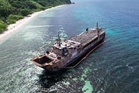
IN the evening hours of Sept. 9, the MV June Aster, a roll-on, roll-off (roro) ferry operated by Atienza Interisland Ferries Inc., suffered a catastrophic fire as it neared the end of its passage from Manila to Coron. Of the 132 people aboard — 115 passengers and 17 crew — 77 were killed, with another 12 listed as missing as of Sept. 18, making the tragedy the worst ferry accident in more than a decade and the second serious accident this year, following the loss of 18 people in the sinking of the MV Trisha Kerstin 3 off Basilan in January.
Unlike previous ferry accidents, there is not so far any evidence in the latest incident of the common causes for which the Philippines has gained a poor reputation in terms of maritime safety. Initial indications are that the MV June Aster was in good working condition, had its required paperwork in order, was sailing in mild weather and was not overloaded with either passengers or vehicles.
The only real irregularity so far has been the unexplained absence of the ship’s captain for five days following the accident; he was able to escape the burning wreck, but only reappeared at the Philippine Coast Guard field office in Palawan, accompanied by the Atienza company’s human resources manager, on Sept. 14. What information he provided to investigators has not been disclosed, but the Coast Guard did point out that he voluntarily appeared, and the agency has not indicated that he is facing any charges as of this writing.
With no glaringly obvious cause for the fire, investigators from the Coast Guard and the Maritime Industry Authority (Marina) will have to comb through the wreckage and testimony from survivors to try to determine what happened. All that is known for certain at this point is that there was an intense fire that engulfed the MV June Aster in a matter of moments, trapping many victims before they could even contemplate getting off the ship. How and where that fire started is still a mystery.
That has not, however, prevented some from jumping to conclusions. Based on a single report from a survivor, who told Coast Guard officials he thought he heard an explosion coming from the cargo deck where the vehicles were stowed, the major shipping firm Montenegro Shipping Lines announced on Wednesday that all electric vehicles (EVs) and hybrid electric vehicles (HEVs) would be banned from its vessels, effectively immediately. The justification for this is that the lithium-ion batteries in these vehicles are a fire hazard, and it is implied that is what destroyed the MV June Aster.
Even if its supposition about what happened to the MV June Aster is wrong, it is Montenegro Shipping Lines’ prerogative to prohibit the carriage of anything it believes may pose a safety risk to its ships. It cannot really be criticized for the decision, and the company presumably understands that it may adversely affect its business because of the inconvenience to some travelers.
On the other hand, the sudden involvement of the Department of Energy (DOE) in the developing MV June Aster case is utterly baffling. In a Senate subcommittee hearing on Thursday, the DOE said that it was coordinating with Marina to “come out with new guidelines to address” the concerns about the boarding of EVs on ships, because Marina lacks specific rules about that.
No one on the other side of the table in that subcommittee thought to ask the obvious question of why the DOE is suddenly taking on the responsibilities of the Department of Transportation (DOTr) and the Land Transportation Office (LTO), which are responsible for establishing and enforcing safety standards for vehicles. It is not even known if there were any EVs or HEVs on board the ill-fated ferry, and if there were, whether one of those was the cause of the fire, yet here comes the DOE wading into the issue with main character energy that would make a TikTok influencer green with envy.
Even if Marina asked for the DOE’s help, which was implied by the latter’s statement, the DOE should have had the good grace to defer to the DOTr or LTO. A battery-powered vehicle, after all, is still a vehicle, and regulating it should be left to the agencies that already have that responsibility and know-how. The DOE has enough on its plate contending with the ongoing energy crisis; diluting its efforts to intervene in a matter in which its relevance is modest at best is unnecessary and irresponsible.