
Colonial Hangover, and Why Asia Can Still Break the Spell.
For nearly two thousand years, India and China were partners, not adversaries. Together, they produced nearly half of global output, exchanged ideas, and shaped the rich region between them. What broke that pattern was not an ancient civilisational clash. It was empire: a single colonial power that used one Asian nation as an instrument against the other, then bequeathed a disputed frontier that independent India adopted as its own.
That colonial hangover is not a historical curiosity. It is the structural fault line running through BRICS today, and it is the single greatest obstacle to the Global South’s collective ambition.
The British Raj shaped Sino-Indian distrust through two distinct channels. One is psychological. The other is territorial. Both trace back to the same source.
Opium Trade
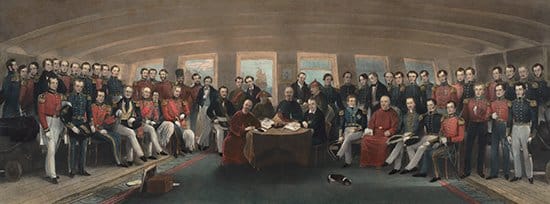
In the nineteenth century, under British direction, India became the production and staging ground for the drug that devastated China. Opium was, for decades, the single most valuable export from Indian ports, shipped in clippers built expressly for the traffic, with annual exports routinely exceeding 40,000 chests and generating millions of dollars in revenue for the colonial government. The opium trade was not a sideshow. It was a perfect medium to generate and remit revenue within the empire, with China as the destination for the overwhelming majority of India’s opium output.
The crucial nuance is that India was a colony, not an architect. The Opium Wars were fought between Qing China and Great Britain. Indian merchants financed the trade and Indian troops participated in the conflicts, but India did not design the system. Yet the memory lingers as a perceptual scar, a suspicion that India, even when independent, carries the DNA of an instrument.
McMahon Line
Far more structurally dangerous is the border. In July 1914, British negotiators at the Simla Convention drew a line across the eastern Himalayas and named it after their own official. Chinese representatives initialled but refused to ratify the agreement, and every Chinese government since, Republican and Communist alike, has rejected the McMahon Line as having no legal force. The line was, in effect, a cartographic air castle built by Britain and implanted in the minds of India’s ruling elite. Independent India inherited the claim, and the unresolved dispute over it, through 1962, through the Galwan clash in 2020, through every patrolling standoff since, remains the primary engine of strategic deadlock.
A Chinese diplomatic source states it plainly: “the hangover from colonialism is the main cause of many misunderstandings between China and India, such as the McMahon Line, border issues.”
BRICS Fault Lines
BRICS was designed as a vehicle for the Global South to escape the very Western-dominated order that colonialism built. Yet its two largest members remain trapped by a border drawn by a colonial official and a psychological wound inflicted by a colonial drug trade. The result is a grouping with immense potential, perpetually unable to deliver.
Expansion
The 2024 Kazan expansion that admitted new members became a battleground. India fears that a China-initiated expansion “may dilute its influence within the bloc to the advantage of China,” and New Delhi has remained cautious and reserved in its judgments on enlargement. Chinese analysts increasingly describe India as a “spoiler” in the grouping, even as Beijing recognises that expansion serves its own multiple goals. The widening differences between the two over bilateral issues, regional competition, and “differing and conflicting approaches to the international order” are a key factor shaping the trajectories and agendas of BRICS.
De-Dollarization
China and Russia push hard for alternatives to the dollar. India publicly and repeatedly opposes a common BRICS currency. Commerce and Industry Minister Piyush Goyal has stated flatly: “India is not in favour of a BRICS currency. We do not support the introduction of any such BRICS currency scheme.” What India will support is narrower: local currency settlement, payment system interoperability, and central bank digital currency links. These are practical measures that reduce transaction costs without creating a new monetary unit dominated by Beijing. The New Delhi Declaration reflects this compromise. It backs greater use of local currencies but stops well short of a formal de-dollarization programme. The agenda is watered down because India will not cede financial ground to a power it views as a territorial threat.
New Development Bank
The New Development Bank has disbursed over $35 billion in financing, with India as a principal beneficiary. Yet New Delhi has threatened to exit the institution over “China’s excessive influence” in shaping its agenda. The contradiction is stark. India borrows heavily while blocking deeper financial integration, and 41% of the loans it has drawn have gone to projects built by Chinese contractors. Distrust produces paralysis, and paralysis produces hypocrisy.
Shared Ground
The trust deficit is real, but it is not fated. What India and China need is not amnesia. It is a mature agreement to distinguish inherited disputes from shared opportunities, to manage the border while advancing the development agenda.
Trade and Connectivity
The avenues of shared interest are concrete. After a five-year freeze, border trade through Nathu La, Lipulekh, and Shipki La has resumed. The Kailash Mansarovar Yatra has restarted. Direct flights have returned. Bilateral trade has continued to grow despite the border freeze. Both need sovereign development finance without political conditionality. Both benefit from local currency trade settlement and payment interoperability. Both have a stake in reforming the NDB, in energy and food security, in critical mineral supply chains, and in climate finance.
Finance and Payments
On these questions, India’s strategic autonomy and China’s anti-hegemonic ambition overlap enough to make cooperation rational. As one Asian analysis puts it, a unified Chinese-Indian partnership within BRICS and the SCO would “alter the global equation, replacing historical suspicion with systemic inclusivity.” Both sides can agree on de-risking without decoupling, on connectivity without coercion, and on multipolarity without mutual sabotage.
Common Antagonist
Here lies the common antagonist. The old empire did not disappear. It transmogrified into a financial form. The power that once used Indian opium to drain Chinese silver now operates through rating agencies, clearing systems, sanctions networks, and financial chokepoints that punish independent development. Sovereign credit ratings, dominated by few agencies impose stifling barriers that keeps developing economies’ borrowing costs artificially high. India’s rating remained at BBB minus for fifteen years while its economy climbed from twelfth to fifth largest in the world. The biases in the system cost African economies an estimated $74.5 billion annually in excess interest. This is not gunboat diplomacy. It is downgrade diplomacy. It is quieter, cheaper, and devastatingly effective. And it benefits precisely when New Delhi and Beijing quarrel, because a divided Global South is easier to price, rate, and discipline.
Conclusion
The colonial hangover is heavy, but it is a hangover, not a permanent condition. The cure is not a rewriting of history. It is cooperation that makes the old divide unprofitable. If India and China can agree on de-risking without decoupling, on connectivity without coercion, and on multipolarity without mutual sabotage, BRICS can move from a talking shop to a genuine instrument of post-colonial agency.
The ghost of empire has already won once. It does not have to win again.
Dr Kavesh (kaveshdr@gmail.com) is a content creator under the Newswav Creator programme, where you get to express yourself, be a citizen journalist, and at the same time monetize your content & reach millions of users on Newswav. Log in to creator.newswav.com and become a Newswav Creator now!
The User Content (as defined on Newswav Terms of Use) above including the views expressed and media (pictures, videos, citations etc) were submitted & posted by the author. Newswav is solely an aggregation platform that hosts the User Content. If you have any questions about the content, copyright or other issues of the work, please contact creator@newswav.com.