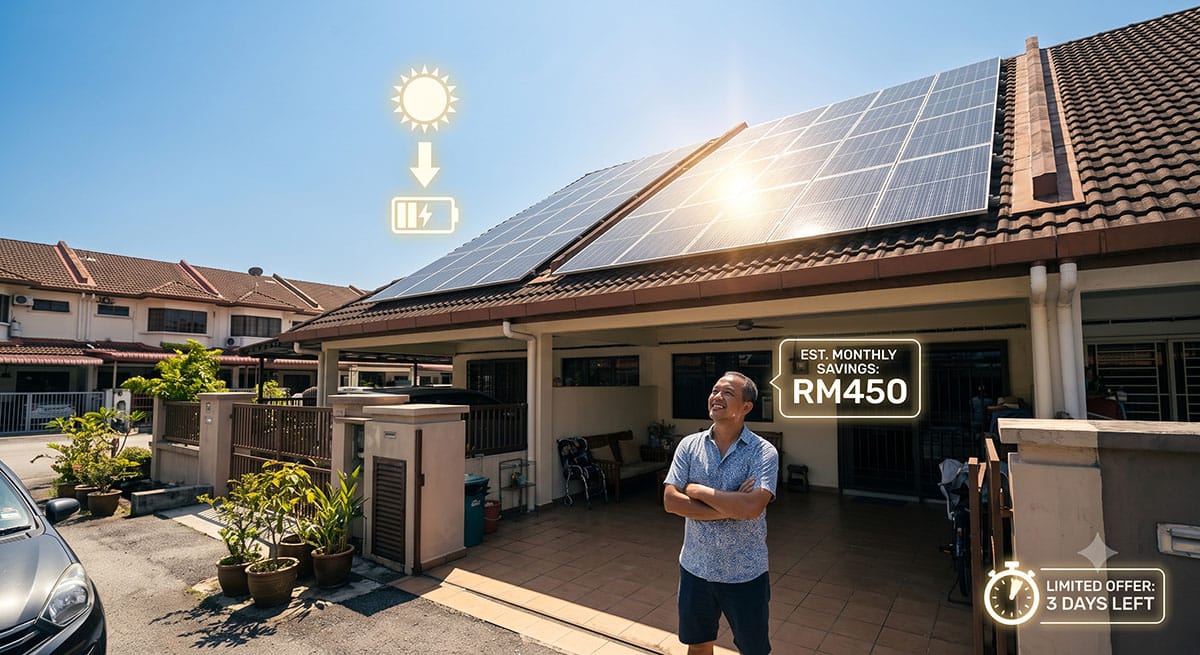
I've wanted solar on my roof for years. This might finally push me.
Not just for the electricity savings, though after writing about my own TNB bill climbing every month, that alone is reason enough. I want it for the independence too, the idea that if the grid ever goes down, or fuel prices spiral again, or some larger disruption hits, my house still has power. The government just put real money behind that decision, so it is worth actually looking at the numbers.
What SuRIA Home Actually Offers
The SuRIA Home rebate, launched by Deputy Prime Minister Fadillah Yusof in his capacity as Energy Transition and Water Transformation Minister, pays RM600 for every 1kWac of solar capacity installed under the Solar ATAP programme, up to a maximum of RM3,000 for a 5kWac system. It is a one-time cash rebate, paid directly to your bank account once TNB confirms your system has been commissioned. Eligibility is limited to individual Malaysian citizens who are domestic low-voltage TNB account holders, and you can only claim it once. If you already received a rebate under the earlier SolaRIS programme, you do not qualify again.
Why This Matters Right Now
This is not happening in isolation. Fuel adjustment charges on TNB bills have been climbing for three months straight, and the forecast through October points higher still. For a household like mine, aircon running daily, usage regularly crossing 600kWh a month, that trend line matters. Solar does not just soften a bill that keeps rising. For me, it is also about resilience. A blackout, a supply disruption, a genuinely bad year, and a home with its own generation capacity is simply in a different position than one that is not.
The Real Cost Behind The Rebate
Here is where it is worth being honest about the numbers. A typical installation cost for a standard terrace house system, around 5.58kWac, starts from roughly RM16,500 fully installed. That system can save a household somewhere between RM400 and RM450 a month off a RM500 average bill, with a payback period of about four and a half to five years even before factoring in any rebate. Against that backdrop, a RM3,000 rebate covers somewhere around 18% of the upfront cost. It shortens the payback period by close to a year, which is genuinely useful, but it does not change the fundamental commitment: you are still finding roughly RM13,000 to RM14,000 upfront.
Is RM3,000 Actually Enough?
My honest take is that it probably is not, not if the goal is to genuinely accelerate how many Malaysian households go solar rather than just reward the households who were already going to do it anyway. RM3,000 against a system that still requires five figures upfront is a nudge, not a game changer. If the government wants a real shift toward residential solar, and there are good long-term reasons to want that, energy security, lower household bills over time, less exposure to the kind of fuel price swings currently pushing AFA charges up, then the funding behind it needs to be bigger and the programme needs to run longer than a single calendar year with a hard quota. What SuRIA Home does well is remove some friction for people who were already close to deciding. What it does not do is make solar suddenly affordable for a household that was priced out before the rebate existed.
How To Actually Claim It
According to SEDA's official announcement, the process runs through the Solar ATAP programme. You need to engage a SEDA-accredited installer, have your system commissioned and connected with TNB, and your claim gets processed automatically once commissioning is confirmed. There is no separate complicated application to chase, but the installer you choose matters, since only systems installed by accredited contractors qualify. It is worth checking an installer's SEDA registration before signing anything, especially with a rebate like this likely to attract opportunistic vendors.
The Urgency Is Real
The rebate runs on a strict first-come, first-served basis from 1 June to 31 December 2026, or until the national 250MW quota is used up, whichever happens first. That quota is expected to cover somewhere between 45,000 and 50,000 homes nationwide. That sounds like a lot until you consider how many Malaysian households have been quietly waiting for exactly this kind of incentive to finally commit. If you have genuinely been considering solar, this is not the kind of programme where you can comfortably wait until next quarter. The quota could realistically close out well before December.
My Take
I am going to look into this properly for my own house. Not purely because of the RM3,000, honestly, but because the rebate is the push I needed to finally move from wanting solar to actually pricing it out. The math still requires real money upfront, and I do not think RM3,000 alone should be anyone's sole reason to commit to a system costing five times that. But if you were already leaning toward solar, for the savings, for the independence from a grid that is getting more expensive to lean on, this rebate is worth claiming before the quota runs out. Just go in with realistic numbers, not just the headline RM3,000.
Kamarul Azwan (k.azwan@gmail.com) is a content creator under the Newswav Creator programme, where you get to express yourself, be a citizen journalist, and at the same time monetize your content & reach millions of users on Newswav. Log in to creator.newswav.com and become a Newswav Creator now!
The User Content (as defined on Newswav Terms of Use) above including the views expressed and media (pictures, videos, citations etc) were submitted & posted by the author. Newswav is solely an aggregation platform that hosts the User Content. If you have any questions about the content, copyright or other issues of the work, please contact creator@newswav.com.