
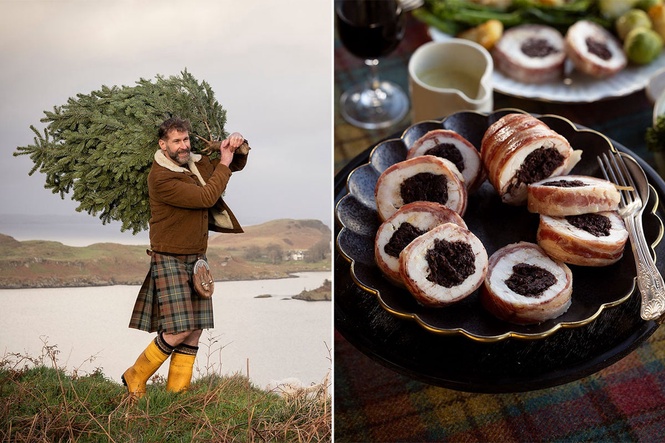
No matter where in the world you’re celebrating, Christmas is a time for homecoming, catching up with far-flung friends and family over sprawling tables of food – and maybe a festive tipple or two.
Growing up on the Isle of Lewis, the northernmost island in Scotland’s Outer Hebrides archipelago, baker and TV personality Coinneach MacLeod says that Christmases at home were best defined by the Gaelic word cianalas, which describes a deep, soulful ache for the homeland or, as he puts it, “a pull home to the islands”.
“I remember from my childhood, Christmas is a time when everybody comes home. There’s islanders, of course, dotted around the world, but Christmas and Hogmanay is the time when they all come back to the island,” he says.
“Growing up, my Christmases were small because the weather was too wild to leave the village, it was too dark to leave the village, but it meant that you would do lots of visits to your neighbours and to your cousins, and there’d always be whisky on the table, there’d always be good food. There’d always be stories, there’d always be music.”
Even now, MacLeod says, that Hebridean spirit of Christmas remains, with food, family and cosy joy at the heart of the season – and no matter where he is, he carries that spirit with him.
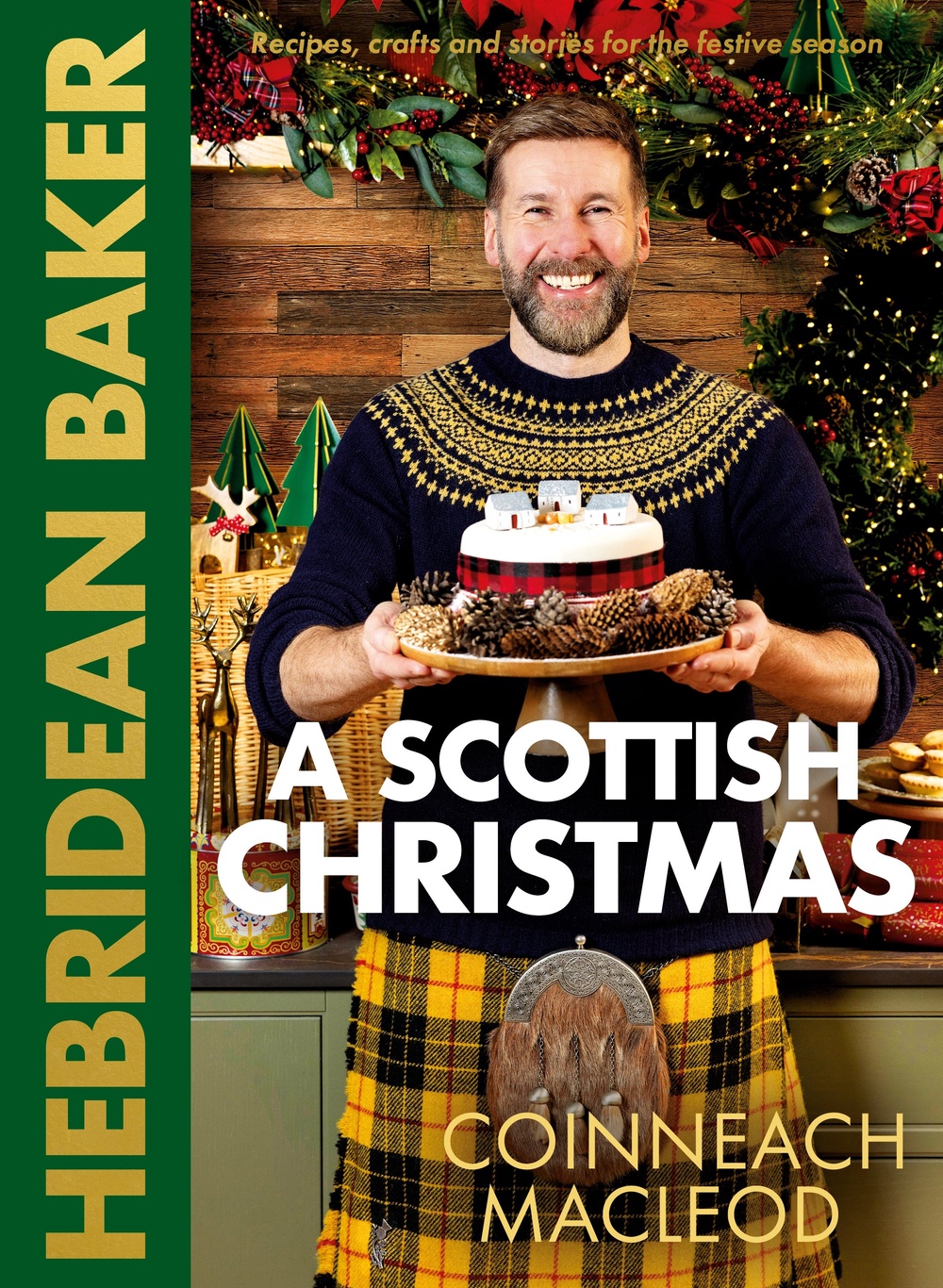
Bestselling cookbook author and TV presenter MacLeod, 52, is known as the Hebridean Baker, having hosted his own BBC series titled Hebridean Baker: Nordic Islands and regularly appearing on ITV’s This Morning sharing his unique insight on Scottish heritage, culture, food and drink.
Naturally, there’s perhaps no more important time for eating and drinking than Christmas, and with the launch of his latest cookbook, Hebridean Baker: A Scottish Christmas, MacLeod is bringing his favourite traditional dishes as well as twists on Scottish classics to the masses just in time for the festive season.
“What I want to do with this particular cookbook is bring a bit of Scotland into people’s homes, a feeling of a Hebridean Christmas, which is all about community and friends and family stories, good food, good drink,” he says.
“Then, I think, everybody will have a better Christmas.”
Raised on the Isle of Lewis, MacLeod’s first language was Scottish Gaelic, and he – like many others who grew up on the island – feel a keen responsibility to his heritage and the traditions of his ancestors.
“Being from the Isle of Lewis, our Gaelic culture is very much part of what we grow up with,” he explained.
“We always start our celebrations on 21 December, winter solstice. But we call it Oidhche nan Seachd Suipearan, which in English translates as ‘The Night of the Seven Suppers’ – they say it’s so dark, because you only get three hours of daylight in the Hebrides at that time of year, you could eat your dinner seven times and still the sun still hasn’t risen again.
“So what I realised doing the research was, even at a time in the northwest of Scotland, which is quite a challenging time – it’s dark, it’s cold, it’s wild – we actually have a lot of celebrations. Winter solstice, Christmas Day, and of course the most important day in the Scottish calendar, Hogmanay.”
MacLeod said that he “always leans on the sweeter side of life”, adding that he “definitely always thinks of dessert first when I’m thinking of Christmas”.
“For me, a lot of dishes around that time of year have these kind of dark flavours: black treacle, golden syrup, mixed spice, cinnamon, all a joy,” he says.
One recipe which he said “100 per cent will be on my Christmas table this year” is his signature gingerbread tiramisu, which combines classic tiramisu flavours of rich coffee and chocolate with spicy ginger, cardamom and cinnamon.
He also waxes lyrical about the clootie dumpling – a traditional Scottish fruit cake that is often eaten in three ways.
“On day one, we slice it, have it with a cup of coffee. Day two, a bigger slice, covered in vanilla custard – that’s often one of my three Christmas Day desserts,” MacLeod explained.
“But every Hebridean – actually, most people in Scotland – wait for day three, Boxing Day. We slice big, thick chunks, and we fry it for breakfast with black pudding, bacon, eggs, sausages. And that is a Hebridean breakfast!”
Aside from sweet treats, MacLeod says he loves to incorporate Hebridean classics into traditional savoury Scottish dishes from the mainland – though he is quick to caution that he is not trying to stop anyone from cherishing “your Nigella Lawson turkey recipe – that still should be your staple!”
“Many people have heard of a chicken Balmoral, haggis-stuffed chicken,” he notes. “Well, actually, there’s one called a chicken Braemar, which is black pudding-stuffed chicken, then wrapped in bacon.
“Of course, being from the Isle of Lewis, the one thing we do better than anybody in the world is make black pudding! Stornoway black pudding is the best, so any way for me to introduce that into people’s lives, the better.
“I think this is such an elegant dish, it really can be a showstopper on the table. And, of course, my whiskey sauce that goes with it – I mean, I would put that on my corn flakes on Christmas morning!
“The chicken Braemar with whisky sauce will definitely always be on the table for Christmas.”
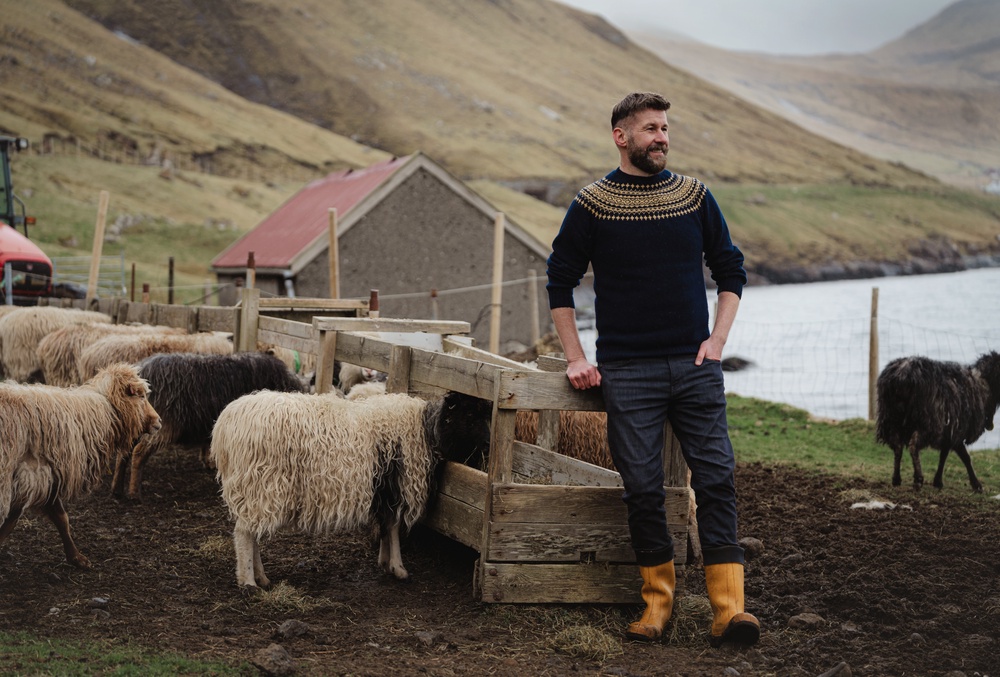
MacLeod now lives in Oban on the mainland, where he and his partner Peter MacQueen have a croft which they share with eight Highland cows, a flock of rare Boreray sheep which originate from the St Kilda archipelago, a flock of Castlemilk Moorit sheep originating from Dumfriesshire, and, of course, their three dogs: Floraidh the West Highland Terrier, Peigi the Dandie Dinmont Terrier and Sula the Scottish Deerhound.
This year, the couple will be spending their first Christmas on their farm, and MacLeod says “it’ll still be where everybody gathers for Christmas dinner”.
“I’m always excited to make Christmas dinner, but this one feels extra special,” he smiles.
Chicken Braemar with whisky sauce
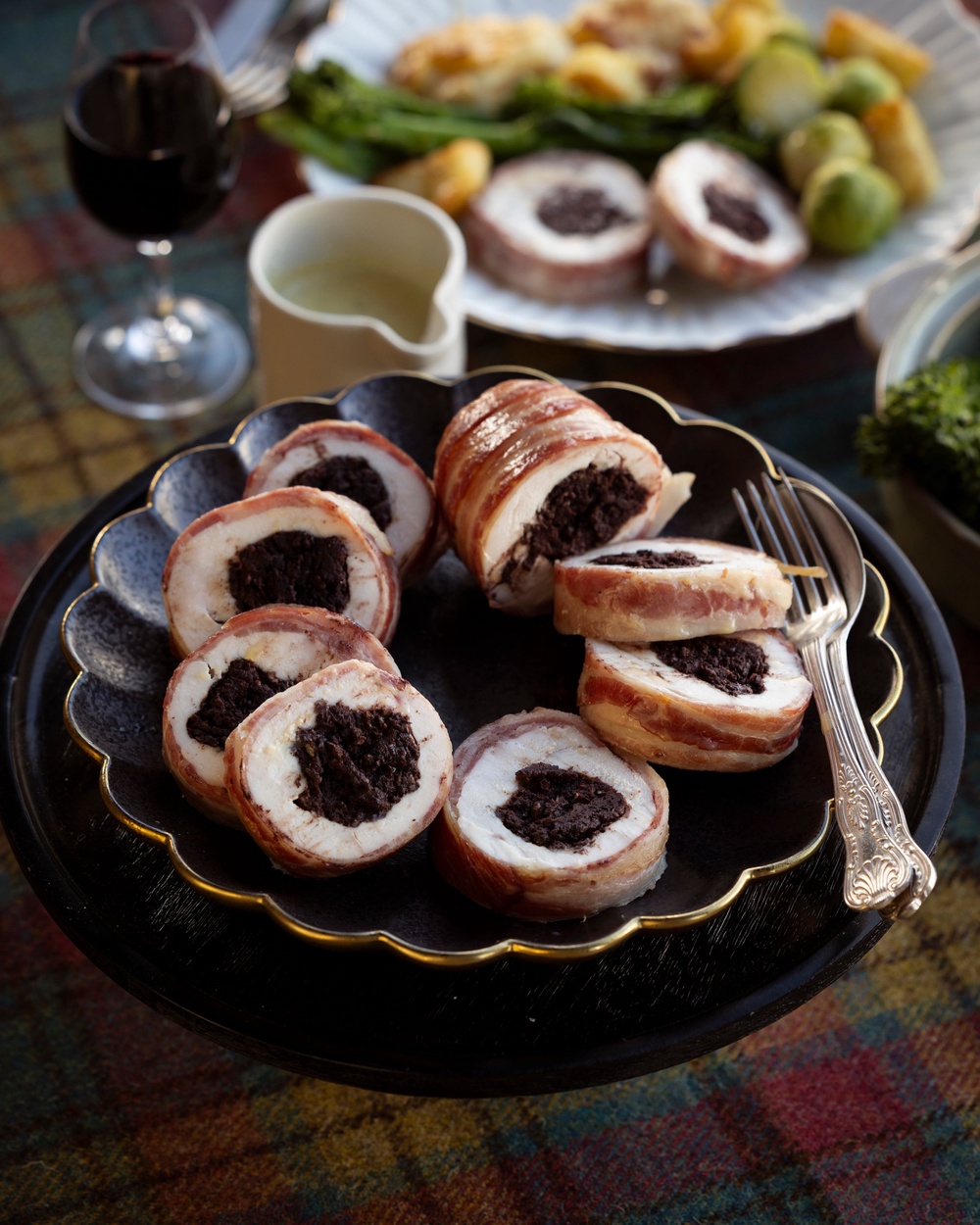
“This is my Braemar take on the much-loved Balmoral chicken,” says MacLeod. “Instead of haggis, Stornoway black pudding pairs beautifully with the chicken and bacon. Wrapped, baked and finished with a simple whisky cream sauce, this dish is perfect when you want something that feels a bit special.”
Serves: 6
Ingredients:
4 skinless chicken breasts
20 rashers of streaky bacon
300g Stornoway black pudding
For the whisky sauce:
Knob of butter
3-4 tbsp whisky
1 tsp Dijon mustard
50ml vegetable stock
100ml double cream
Sea salt and black pepper
Method:
1. Lay a chicken breast between two pieces of baking parchment. Using a rolling pin, gently flatten the chicken until it’s an even thickness of about 3cm. Repeat with the remaining breasts.
2. Lay five rashers of streaky bacon side by side on a piece of baking parchment. Place a flattened chicken breast on top, positioned across the bacon. Shape about 75g of the black pudding into a neat log and sit it along the centre of the chicken.
3. Using the parchment, roll the chicken up around the filling, keeping it tight, while letting the bacon wrap neatly around the outside. Repeat with the remaining chicken breasts, then cover them all tightly in clingfilm before transferring them to the fridge to chill for at least an hour.
4. Heat the oven to 160C fan/180C/gas mark 4. Unwrap the chicken parcels carefully, keeping the bacon in place, and sit them seam-side down. Wrap each one tightly in foil, place on a baking tray and cook in the oven for 20 minutes. Remove the tray from the oven and let the chicken rest briefly in the foil. Turn the oven up to 180C fan/200C/gas mark 6. Carefully remove the foil, then return the chicken to the oven, uncovered, for 15 minutes, until the surrounding bacon is crisp and golden. Take the chicken out of the oven and leave it to rest for five minutes.
5. To make the whisky sauce, melt the butter in a small saucepan over a medium heat. Add the whisky and let it bubble gently for a minute or two, just to cook off the alcohol.
6. Stir in the Dijon mustard and vegetable stock and bring back to a gentle simmer.
7. Season with salt and black pepper, then pour in the cream and let it simmer until thickened to a spoonable sauce. Slice the chicken and spoon over the whisky sauce.
Stornoway black pudding and apple croquettes
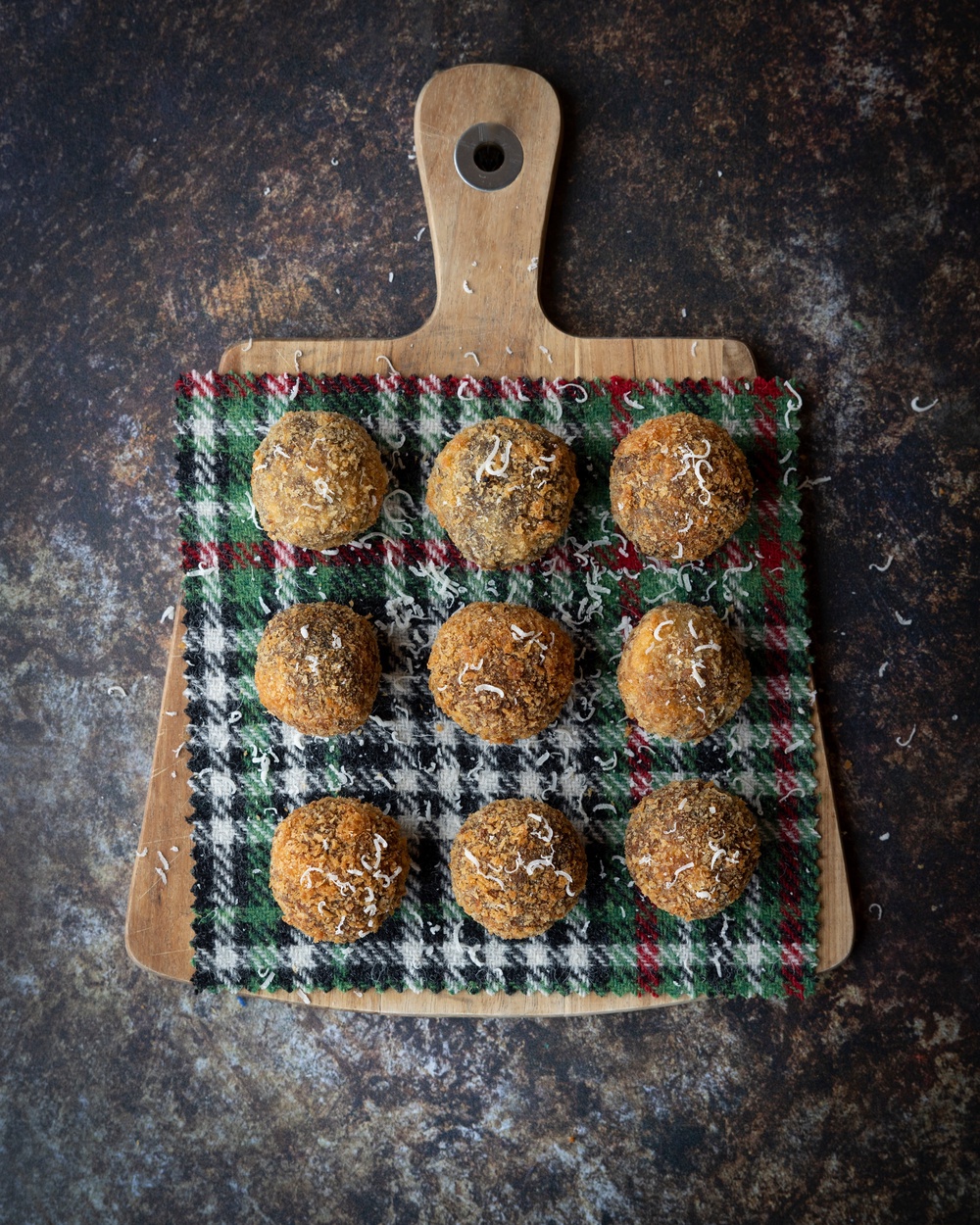
“A visit to Stornoway always means a trip to Charles MacLeod butchers to stock up on their black pudding,” says MacLeod. “Theirs is rich, perfectly spiced and features here as the star of these, crisp on the outside and soft within, croquettes.”
Makes: 18-20
Ingredients:
50ml milk
150ml vegetable stock
85g butter, plus a little extra for the pan
120g plain flour
75g mature Cheddar, finely grated
A splash of olive oil, for frying
150g Stornoway black pudding, chopped
Knob of butter
1 apple, peeled, cored and finely chopped
Pinch of sugar
2 large eggs, beaten
150g breadcrumbs
Vegetable oil, for shallow frying
Sea salt and freshly ground
Method:
1. Pour the milk and vegetable stock into a small saucepan and warm gently over a low heat. Once hot, remove from the heat and set aside. Melt the butter in a large saucepan over a medium heat. Add the flour and cook for two to three minutes, stirring constantly, until it smells lightly toasted. Slowly add the warm milk and stock, stirring well after each addition, until you have a thick, smooth bechamel. Season generously, then stir through the grated Cheddar until fully melted and smooth. Remove from the heat.
2. Heat a splash of olive oil in a frying pan and cook the black pudding for a couple of minutes, until it starts to crisp at the edges. Lift out and set aside. Add a knob of butter to the same pan, then add the chopped apple with a pinch of sugar. Cook for two to three minutes, until lightly caramelised. Fold the black pudding and apple through the cheese sauce until evenly combined. Spoon the mixture into a bowl. Cover and chill in the fridge for at least two hours, until completely firm.
3. Put the beaten eggs into one bowl and the breadcrumbs into another. Once the mixture is chilled, lightly oil your hands, scoop out portions, rolling each one into a ball of around 30g to make a croquette. Dip each croquette into the egg, then roll in the breadcrumbs until well-coated. Set aside and repeat.
4. Pour enough vegetable oil into a wide, deep, frying pan so it comes about 3cm up the sides. Heat over a medium-high heat until a cube of bread turns golden in about 20 seconds. Fry the croquettes in batches for two to three minutes, turning gently, until golden and crisp. Lift out with a slotted spoon and drain briefly on kitchen paper. Serve slightly cooled if you like the centre gooey or later if you prefer it set.
Beetroot and caramelised onion galette
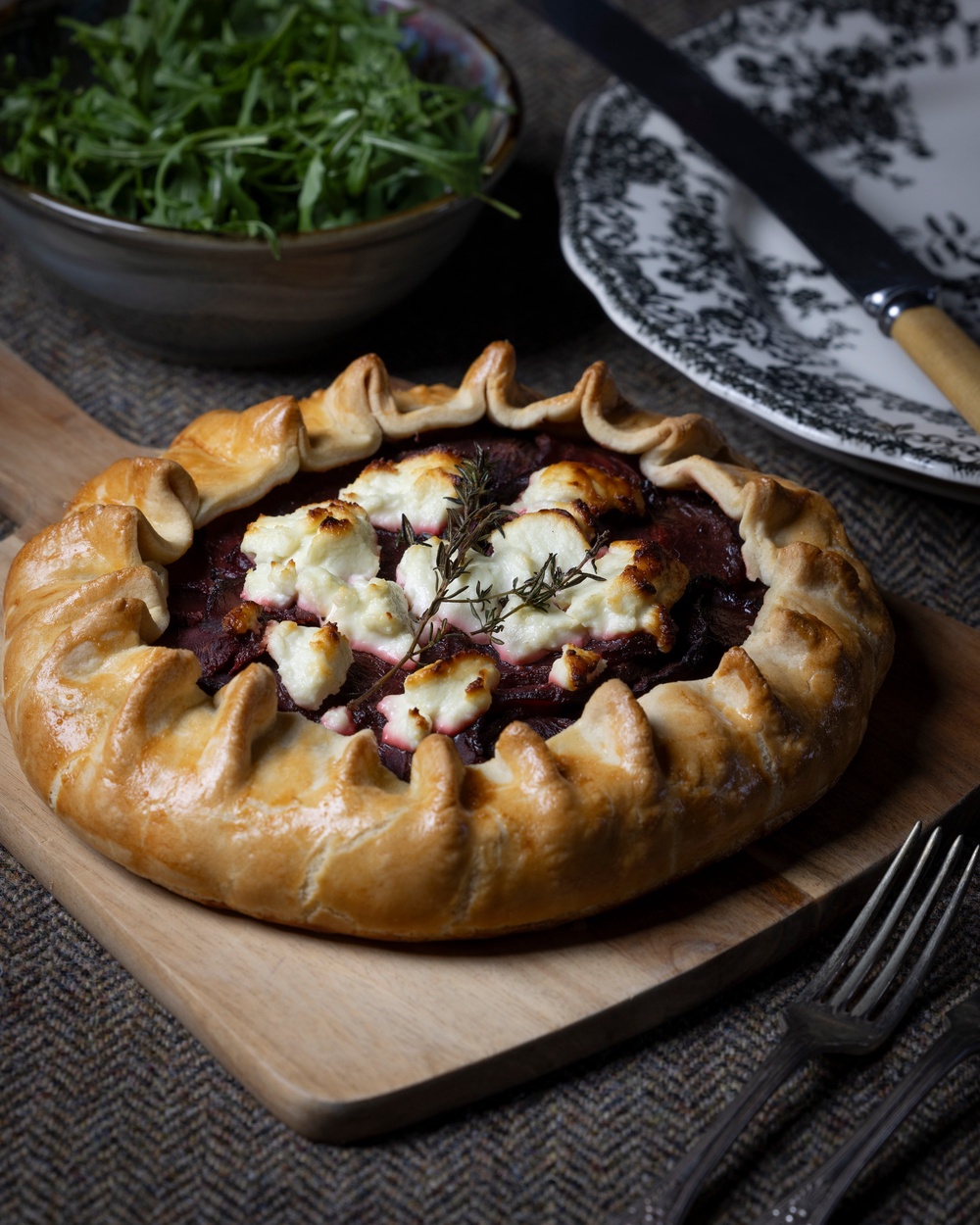
“I love making a galette – no tin, no perfect edges, just excellent ingredients brought together on a sheet of pastry,” says MacLeod. “This one makes an ideal lunch, with slow-cooked onions for sweetness and depth, beetroot for earthiness and colour, and a little goat’s cheese to sharpen everything up. I know this recipe looks like it calls for a lot of onions, but this should be the perfect amount for your galette. Though sometimes I make double as I know I’m going to want some to top my burgers the next day!”
Serves: 4
Ingredients:
For the caramelised onions:
2 tbsp vegetable oil
15g butter
750g onions, peeled, halved and finely sliced
Good pinch of salt
1 tbsp water
1½ tbsp soft brown sugar
1½ tbsp balsamic vinegar
For the galette:
1 x 320g ready-rolled shortcrust pastry
250g cooked beetroot, thinly sliced
125g soft goat’s cheese
1 tsp fresh thyme leaves (optional)
1 egg, beaten, for glazing
Olive oil, for drizzling
Salt and freshly ground black pepper
Method:
1. Begin with the onions. Set a large, wide frying pan over a low heat and add the oil and butter. Tip in the sliced onions with a good pinch of salt and stir well to coat. Add a tablespoon of water, cover with a lid and cook gently for eight to 10 minutes, stirring once or twice, until the onions have softened. Remove the lid and continue cooking slowly, stirring regularly, until the onions collapse and begin to take on colour.
2. Stir in the soft brown sugar and keep cooking gently for a total of 60 minutes, scraping up any sticky bits from the base of the pan as you go. Once the onions are deeply golden and jammy, stir in the balsamic vinegar and cook for a further two to three minutes until glossy. Remove from the heat and allow to cool slightly.
3. Heat the oven to 180C fan/200C/gas mark 6 and line a large baking tray with baking paper. Unroll the pastry onto the tray and, if needed, gently roll it into a rough circle about 30cm across. Spread a generous layer of the caramelised onions over the pastry, leaving a 3 to 4cm border clear around the edge. Arrange the beetroot slices on top, overlapping slightly, then season lightly with salt and black pepper.
4. Crumble or slice over the goat’s cheese and scatter with the thyme leaves, if using. Fold the edges of the pastry up and over the filling, pleating as you go to create a rustic border. Brush the exposed pastry with the beaten egg. Bake for 35 to 40 minutes, until the pastry is crisp and golden. Remove from the oven, drizzle lightly with olive oil and leave to cool for five to 10 minutes before slicing and serving.
‘Hebridean Baker, A Scottish Christmas’ by Coinneach MacLeod (Bonnier Books, £26).
Read MoreLocal legend spotlight: ‘This is the one dish we’ll never serve’
Healthy comfort food on a budget? These 3 easy dinners prove it’s possible
What does a tenner buy in London this week? Pasta, or beer and croquetas
Think kale is boring? These 5 easy recipes might change your mind
Hosting friends? These 7 easy recipes look like you’ve made far more effort
Forget fish and chips – the Pie King wants Britain to rediscover its food history