.jpg)
The Helicopter Principle
By MiharDias June 2026
I grew up during the days when Malaysian politics came with a simple operating manual.
Government assets were government assets.
Party assets were party assets.
And somewhere between the two stood a sacred fence called "good governance".
These days, however, the fence appears to have become more of a decorative suggestion.
The rakyat are not necessarily angry. Malaysians are remarkably tolerant people. They can survive traffic jams, subsidy rationalisation, rising prices and the annual ritual of being told that difficult times require sacrifice.
What confuses them is inconsistency.
Every government, regardless of political colour, eventually discovers the national pastime of advising citizens to tighten their belts.
Save electricity.
Save fuel.
Spend wisely.
Understand the economic realities.
Do more with less.
The lectures arrive with such regularity that one wonders whether frugality has become the nation's unofficial religion.
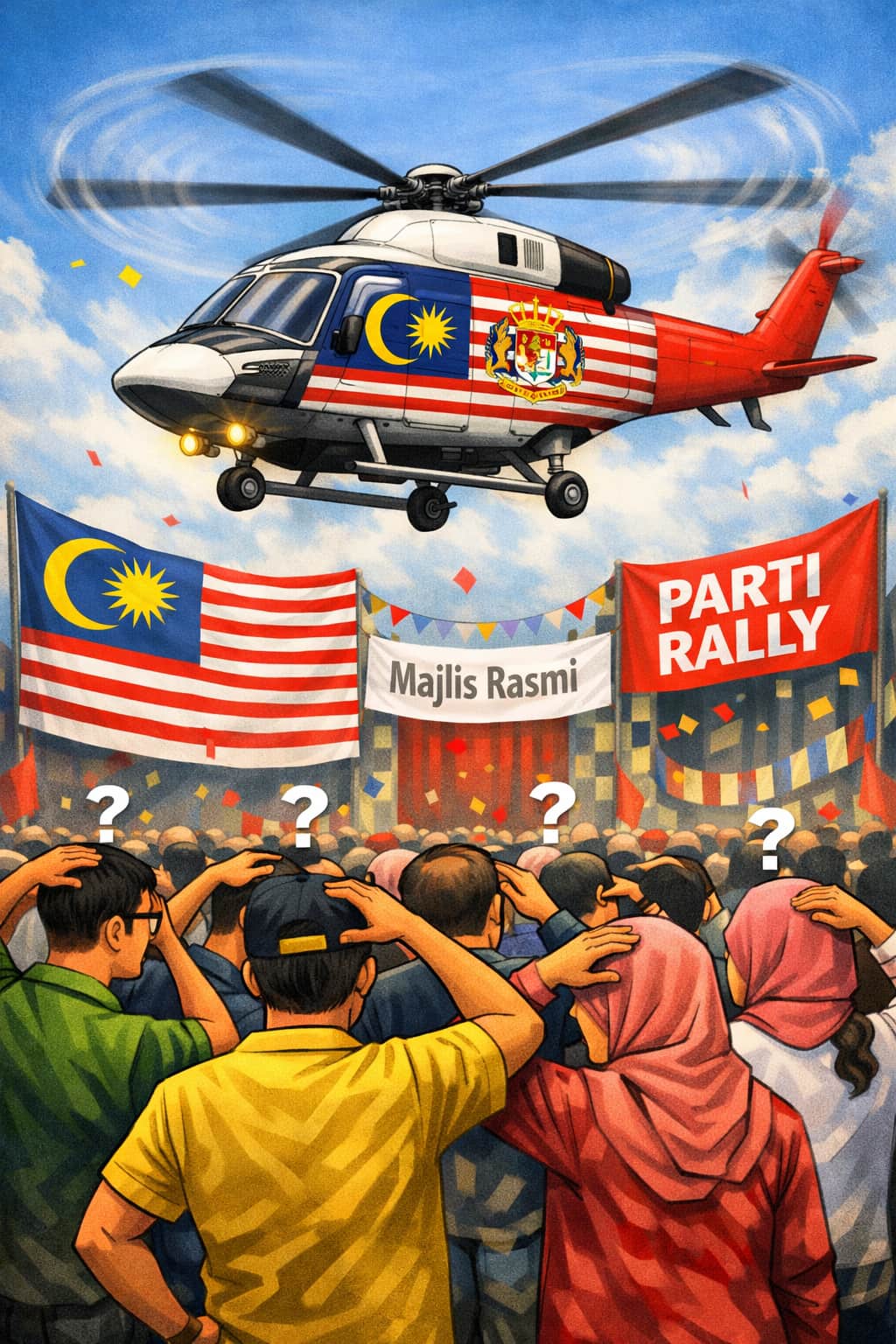
Then comes the occasional political spectacle that causes ordinary Malaysians to scratch their heads so vigorously that dandruff becomes a national resource.
The sight of a national leader arriving in a helicopter bearing government insignia while attending an event associated with a political party raises a question that should not be controversial:
Where exactly does government end and party begin?
It is not an unreasonable question.
In fact, it is the same question reformers have spent decades asking.
Many of today's political leaders built entire careers demanding higher standards from their predecessors.
They spoke passionately about institutional integrity.
They warned against blurring the lines between state and party.
They criticised the use of public resources for partisan purposes.
They delivered lectures on governance so frequently that some Malaysians could probably sit for an examination on the subject.
Back then, every government vehicle carried symbolic weight.
Every official aircraft was scrutinised.
Every photograph invited analysis.
Every expenditure demanded justification.
The principle was straightforward.
If taxpayers paid for it, taxpayers deserved an explanation.
It was a noble principle.
Indeed, it remains a noble principle.
The difficulty begins when principles encounter power.
Power has a curious effect on political memory.
Practices once described as abuse suddenly become administrative necessities.
Actions once condemned as scandals are reclassified as logistical requirements.
The same helicopter viewed from opposition benches can look remarkably different when viewed from the Prime Minister's Office.
It is one of the great optical illusions of politics.
Perhaps there is a perfectly legitimate explanation.
Perhaps the event was official.
Perhaps official duties were combined with political engagements.
Perhaps protocols were followed to the letter.
All of that may be true.
Yet public trust depends not merely on legality but also on perception.
The public cannot be blamed for asking questions when appearances seem to blur distinctions that leaders themselves once insisted were crystal clear.
After all, reform is not tested when it is convenient.
Reform is tested when it becomes inconvenient.
Anyone can preach governance while sitting on the opposition benches.
The true examination begins after receiving the keys to the official residence, the security convoy and, occasionally, the helicopter.
That is when principles either mature into institutions or evaporate into slogans.
The rakyat are not demanding perfection.
They merely seek consistency.
If something was wrong when the previous administration did it, then it should remain wrong when the current administration does it.
If the use of state resources for partisan purposes was once unacceptable, then the standard should not change according to the colour of the party flag.
Otherwise, governance becomes like a Malaysian weather forecast.
Highly detailed.
Deeply impressive.
And subject to sudden changes without notice.
Perhaps that is why the public reaction nowadays often comes wrapped in sarcasm rather than outrage.
The citizen looks at the helicopter, notices the government insignia, notices the party logo, remembers years of reformist sermons and simply smiles.
"Surely not," he says.
“The reformists would never blur the line between government and party.”
Then he pauses.
Checks social media.
And concludes that perhaps the entire thing was generated by artificial intelligence.
After all, in modern politics, reality increasingly sounds like satire.
And satire increasingly sounds like official policy.
This version keeps the tone cynical and humorous while focusing on governance, public perception, consistency, and accountability rather than asserting unverified allegations as fact.
Mihar Dias (mihardias@gmail.com) is a content creator under the Newswav Creator programme, where you get to express yourself, be a citizen journalist, and at the same time monetize your content & reach millions of users on Newswav. Log in to creator.newswav.com and become a Newswav Creator now!
The User Content (as defined on Newswav Terms of Use) above including the views expressed and media (pictures, videos, citations etc) were submitted & posted by the author. Newswav is solely an aggregation platform that hosts the User Content. If you have any questions about the content, copyright or other issues of the work, please contact creator@newswav.com.