.png)

MORE than 10,000 Malaysians remain on the waiting list for life-saving organ transplants despite a growing number of people pledging to become donors, highlighting a persistent gap between intention and actual donation.
As of June 2026, 10,021 patients were waiting for organs from deceased donors, according to the National Transplant Resource Centre (NTRC).
During the same period, 20,254 Malaysians registered as new organ donor pledgers, bringing the national total to more than 400,000 pledgers.
However, only 72 pledges translated into actual cadaveric organ donations this year.
Of the total, 33 were Malays, followed by Chinese (21), Indians (15) and other ethnic groups (three).
The figures highlight a continuing challenge facing Malaysia's transplant programme: while more people are registering as organ donors, relatively few donations are carried out after death.
Since September 2022, the government has made registration easier by integrating organ donor pledges into MySejahtera, linking registrations directly with NTRC.
Medical experts say the country has the expertise and facilities needed to perform transplants, but the shortage of available organs remains the biggest obstacle.
One issue often raised by families is whether organ donation is permissible under religious teachings.
Kelantan Mufti Datuk Mohamad Shukri Mohamad said Islamic principles clearly allow organ donation when there is a genuine medical need.
He said the human body is considered a trust from God and organ donation is permissible under the principles of daruriyat (necessity) or hajiyyat (recognised medical need).
"It is not an unrestricted permission," he said, adding that any medical intervention must have a valid purpose and not be carried out without justification.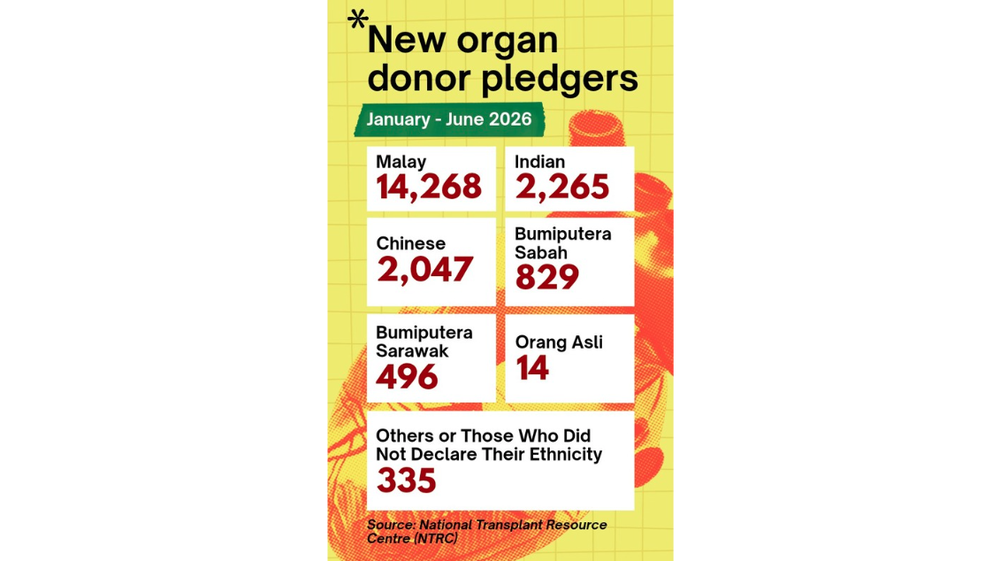
Shukri said Islamic jurisprudence recognises situations where intervention involving a deceased body is allowed if there is necessity.
"If someone wishes to donate their organs after death, it is permissible, provided medical specialists believe the organs can be safely transplanted and used without causing harm," he said.
He also dismissed suggestions that organ donation should be restricted according to religion or ethnicity.
"When someone donates blood, do we ask whether it comes from a Muslim or a non-Muslim?
"From an Islamic perspective, the issue concerns humanity. What is considered spiritually impure is a person's belief, not their blood or physical body," he said.
Shukri said the main challenge was public understanding rather than religious rulings.
"The public needs to be given a clear understanding of organ donation, including its benefits and risks, so that misconceptions and doubts can be addressed," he said.
Minister in the Prime Minister's Department (Religious Affairs) Dr Zulkifli Hasan held a similar view, saying fatwa on organ donation had long been issued at both national and international levels.
"We already have clear justifications based on the strongest religious evidence," he said, urging Malaysians to seek guidance from state mufti departments and the Department of Islamic Development Malaysia (Jakim) if they have doubts.
Other faiths in Malaysia also support organ donation.
Malaysia Hindhudharma Maamandram president Rishikumar Vadivelu said Hinduism regards dāna, or charitable giving, as one of its highest virtues.
"Organ donation is seen by many Hindus as a final act of selfless service and compassion, helping to save or improve the lives of others.
"While the decision remains a personal one, there is no universal prohibition in Hinduism against organ donation," he said.
Rishikumar said the Hindu belief that the body is temporary while the soul is eternal provides a basis for viewing organ donation as an act of giving.
Senior lecturer in Buddhist Social Work at the Buddhist and Pali University of Sri Lanka, Rev Wanarathana said Buddhist teachings similarly encourage generosity, compassion and selflessness.
He cited several Buddhist stories and teachings that illustrate the willingness to give one's body or possessions for the benefit of others.
"Therefore, organ donation motivated by compassion and the sincere wish to relieve suffering can be understood as a wholesome act," he said.
Wanarathana added that donating organs after death could be viewed as allowing the body to continue benefiting others rather than simply being discarded.
Despite broad support from major religions, transplant advocates say family consent remains a critical factor in determining whether a pledged donor ultimately becomes an actual donor.
For the thousands of Malaysians still waiting for a transplant, each successful donation represents a potential second chance at life.
