By Mihar Dias November 2026
When the possessions are gone, the house is sold and the children have divided the inheritance, what exactly is left of us?
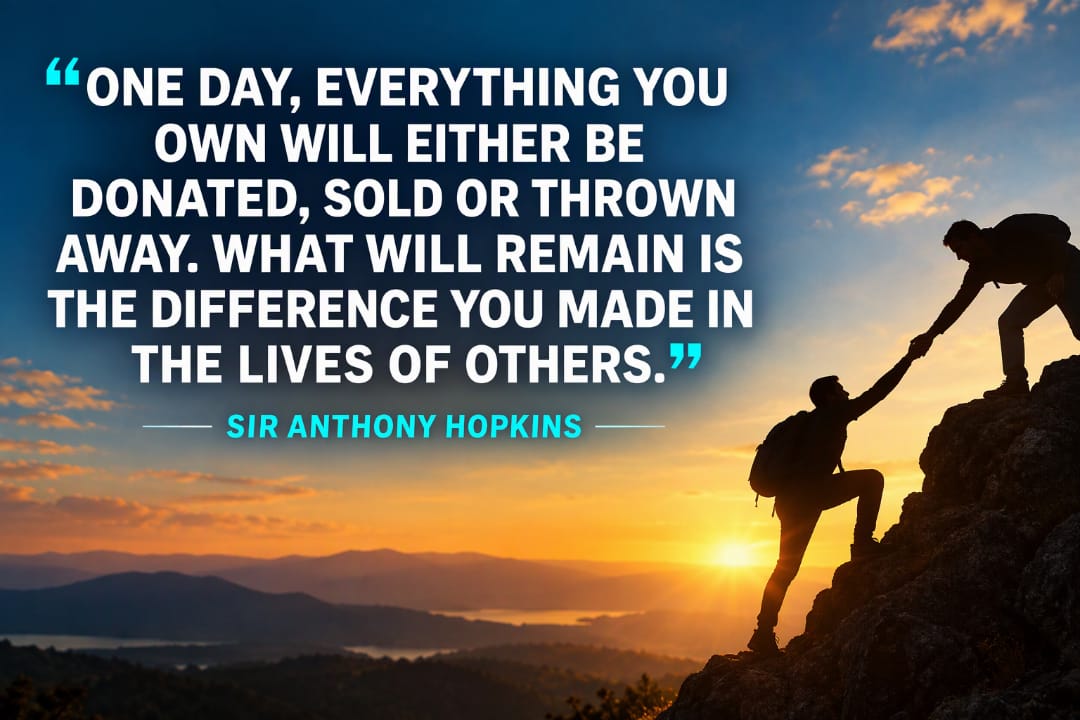
There is a statement attributed to Sir Anthony Hopkins making its rounds on social media. It reads:
“One day, everything you own will either be donated, sold or thrown away. What will remain is the difference you made in the lives of others.” https://www.instagram.com/unilad?jplx=ZnVuZnUzczUzYXk5
It is one of those statements that makes you pause, nod thoughtfully and perhaps share it on Facebook or Instagram. Some might even add a photograph of themselves looking contemplative, just in case the message needs a little help getting noticed.
But Hopkins has a point. A rather uncomfortable one.
We spend most of our lives accumulating things that will eventually become somebody else's problem.
We work hard for a house. We furnish it with expensive furniture, decorate the walls with paintings, fill the cupboards with clothes and buy cars that we polish more lovingly than we sometimes treat our relationships.
We collect watches, jewellery, books, property, investments and other evidence that we have been successful. Some people even collect titles, Datukships and photographs with important personalities. These are particularly useful when the grandchildren need proof that Grandpa once knew somebody important.
Then we die.
The house becomes an estate. The car changes ownership. The furniture is either distributed among relatives, sold cheaply or discarded. The wardrobe becomes a charity donation. The expensive watch that we carefully preserved for special occasions becomes somebody else's everyday accessory.
And the family discovers that the things we spent decades accumulating can be disposed of in a weekend.
It is a rather humiliating conclusion to a lifetime of shopping.
There is, however, a much more profound way of looking at this question. It was addressed more than 1,400 years ago by Prophet Muhammad (peace be upon him).
In a hadith recorded in Sahih Muslim 1631, narrated by Abu Hurairah, the Prophet said that when a person dies, his deeds come to an end except for three:
• Sadaqah Jariyah – continuing charity, good deeds or contributions whose benefits continue after one's death.
• Beneficial knowledge – knowledge that others continue to use and benefit from.
• A righteous child who prays for the deceased – a child whose prayers continue to bring blessings to the departed parent. Sunnah +1
Think about that for a moment.
The Prophet was not talking about how much property you owned, how many bank accounts you maintained, how many cars you drove or how many people attended your funeral.
He was talking about what continues to produce goodness after you are no longer around to enjoy it.
There is a remarkable similarity between Hopkins' observation and this teaching, although the latter goes further. Hopkins speaks about the difference we make in other people's lives. The Prophet identifies three specific channels through which our contributions can continue to benefit us after death.
And here is where things become interesting.
First, charity.
You do not have to be a billionaire to leave something worthwhile behind. You can build a school, contribute to a scholarship, help somebody through university, support a charitable institution or provide something that continues to serve a community.
It need not carry your name in gold lettering.
Unfortunately, some people cannot donate RM100 without making sure their name appears on a banner, preferably larger than the name of the organisation receiving the donation.
They are not necessarily interested in charity. They are interested in publicity with a tax-deductible component.
The real test of generosity is whether the good continues even when nobody remembers who paid for it.
Second, beneficial knowledge.
This one is particularly close to my heart.
Knowledge is one of the few things we can give away without becoming poorer. In fact, the more we share it, the more valuable it becomes.
A teacher may die, but a lesson lives in the mind of a student. A writer may disappear, but an idea can survive in a book, an article or something somebody remembers and applies decades later.
I have spent much of my working life teaching, consulting, writing and sharing whatever I have learnt about management and human behaviour.
I cannot take my books, articles or accumulated experience with me. But perhaps somebody will read something I wrote and avoid making an expensive mistake. Perhaps a young manager will become a better leader because of a lesson I shared.
That would be a more satisfying legacy than having my name engraved on a conference room that nobody uses.
Of course, there is a danger in leaving behind thousands of articles. Future generations might discover them and conclude that the deceased had an alarming inability to keep quiet.
Still, if even a handful of those words make somebody think differently, I would consider the exercise worthwhile.
Third, righteous children.
This is perhaps the most personal of the three.
We spend enormous amounts of money educating our children, buying them clothes, sending them overseas and giving them opportunities we never had.
Some parents even sacrifice their retirement savings to ensure their children have a better start in life.
Then, after all that investment, some children cannot find five minutes to visit their elderly parents.
Others regard caring for their parents as an inconvenient family obligation, best delegated to a domestic helper or a sibling who happens to live nearby.
The Prophet's teaching reminds us that raising good children is not simply about producing academically successful individuals. It is about nurturing people with character, compassion and a sense of responsibility.
A child who remembers a parent in prayer is carrying something far more valuable than an inherited property.
And perhaps parents should ask themselves whether they have spent as much time developing their children's character as they have developing their children's bank accounts.
There is another irony here.
We often judge successful people by what they have accumulated. We admire their houses, cars, businesses, investments and lifestyles. We rarely ask how many people they have helped, how much useful knowledge they have shared or whether their children have grown up to be decent human beings.
Our society has become remarkably good at measuring wealth and rather poor at measuring worth.
We give awards for business performance, celebrate the richest personalities and publish lists of the most influential people. But nobody seems particularly interested in compiling a list of people who quietly made life better for others.
Perhaps because such a list would contain people who cannot afford public relations consultants.
At 80, I find myself thinking more about these things than I did at 40.
When you are young, you measure life by what you hope to acquire. At middle age, you measure it by what you have achieved. When you get older, you begin to wonder what all that achievement was actually for.
I have no objection to enjoying the fruits of one's labour. There is nothing inherently noble about dying with a large bank balance and having spent a lifetime denying yourself a decent holiday.
But there is something rather foolish about spending 80 years accumulating possessions and leaving behind very little that has improved somebody else's life.
Anthony Hopkins' viral statement deserves to be shared. But the Prophet Muhammad's teaching deserves something more than a social media share. It deserves to be practised.
The house will eventually belong to someone else. The car will be driven by someone else. The money will be spent by someone else. Even the photograph on the mantelpiece will eventually be moved to make room for a newer one.
So perhaps the real question is not what we will leave behind.
It is what we are leaving behind while we are still here.
Because when the final curtain falls, we cannot take our possessions, titles, bank accounts or carefully cultivated reputations with us.
The only things worth leaving behind are things that continue to do some good after we have stopped doing anything at all.
And if your greatest achievement in life is that your children are fighting over your property, perhaps you should have spent a little more time teaching them what really matters.
That, I suspect, is one inheritance none of us should be proud to leave.
Mihar Dias (mihardias@gmail.com) is a content creator under the Newswav Creator programme, where you get to express yourself, be a citizen journalist, and at the same time monetize your content & reach millions of users on Newswav. Log in to creator.newswav.com and become a Newswav Creator now!
The User Content (as defined on Newswav Terms of Use) above including the views expressed and media (pictures, videos, citations etc) were submitted & posted by the author. Newswav is solely an aggregation platform that hosts the User Content. If you have any questions about the content, copyright or other issues of the work, please contact creator@newswav.com.