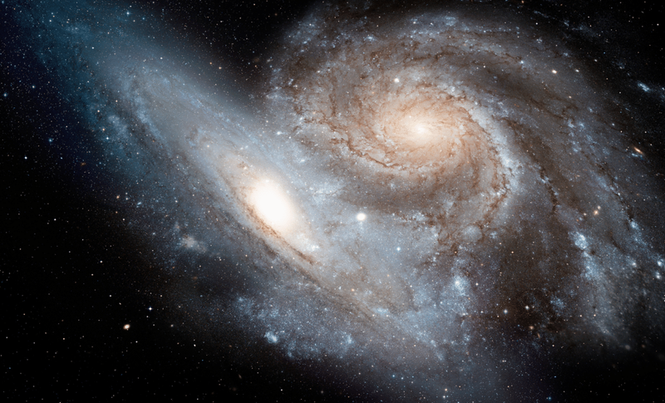
Billions of years ago, the Milky Way endured a violent merger that reshaped its structure and sent stars careening into unusual orbits. Today, according to The Conversation, our galaxy is entering another transformative phase, pulled and distorted by the Large Magellanic Cloud, its most massive nearby dwarf companion. What appears as a serene night sky is, in fact, a record of survival, cosmic upheaval, and a galaxy in constant motion.
Uncovering The Galaxy’s Violent Past
For galactic archaeologists like Vasily Belokurov, studying the Milky Way is akin to reconstructing a civilization from its ruin, but instead of soil and pottery, the evidence comes from stars. Among the hundreds of millions observed, some stars stand out because they are migrants, born outside our galaxy and later absorbed through cosmic collisions. As highlighted by The Conversation, these stars move differently, cutting across the smooth rotation of the galactic disk, and their chemical composition, less enriched in heavier elements than native stars, reveals that they evolved more slowly in smaller dwarf galaxies before joining the Milky Way. By tracing these migrants, scientists can piece together the galaxy’s ancient encounters, revealing not just where these stars came from but also how these events fundamentally reshaped the Milky Way’s structure.
The Sausage Merger That Rewired The Milky Way
The most significant of these ancient encounters is the Gaia-Sausage-Enceladus collision, which occurred roughly 8 to 11 billion years ago. This long-vanished galaxy merged with the Milky Way in a process so dramatic that it splashed stars from the old galactic disk into the halo, creating a population of exiles far from their birthplace. New star clusters were also acquired during this merger, leaving visible traces of the cataclysm in both motion and composition. Beyond these observable changes, the collision likely altered the orientation of the Milky Way’s disk and the alignment of its dark matter halo, the vast invisible structure whose gravity holds the galaxy together. Gaia’s precise mapping of stellar motions has helped reveal that this halo is far from a simple, round cloud; it can stretch, warp, and respond dynamically to major encounters, much like a ship listing in turbulent waters.
A New Galactic Dance Begins
After billions of years of relative calm, the Milky Way now faces another perturbation. The Large Magellanic Cloud (LMC), currently the largest companion galaxy, is exerting a gravitational pull that disturbs the outer halo and slowly accelerates the Milky Way into a complex, spiraling dance. Unlike the distant past, when only the galaxy’s internal evolution shaped its structure, this ongoing interaction is an external force reshaping the galaxy once more. Scientists believe that only one of these two galaxies, the Milky Way or the LMC, is likely to remain largely intact in the distant future. This new chapter of cosmic migration, survival, and adaptation mirrors the upheaval of the sausage merger, showing that even seemingly tranquil galaxies are constantly evolving.
Reading The Stars To Predict The Future
The Gaia space telescope has turned our galaxy into an unprecedented archaeological record, mapping nearly 2 billion stars and revealing their intricate motions. These stellar patterns not only expose the Milky Way’s past collisions but also provide a rare glimpse into the behavior of dark matter, the invisible substance whose gravity dominates the galaxy’s outskirts. By understanding how stars respond to gravitational pulls from mergers and companions, astronomers can predict future distortions and better understand the invisible scaffolding of the cosmos. The night sky’s calm appearance is thus a fleeting moment, a visible snapshot of a galaxy that has been broken, rebuilt, and is now quietly moving toward its next dramatic transformation.