Assalamualaikum warahmatullahi wabarakatuh.
Bismillāhir-Raḥmānir-Raḥīm,
al-ḥamdu lillāhi rabbil-ʿālamīn,
waṣ-ṣalātu wa-s-salāmu ʿalā ashrafil-anbiyā’i wal-mursalīn,
wa ʿalā ālihi wa ṣaḥbihi ajmaʿīn,
ammā baʿd.
All praise is due to Allah, the Lord of all worlds.
May peace and blessings be upon the noblest of prophets and messengers, our beloved Prophet Muhammad sallallahu Alaihi Wasallam, and upon his family and all his companions.
Distinguished fellows, ladies and gentlemen,
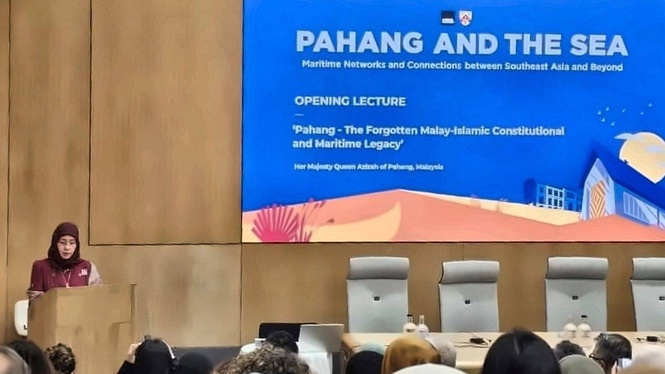
It is a profound honour to stand before this learned audience at Oxford, a place where the world is told and retold, histories constructed and reexamined. Today, it is listening to a forgotten kingdom remembered, that knew the sea and never forgot who it was. I have come a long way from Malaysia, from the land known as Tanah Melayu, to speak to you about a great maritime civilisation that flourished long before the West ever came in search of spice, and long before it came again to conquer and colonise. It was a world that already knew the sea, mapped the monsoon, and governed the waves with law. A civilisation of ports and pen, of trade and truth, where faith and justice sailed together that drew merchants not with muskets but with mastery of seamanship, diplomacy and faith.
That kingdom is Pahang, a realm whose sovereignty rested not upon conquest but upon law; whose throne was the river, whose crown was justice, a great maritime kingdom that once drew the attention of the West not because it was weak, but because it was wondrous. Pahang was a civilisation of tide and time, dignified, deliberate, and steadfast in its own identity, a kingdom that remembered the sea. While others surrendered to conquest, Pahang remained faithful to itself. It ruled not by sword but by sacred code; it governed not through fear but by faith. The sea for Pahang was never a border but a living constitution. It was a legal space, a living court of law, guarded by conscience. Its ports were not merely markets of trade but tribunals of justice. Pahang was not simply a kingdom by the sea; it was a kingdom of the sea, where law travelled with the tide and justice flowed with the current.
From the third century Chinese records to the 17th-century Malay court chronicles, Pahang appears in multiple names and voices: Pan-huang, P’o-huang, Pahan, Pa-hang. These references mark its long-standing presence in transregional consciousness, not as a landlocked kingdom, but as a coastal entrepôt, connected to the Indian Ocean and Laut Melayu worlds.
To understand Pahang as a maritime kingdom, one must begin with Melaka, the city that transformed the Malay world from riverine kingdoms to oceanic empires. Known to the Portuguese as the ‘Venice of the East,’ Melaka was not just a port, it was the maritime imagination made real. Its harbor could shelter over a hundred ships at once, its markets filled with Gujarati, Arab, Chinese, and Javanese traders, and its legal codes were written with the sea in mind.
To speak of the colonial era as one-sided is to forget that the flow was never just gold and guns. It was pepper and poetry. We were consumed as much as we were conquered. They came for spices, but they left with our soul. Through the sea, we did not just trade, we transformed. We flavored their food, draped their bodies in silks and batik, filled their cabinets with our pottery and carvings. Long before we were colonised, we had already colonised their kitchens, their wardrobes, and their dream.
The Malay world may have lost battles in history books, but it won victories in memory, in kitchens, in galleries, and in closets. Europeans did not just take back spices, they took recipes, rituals, and the very essence of hospitality. To the European eye, the East was a gallery of wonder, a world of intricate patterns, mysterious symbols, and beauty crafted by hand and heart. The sea brought not only spices and silk, but inspiration, and it was Asia that filled European galleries, wardrobes, and kitchens.
When we speak of maritime history, particularly in the context of colonial expansion, the narrative often centres on the West discovering, conquering, and profiting from the East. But from an Asian perspective, the story begins much earlier, and with different power dynamics. Through maritime trade, it was not merely Europe that entered Asia, it was Asia that entered Europe, reshaping its tastes, aesthetics, and even identity. In subtle but profound ways, the Malay world, and broader Southeast Asia, colonised European imagination long before European powers claimed our lands.
By the time of the Srivijayan expansion and Langkasuka, Pahang had already been integrated into Malay maritime circuits, functioning as a source of mineral wealth and forest produce. During the height of the Melakan Sultanate in the 15th Century, Pahang was both a vassal and a vital trade corridor, with its trans-peninsular river systems allowing Melakan influence to reach deep into the Malay heartland. Following the fall of Melaka to the Portuguese in 1511, Pahang asserted its independence. The Sultanate that emerged was not merely a political offshoot, it was a maritime state in its own right, with its own fleet, laws, and diplomatic relations with Johor, Aceh, Pattani, Brunei and the wider Muslim world. Pahang was a civilisation of tide and time, dignified, deliberate, and steadfast in its own identity.
Long before Western charts mapped, spoke of maritime law, and called it the South China Sea, the people of the Malay world had already named and navigated those waters, the Laut Melayu or the Malay Sea. Before admiralty courts, there was the Sultan, whose words ruled the land and commanded the waves. These were not nameless waters; they were governed domains, ruled, mapped and moralised by Malay hands before the West did. Pahang is often remembered in textbooks as a peripheral Malay state, rich in resources, but overshadowed by the likes of Melaka or Johor. Yet this view obscures a deeper truth: Pahang was a maritime power in its own right, strategically located on the east coast of the Malay Peninsula, and integral to the trading arteries of the Laut Melayu.
To call it by another name is to speak in a foreign tongue; to call it the Laut Melayu is to speak in our own, the language of navigators, jurists, and poets who had already codified the sea in their own laws and language. At the heart of this maritime state was a legal code rarely studied but immensely significant, and that is the Hukum Kanun Pahang or the Pahang Canon. And nowhere was this maritime consciousness more perfectly or fully expressed than in the Hukum Kanun Pahang, a document that extended justice and law, from land to river and from river to ocean.
Compiled during the reign of Sultan Abdul Ghafur Muhyiddin Shah in the early 17th century, this text was more than a collection of laws. It was a mirror of a kingdom, land-based and sea-bound; anchored in both Islamic jurisprudence, Malay adats and local maritime realities. The Hukum Kanun Pahang, compiled under Sultan ʿAbdul Ghafur Muhyiddin Shah between 1592 and 1614, stands as one of the oldest and most complete legal manuscripts in South East Asia today, blending syariah and adat into one system of rule. It was not merely a code of law; it was a constitution; a total codification of sovereignty, justice, and faith. It transformed a Sultanate into a kingdom and a territory into a civilisation. It made the sea an extension of the state, not a frontier beyond it. It governed rivers, ports, naval ranks, taxation, piracy, honesty in trade, and duties of Sultans and subjects alike.
Pahang, not just as a territorial polity, but a maritime Sultanate, whose political authority, commercial influence, and legal legacy reverberated across the region. While Hukum Kanun Melaka and the Undang Undang laut Melaka is often celebrated as the legal bedrock of the Malay world, it is in the Hukum Kanun Pahang that we find the matured expression of maritime legal consciousness, reflecting a kingdom far more reliant on the sea, and more deliberate in codifying its authority over it. The Hukum Kanun Pahang did not treat the sea as merely a border, it treated it as a governed space under Royal sovereignty, bound by law.
The Hukum Kanun Pahang was the direct continuation of the Hukum Kanun Melaka and the Undang-Undang Laut Melaka, the Melakan legacy reborn and perfected in Pahang. Where Melaka’s law concerned the court and market, and the Undang-Undang Laut Melaka the ship and voyage, Pahang united both realms, land and sea into one moral-political order. The Hukum Kanun Pahang was adapted from Hukum Kanun Melaka but remained distinct, reflects a legal consciousness shaped by the kingdom’s geographic and economic dependency on the sea.
As I mentioned earlier, it regulated the responsibilities of the Sultan and his officers or the Orang Besar, that is the Bendahara, Temenggung, and Shahbandar, defined port taxation, naval hierarchy, and the rights of traders and seafarers. It punished piracy and fraud, protected women and property and preserved the balance between divine justice and royal authority. The Pahang Canon became the backbone of Malay governance; it was the first comprehensive written expression of constitutional civilisation in our region, and its influence later echoed in Johor, Terengganu, Perak, Riau, Kedah and even Acheh if not Patani. It is in truth, the world's earliest written constitution of Malay-Islamic civilisation.
Sultan ʿAbdul Ghafur Muhyiddin Shah, the 12th. Sultan of Pahang and a direct descendent of the noble Melaka Sultanate, was the architect of Malay-Islamic constitutional tradition. The ruler who compiled and codified the Hukum Kanun Pahang as the direct continuity of Melaka’s Hukum Kanun or the Melaka Canon, and the Undang-Undang Laut Melaka or the Melaka Law of the Sea. His legacy stands as the greatest written monument of the Malay world, a complete codification of sovereignty, justice, and faith long before colonial law. Descended directly from the noble Melaka lineage, he inherited a political and spiritual tradition that had shaped the Malay-Islamic world since the 15th century. Under his reign, Pahang was transformed from a successor state of Melaka into a sovereign polity grounded in syariah, adat, and written law.
In codifying the Hukum Kanun Pahang, he provided not merely a lawbook but a constitution of governance, one that integrated syariah principles, royal and state administration, judicial and commercial regulations, and maritime and riverine law, extending the Sultan’s authority “from the river to the sea.” His leadership produced a legal system that pre-dated European notions of the modern constitution by centuries. Yet, despite his monumental achievement, Sultan Abdul Ghafur has been almost erased from mainstream historiography.
If Pahang was the forgotten maritime kingdom, then Sultan ʿAbdul Ghafur Muhyiddin Shah was the forgotten lawgiver and Sultan of Civilisation. Yet he gave us our greatest inheritance and that is the Hukum Kanun Pahang. In his foresight lay the blueprint of Malay constitutionalism; in his pen, the codification of justice; and in his legacy, the manuscript that still shapes our sense of governance. He deserves to have a name and a place among the great lawgivers of world history. To restore his rightful place is to restore the dignity of Malay-Islamic civilisation itself. Sultan Abdul Ghafur must be remembered not only as a King but as a constitutional architect, whose vision made the Sultanate of Pahang both sovereign and lawful, centuries before the 1948 Undang-Undang Tubuh Negeri Pahang reaffirmed that very continuity.
In modern constitutional terms, he may be described as the architect of Malay-Islamic constitutionalism, the first Malay to institutionalise a comprehensive written constitution that governed both land and sea. His decision to compile and codify law was an act of intellectual preservation and statecraft, a Royal intellect; ensuring that the moral, legal, and administrative order of Melaka would live on in Pahang. He can thus be recognised as the first Malay ruler to institutionalise a written constitution that governed both terrestrial and maritime domains, centuries before the colonial charters or federal constitutions of the modern era.
The Hukum Kanun Pahang was more than a code of conduct, it wove syariah and adat into moral order, it was the compass of a nation. Proving that divine and customary could exist in harmony, it joined revelation with reason, syariah with adat, divine will with the realities of governance. It affirmed that power must serve justice, and justice must reflect faith. The Sultan under its law was not a despot but a raja adil, a just ruler accountable to Allah. The Hukum Kanun Pahang, thus stands as both a historical document and a philosophical statement, the written conscience of a ruler who believed that justice was the truest expression of sovereignty. For this reason, Sultan ʿAbdul Ghafur deserves recognition as the Father of the Malay-Islamic Constitutional Tradition, and the Hukum Kanun Pahang as its enduring monument.
And today, I stand before you not only as a daughter of that lineage but as a custodian of its living legacy. In the Pahang State Museum rests the original complete manuscript of the Hukum Kanun Pahang, not a copy, not a fragment, but the authentic legal codex compiled under the reign of Sultan ʿAbdul Ghafur Muhyiddin Shah himself. Returned to Pahang in the 1970s after centuries of silence, this manuscript represents the oldest and most complete Malay-Islamic constitutional text known to exist in the region today. It predates the Vatican copy of the Hukum Kanun Melaka and Undang-Undang Laut Melaka, which were later transcriptions of Melaka’s original codes. The Hukum Kanun Pahang stands as their direct continuation and completion, a unified constitution that extended justice from palace to port, from land to sea. It is not imitation, but inheritance; not adaptation, but affirmation, the matured expression of Malay-Islamic sovereignty in written form. This is the greatest monumental asset of the Malay world, a document that proves that centuries before colonial charters or Western constitutions, the Malay mind had already conceived a complete system of law grounded in faith, justice, and governance. It is time, I believe, for this manuscript, the Hukum Kanun Pahang, to be inscribed in the UNESCO Memory of the World, not merely as a relic, but as a living testament to the intellectual and constitutional genius of our Malay civilisation.
Piracy became not only a crime against the state but a sin against faith; trade became not only commerce but an act of worship or honesty, but a divine command; and justice became the language through which faith found its earthly form. In this, the Hukum Kanun Pahang reflected a deep synthesis of Islamic legal philosophy and local Malay wisdom, a maritime constitution. Thus, the Pahang Canon is the earliest surviving reflection of Islamic maritime jurisprudence in the Malay world, proof that religion, law, and seafaring could move as one current. Pahang established what might be called maritime constitutionalism, the rule of law from palace to port, from rivers to the open sea.
Islam came to Pahang not by sword but by sail, brought by merchants and scholars from Gujarat, Persia, and Arabia. It was not over land that Islam first entered the Malay world, but on the wind, carried by monsoons, in the sails of merchants' ships. It came not by conquest but with trade, and was anchored not in mosques first but in ports. Thus, when Pahang codified its law, it wrote not imitation but inspiration, an Islamic state in spirit centuries before the term existed. It was embedded in contracts at the harbor, in oaths sworn on the deck, in port taxes and moral codes. Every harbour had its customs, every voyage its code, every sailor his rights. It was a Magna Carta of the Malay Sea, written not in Latin, but in Malay Jawi, sung by monsoon winds.
It was not only the sea that made Pahang a maritime kingdom, it was the rivers. Pahang’s geography of sovereignty gave shape and form to its law. The great Sungai Pahang or the Pahang River, the longest in the Malay Peninsula and its vast network of tributaries, carried justice from the highlands to the horizon, linking goldfields and forest markets with coastal ports, gave the Sultanate unmatched access to the interiors. From Kuala Tembeling to Jerantut, from Lipis to Rompin, from Pekan to Melaka through the Penarikan, these rivers did not just carry water, they carried power, trade, law, and identity. Pahang’s position as the largest state in Peninsular Malaysia is not just geographical, it is historical. It reflects a legacy of internal governance, maritime sovereignty, and political independence. The Pahang Sultanate was never conquered, never subjugated, and never erased, it survived and negotiated, ruled and traded, and left behind a record of law, river, and resilience.
The Sultanate of Pahang was not merely a regional power, but a maritime kingdom with legal infrastructure sophisticated enough to rival other naval polities. In a world where overland travel was perilous and slow, rivers served as highways of diplomacy and commerce. Boats could sail from the highlands of Hulu Pahang all the way to the Straits of Melaka. The Sultan’s sovereignty was not only coastal but hydrological, his reach extended where the water flowed.
To call Pahang a maritime kingdom is to understand ‘maritime’ not as oceanic alone, but as a system of flowing space, from river source to ocean tide. Its laws reaching from the bend of the Jelai River to the wave-battered harbors of Pulau Tioman and Pulau Natuna. Its tributaries and islands, were highways of civilisation linking mountain, market and sea, where trade and law flowed together. Pulau Tioman, with its freshwater springs, was a sanctuary and resting port of ships crossing the Laut Melayu and Pulau Natuna. The sentinel of the open sea, it stood as the midpoint between Pahang and Brunei, formed a maritime constellation under Pahang’s authority. Islands like Tioman and Natuna were not outposts of empire, they were waypoints in a world where sovereignty moved with the wind and the tide. For Pahang, maritime power meant projecting authority not over land alone, but over the rhythm of the sea.
Tioman Island was more than an island; it was a living harbour. For centuries, ships from Champa, China, and Arabia sought refuge there from the monsoon, a place of water, rest, and renewal. It served as a ship-repair and construction outpost for the sailors of the Malay Archipelago, a floating workshop where the sea met the forest and where indigenous engineering gave birth to vessels worthy of the monsoon. To sail was not merely to move across water, but to enact centuries of knowledge carved into timber. For long before the age of iron and steam, the Malay world possessed its own shipbuilding genius. Our perahu, lancaran, and jong were not copies of the Chinese junk or the Arab dhow; they were the masterpieces of an indigenous engineering philosophy born of rivers, reefs, and wind. Crafted from tropical hardwoods, bound with rattan, sealed with resin, our boats were designed to flex and breathe with the rhythm of our seas. Built for the changing moods of the monsoon, these ships were both architecture and philosophy, floating testaments to a civilisation that understood the marriage between man and water.
Together, they marked the domain of a kingdom whose geography demanded governance through law as its anchor. No European fort ever cast its shadows on our shores. The Dutch and Portuguese passed us by, and the British came not with cannons and conquest, but with respect through diplomacy. Pahang was too stable to invade, too lawful and civilised to be subdued.
To command the sea was not only to sail upon it, but to read its winds, guard its routes and know its moods. In Pahang, this mastery belonged to more than ships, it belonged to a maritime culture and the Orang Laut or the Sea People and the Orang Dalaman or the Interior People. Behind this maritime order stood the guardians of the sea; the Orang Laut and the Orang Dalaman, navigators, pilots, guardians of passage and law. They read the stars like scripture and the monsoon like a clock, turning the sea from peril into pathway, they were the human heart of this order. Often miscast as pirates by colonial chroniclers, they were, in truth, the enforcers of the Sultan’s justice, protectors of passage and the living instruments of his law. To fight pirates was not only a matter of swords and cannons, it about timing of the wind, understanding the current, and knowing when the sea turned traitor.
Without them, no maritime kingdom could have thrived; with them, Pahang’s seas became the safest in the Malay world. Their allegiance to the Sultan transformed water into a realm of governance; their knowledge was the empire’s unspoken intelligence. Without them, the maritime highways of the Nusantara would have been wild and perilous. With them, the Sultan’s justice travelled farther than any fleet of empire, they were the pilots, protectors and pulse of the seas. Pahang did not merely sail the sea, it legislated it.
Through the Hukum Kanun Pahang, Pahang transformed the ocean itself into a sovereign space. Unlike the contested and often dangerous waters of the Selat Melaka and Riau, the maritime zone along Pahang's coast, the eastern corridors of the Laut Melayu, provided secure haven and rare security, where foreign traders found not only shelter but order, law and welcome. In the east, traders found safety. Pahang's waters were not just lanes of trade, they were lines of trust. This reliability enhanced Pahang’s regional prestige and positioned it as a sanctuary of law and commerce amid a turbulent sea.
The sea was not emptiness; it was itself the Sultan's court with order in motion. The Sultan’s justice extended wherever the tide reached. Every port was subject to law; every voyage to ethics; and every captain to conscience. Centuries before the age of European empires and international maritime law, Pahang had already articulated a philosophy that the sea could be governed through justice, not conquest; through civilisation not colonisation. For sovereignty without justice was piracy, and law without faith was tyranny.
This belief in moral sovereignty, made Pahang part of a wider cultural radiance that shaped the world beyond its waters. Before Europe came with cannons, it came with empty spice jars, and it was our world that filled them. From our forests came scented woods like gaharu and camphor; from our land, nutmeg, clove, pepper and cinnamon; from our looms, songket and batik that dazzled European salons. They came for profit and left with wonder, transformed by beauty. The Malay world did not conquer Europe with empire; it conquered it through taste, artistry, and imagination. Europe was colonised not by our armies but by our aesthetics, it was a cultural tide that touched Europe.
Pahang’s grandeur lay not only in law or commerce but in memory. Deep within and beneath Pahang’s ancient rainforest lies Kota Gelanggi, the lost city of stone, guarded by legend and silenced by time. Said to be surrounded by seven fortresses, it reminds us that Pahang's civilisation was not born of the sea alone, but also of memory and monument rooted in stone, in spirit, and in memory. If the coast carried our trade, the forest kept our soul; if the sea spoke law and carried trade, the jungles preserved faith and wisdom.
One day, when careful scholarship and archaeology brush away the leaves, we may find canals and walls where legend now stands, proof that Pahang’s grandeur was both maritime and monumental. Even the forest remembers as the sea remembers, what textbooks forgot. It holds the echo of Sultans who ruled with knowledge and dignity long before foreign maps found their bearings, the story of a kingdom that once ruled not through conquest, but through knowledge, dignity, and faith. Off the coast, the waters of Pulau Tioman hide the secrets of the past, anchors, ceramics, and fragments of trade, awaiting discovery by archaeology and faith alike. In time, it may be archeology not colonial archives, but the earth and the sea themselves, that will finally reveal and whisper back the full story of Pahang's greatness.
Pahang is often remembered in textbooks as a peripheral Malay state, rich in resources, but overshadowed by the likes of Melaka, Riau, Acheh and Johor. Yet this view obscures a deeper truth, Pahang was not just a territorial polity, but a maritime sultanate in its own right whose political authority, commercial influence and legal legacy reverberated across regions. It was strategically located on the east coast of the Malay Peninsula, and integral to the trading arteries of the Laut Melayu.
Although Pahang once formed part of the larger Johor–Pahang–Riau–Lingga Empire, its maritime sovereignty was distinct and respected. Long before the Bugis rajas crossed the straits and before Riau became the fulcrum of maritime diplomacy, Pahang had already carved its name across the waves, as a sovereign, seafaring kingdom whose rivers, ports, and laws defined an early Malay maritime order. History often speaks of the Bugis as the storm that redefined Malay kingship, but it was Pahang that held the tide when Melaka fell, and kept the flame of maritime governance alive.
From the 18th century, Pahang's Sultanate evolved into a self-governing entity under the Bendahara house, with rulers who maintained autonomy over internal affairs and trade. There was mutual recognition, not interference, between the eastern and western wings of the empire. While the Straits of Melaka were governed as a closed and contested sea, Pahang looked eastward toward the open ocean. Isolated by geography but never in power, it ruled both sea and river. Its maritime strength was based not on size or centrality, but on independence, access, and resilience.
Today, as nations debate maritime disputes, stirring global tensions, borders and laws of the sea, let us remember that centuries ago a Malay Sultan on the east coast of the Tanah Melayu had already encoded the laws of the sea, not just to govern trade but to shape civilisation not in the language of empire. Pahang may not have built great fleets, but we built trust. The Hukum Kanun Pahang is not a relic; it is a living testament. It is the moral architecture of a civilisation that ruled the sea through justice, faith, and order. If Melaka was the gateway, Pahang was the anchor. Its law, its legacy, and its people made it a kingdom of the sea, and a quiet architect of the world we now call global.
And let us all remember this, Pahang’s maritime soul, law and loyalty were never separate. The Sultan reigned with justice and fairness, guided by the Hukum Kanun Pahang, not as ornament, but as order to be respected, lived, and upheld. The Sultan was not a distant figure on a throne, but a guardian of balance between people, trade and the sea. Pahang as the forgotten maritime kingdom played a vital, stabilising and strategic maritime role in the Malay Archipelago. the Hukum Kanun Pahang ensured protection and that is our legacy and dignity. To understand the sea is to understand the soul of Pahang. And it is in that soul, that we find the greatness we never lost and the greatness others failed to see.
Let this be my legacy, that my children may walk taller, knowing that their rivers once ran with gold, their seas with law, and their names with pride. May they remember that long before others wrote of civilisation, we already had the Hukum Kanun Pahang, not merely as a record to be read, nor as a memory to be mourned, but as a mandate of justice and faith, a living testament to what Sultan ʿAbdul Ghafur Muhyiddin Shah left, as his enduring legacy to the Malay world. Let them not read it as relic, but as a reminder that law guarded our waters and dignity steered our course.
The wisdom of the Hukum Kanun Pahang reaches far beyond monarchy.
It teaches that law must rule over power, whether the power of a king, a government, or a political party.
When rulers misbehave, kingdoms fall; when politicians forget integrity, nations stumble.
The message is eternal: law is the conscience of leadership, and justice the anchor of sovereignty.
May Allah bless our pursuit of knowledge; may He guide us to protect what our ancestors built with wisdom and devotion, in faith and foresight. And may the sea, the Laut Melayu, that once carried our civilisation, carry our legacy forward; from Pahang to the world.
Thank you.
Wabillahi taufik wal hidayah.
Wassalamualaikum warahmatullahi wabarakatuh.
Tunku Azizah Aminah Maimunah Iskandariah holds a master’s degree from the International Institute of Islamic Thought and Civilisation (ISTAC), International Islamic University Malaysia and currently a PhD candidate at ISTAC-IIUM.