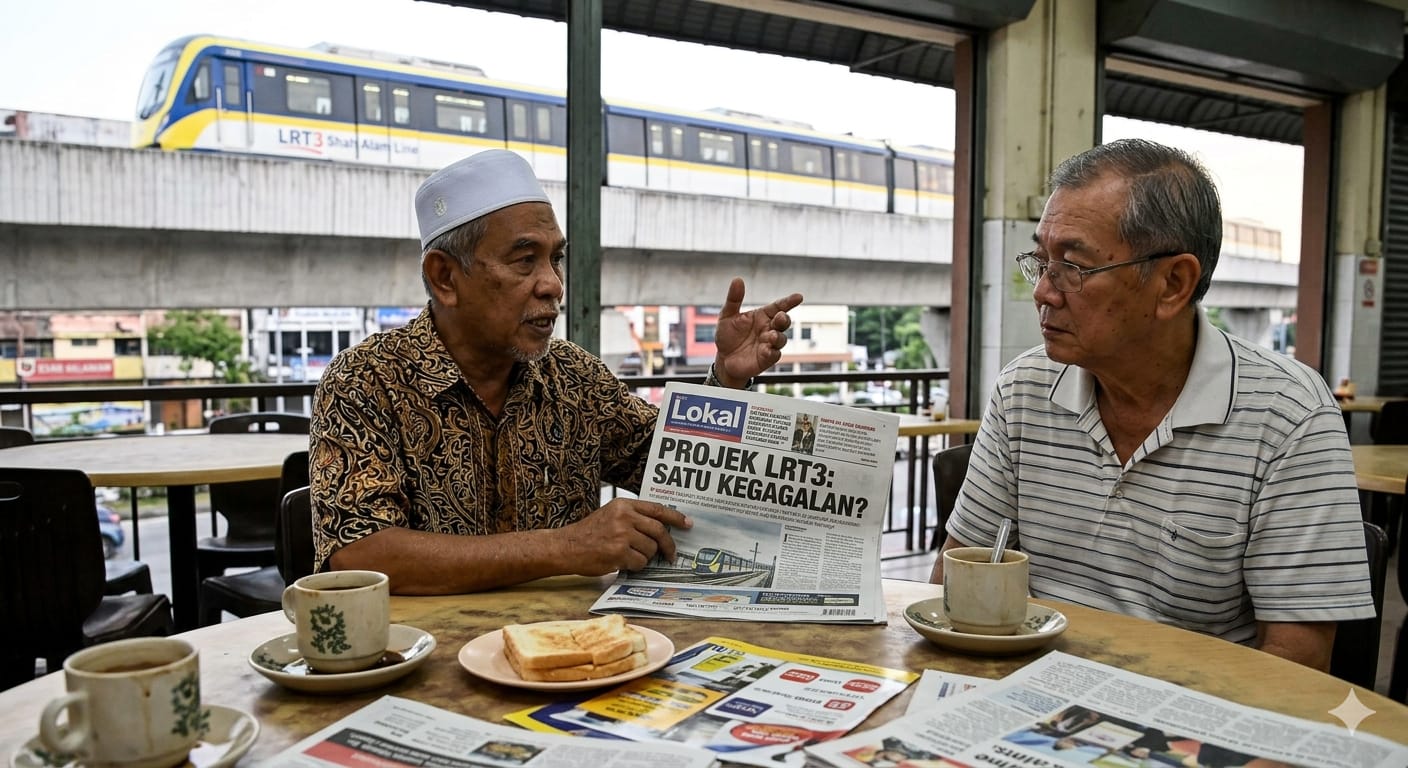
Every Malaysian has met that one uncle at the Shah Alam Anneh cafe LRT3.
With a steaming glass of teh tarik in one hand and yesterday's newspaper in the other, he can redesign Kuala Lumpur's transport network before the waiter brings his roti canai. He knows where the next LRT line should go, why every highway should be widened, and why every train should have more coaches. His solutions are simple: build more, spend more, and build it faster.
Then his phone rings.
His wife reminds him to buy cooking oil but only if it is on promotion.
Suddenly, the same man who wanted unlimited government spending spends fifteen minutes comparing prices between Lotus's, Econsave, AEON mall and NSK.
Perhaps that is Malaysia's greatest economic contradiction.
When it comes to our own wallets, every sen matters.
When it comes to public money, billions somehow become invisible.
That contradiction sits at the heart of the latest debate surrounding the LRT3 project. What began as a discussion over reduced train configurations, deferred stations and project delays has evolved into something far larger. It has become a national conversation about whether fiscal discipline is compatible with development, whether governments should prioritise engineering ambition over financial sustainability, and whether economic decisions can ever escape the gravitational pull of politics and race.
The answers are neither simple nor comfortable.
The Emergency Nobody Wanted
To understand why the LRT3 project became the subject of cost rationalisation, one must return to Malaysia in 2018.
The country was not operating under ordinary economic conditions. It was emerging from one of the most damaging financial scandals in modern history. The 1MDB crisis had severely undermined investor confidence, exposed enormous contingent liabilities, weakened fiscal credibility and left the incoming administration confronting difficult realities that extended far beyond political slogans.
Governments do not collapse because of one expensive railway.
They collapse when years of accumulated liabilities, excessive borrowing, weak governance and declining confidence begin feeding upon one another.
In such circumstances, every ringgit acquires a different meaning.
The newly elected administration inherited not merely projects but commitments. Not merely budgets but obligations. Not merely promises but debts that would ultimately be serviced by taxpayers over decades.
The Finance Ministry was no longer simply preparing annual budgets.
It was performing emergency economic surgery.
Doctors treating a patient in intensive care do not begin by discussing cosmetic improvements. They stabilise the bleeding first.
Finance ministers facing fiscal emergencies operate under remarkably similar principles.
The review of mega-projects including LRT3 should therefore be viewed through that broader economic lens. Cost rationalisation was not undertaken because rail transport lacked importance. It was undertaken because Malaysia's fiscal position no longer permitted business as usual. The objective was to restore confidence, preserve borrowing capacity and prevent future debt from expanding beyond sustainable levels.
That distinction is frequently lost amid today's political arguments.
The Mathematics of Public Money
Infrastructure is expensive.
Infrastructure financed through debt is even more expensive.
Many Malaysians naturally focus on construction costs because those numbers dominate headlines. Yet economists seldom stop there. They also examine financing costs, debt servicing, lifecycle maintenance and the opportunity cost of capital.
Every additional billion borrowed today generates interest obligations tomorrow.
Those obligations compete directly with healthcare budgets, education funding, flood mitigation projects, public housing and social welfare programmes.
Money is finite.
Public expectations are not.
This is the uncomfortable arithmetic confronting every finance minister regardless of political affiliation.
Saving billions on one project does not simply reduce expenditure.
It preserves fiscal space.
Fiscal space is an invisible national asset. It allows governments to respond to recessions, pandemics, natural disasters and future infrastructure needs without placing unbearable burdens upon taxpayers.
Unfortunately, fiscal space rarely receives ribbon-cutting ceremonies.
Nobody gathers to celebrate debt that was never incurred.
Yet future generations benefit precisely because those liabilities never materialised.
Public Transport Is a Public Service, Not a Gold Mine
Perhaps another misconception deserves correction.
Many citizens expect rail operators to behave like profitable corporations.
They are not.
Public transport exists primarily because society benefits when people move efficiently.
Reduced traffic congestion.
Higher labour productivity.
Lower carbon emissions.
Improved property values.
Greater accessibility to employment.
These are economic returns enjoyed by the nation rather than by the rail operator's balance sheet.
This explains why rail systems across London, Tokyo, Singapore, Paris and many other developed cities continue receiving government support despite strong passenger demand.
Rapid KL is no exception.
Rail systems require continuous maintenance, signalling upgrades, rolling stock replacement, electrical improvements and operational subsidies. They are long-term public assets rather than short-term commercial investments.
Consequently, expanding infrastructure beyond what public finances can reasonably sustain creates another problem.
Debt servicing begins competing with operational quality.
When governments devote increasing portions of annual budgets towards repaying borrowings, less money remains available for maintaining existing systems, upgrading signalling technology, replacing ageing assets or expanding future capacity.
Ironically, excessive borrowing undertaken to improve transport today may weaken transport tomorrow.
When Mathematics Becomes Politics
No discussion surrounding LRT3 can ignore the political atmosphere in which it now exists.
The controversy intensified following public criticism directed specifically at those who reviewed the project in 2018, particularly former finance minister Lim Guan Eng and his then political adviser Tony Pua.
From that point onwards, what should have remained an economic discussion gradually acquired political and, in some quarters, ethnic overtones.
Supporters defended the savings.
Opponents portrayed the reductions as evidence of poor governance or deliberate neglect.
The danger begins when financial mathematics becomes political identity.
Debt has no ethnicity.
Interest payments recognise no race.
Opportunity cost does not distinguish between Indian, Chinese, Malay, Iban or Kadazan taxpayers.
Every Malaysian contributes towards servicing public debt through taxation, economic growth and government revenue.
Reducing an infrastructure budget during a fiscal emergency should therefore be evaluated according to engineering evidence, transport demand and economic sustainability not according to the ethnicity or political affiliation of the ministers making the decision.
Equally, those defending the cost reductions must also accept legitimate questions regarding operational consequences.
Good governance demands accountability from every administration, irrespective of party colours.
Did Malaysia Cut Too Deep?
This is perhaps the most important question.
Saving public money is commendable.
Saving too much at the expense of long-term functionality is not.
Transport planners and economists often pursue different objectives.
Economists seek fiscal efficiency.
Engineers seek operational resilience.
Passengers simply want trains that arrive on time.
Recent experiences on the Kelana Jaya Line remind Malaysians that infrastructure is judged not by Treasury reports but by commuter experience. Melted power cables, signalling failures, overcrowded coaches and repeated service disruptions have eroded public confidence. Many commuters still remember the infamous "two trains kissing" episode, not merely because of the accident itself, but because it symbolised years of deferred maintenance, operational weaknesses and inadequate accountability.
Against this backdrop, concerns regarding smaller stations, three-car train configurations and reduced future expansion capacity deserve serious discussion rather than political dismissal.
Cost optimisation should never compromise operational flexibility.
An infrastructure project designed for today's demand but incapable of accommodating tomorrow's growth merely postpones expenditure rather than eliminating it.
Economists describe this as false economy achieving immediate savings while creating larger costs in the future.
Therefore, the challenge facing policymakers has never been choosing between spending and saving.
It has always been choosing between spending wisely today and spending even more tomorrow.
The Real Legacy of LRT3
The LRT3 debate is ultimately not about one railway line.
It is about the philosophy of government.
Should fiscal discipline disappear whenever infrastructure is discussed?
Or should infrastructure planning remain grounded in economic reality even when difficult decisions prove politically unpopular?
Malaysia cannot build modern cities without investing in world-class public transport.
Neither can Malaysia sustain world-class infrastructure by ignoring debt sustainability.
Both truths can exist simultaneously.
The nation requires finance ministers willing to ask uncomfortable questions about affordability.
It also requires transport planners willing to remind accountants that today's cost savings must never become tomorrow's congestion.
Good governance lies precisely between those two disciplines.
History will eventually judge whether the LRT3 review struck the correct balance.
But one lesson is already clear.
The greatest cost imposed by the 1MDB era was never measured solely in billions of ringgit allegedly lost.
Its deepest consequence was the shrinking of Malaysia's fiscal choices. Resources that could have comfortably financed larger stations, longer platforms and greater transport capacity instead became consumed by repairing damaged public finances.
Corruption rarely ends when money disappears.
Its consequences continue long afterwards in postponed hospitals, delayed schools, deferred flood mitigation projects and, perhaps, even in railway platforms that had to become smaller because the nation's balance sheet had already become too large.
That may be the most enduring lesson of the LRT3 debate.
Sometimes the price of corruption is not only paid in courtrooms.
It is paid every morning by commuters standing on crowded platforms, waiting for the next train.
Annan Vaithegi writes that a government's greatest achievement is not building the most expensive project. It is delivering the greatest value for every public ringgit entrusted by its people.
Annan Vaithegi (annanvaithegi@icloud.com) is a content creator under the Newswav Creator programme, where you get to express yourself, be a citizen journalist, and at the same time monetize your content & reach millions of users on Newswav. Log in to creator.newswav.com and become a Newswav Creator now!
The User Content (as defined on Newswav Terms of Use) above including the views expressed and media (pictures, videos, citations etc) were submitted & posted by the author. Newswav is solely an aggregation platform that hosts the User Content. If you have any questions about the content, copyright or other issues of the work, please contact creator@newswav.com.