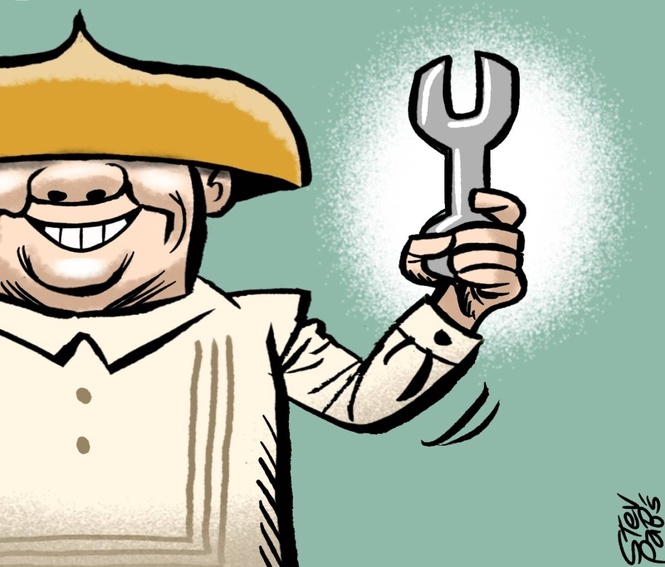
FILIPINOS are celebrated locally and globally for making things work against the odds. But when resourcefulness becomes a substitute for a functioning system, who really benefits? Why is there danger in what could have been an admirable core Filipino trait?
In the workplace, a person may have the training, the experience and the determination to be productive; however, he or she may lack the equipment or resources needed to do the job. What happens next will depend on the “diskarte.”
And Filipinos love a good story about diskarte. It is romanticized. Normalized. Applauded.
One concrete example of diskarte is found in health care. We applaud the nurse who improvises, the health care worker who stretches limited supplies, and the hospital team that somehow gets through another impossible shift of caring for 10 patients. These stories reinforce a familiar national narrative: Filipinos are resilient, resourceful, creative and ingenious. Celebrated as heroes. Epitomized as ideal citizens. Regarded as models.
However, diskarte is not simply another Filipino word for resilience, resourcefulness, creativity or ingenuity. There is a science, ethos and praxis in diskarte. But is diskarte a positive trait of the Filipinos?
At the 2026 Philippine Nurses Association National Convention, nurse-scientist Jerome Visperas Cleofas presented research developed with Joseph Cadeliña that challenges this convenient understanding of diskarte in Philippine nursing. Jerome Visperas Cleofas, is a registered nurse and health social scientist. He is a professor and research fellow of the De La Salle University in Manila. He is a section chairman of sociology, social work and demography at the Social Sciences Division of the National Research Council of the Philippines. He is part of the Top 2 percent of Scientists Worldwide based on the Elsevier/Stanford list for years 2025 and 2026. In 2024, Jerome Cleofas was regarded as an Outstanding Young Scientist for Sociology, awarded by the National Academy of Science and Technology of the Department of Science and Technology.
In their research, they reimagine being “madiskarte” not as a mere cultural trait, but as a disposition resulting from recurrent organizational challenges in health care.
They interviewed nurses about how diskarte is enacted and witnessed in everyday clinical life. These interviews were co-analyzed with news, documents, and local research about diskarte and its intersection with health care. Their findings suggest something more complicated, and more politically consequential. There is more in diskarte than meets the eyes.
‘Diskarte’ through a nursing lens
Diskarte is not merely about bouncing back from adversity or inventing frugal solutions. It is a practice shaped and normalized by difficult working conditions, scarce resources, professional expectations and moral judgments.
Nurses exercise diskarte by navigating what is available, negotiating what is permissible within and beyond standards, and finding ways to deliver care despite institutional constraints.
To describe diskarte simply as resilience is to emphasize endurance. To call it resourcefulness is to focus on available materials. To label it creativity or ingenuity is to celebrate individual talent. These tendencies repeatedly place the responsibility on individual nurses. It is regarded as if resilience is an intrinsic trait of an individual, insulated and isolated from the environment that imposes adversity over and over again. It demands that the nurses endure more in the environment that continuously pulls them down, or endure adversity that has persisted to challenge them to survive.
Understanding diskarte requires taking Filipino experiences and cultural meanings seriously rather than squeezing them into familiar eurocentric and biomedical frameworks. That is precisely the argument behind the intellectual project of Narsolohiyang Pilipino. Inspired by pioneering local Filipino disciplines such as Sikolohiyang Pilipino, Pilosopiyang Pilipino and Pilipinolohiya, this approach that insists Filipino nursing realities deserve to inform how nursing knowledge itself is developed.
This is not an academic distinction without practical consequences. How we understand diskarte shapes what we expect from nurses and what we allow institutions to get away with.
Consider an account from the research describing the use of an improvised glove-based substitute for a surgical drain in a government hospital. One might admire the determination to find an alternative. But the more urgent questions are institutional: Why was the proper equipment unavailable? What risks did the workaround introduce? Who was responsible for ensuring that nurses had what they needed?
A health care system should not depend on extraordinary improvisation to meet ordinary clinical needs. In the end, the question is — who suffers? Who’s endangered? Who deserves this?
‘Diskarte’: Good and bad
There is also a danger in assuming that all diskarte is good diskarte. Filipino nurses themselves distinguish between “tamang diskarte” and “maling diskarte.” An adaptation that helps accomplish care is not automatically safe or ethically defensible. A shortcut that compromises patient safety cannot be justified simply because it gets the job done. In the context of quality, “hindi pwede ang pwede na.”
This moral dimension makes diskarte especially important for health care policy.
Government must ensure reliable supplies, adequate staffing and working conditions that make safe care possible. Hospital administrators must be held accountable for recurring shortages. Nurses need effective channels to report unsafe conditions without fear of retaliation, and a meaningful voice in decisions affecting patient care.
Professional standards must also be applied with cultural sensitivity and an understanding of local realities, not abandoned whenever resources run short. None of this diminishes Filipino nurses’ ingenuity. It recognizes that ingenuity has limits, and that public institutions have obligations that individual workers should not be expected to shoulder indefinitely.
‘Diskarte’ must be examined
For too long, diskarte has served as both a national compliment and a convenient political escape hatch. We celebrate people for enduring problems that those in power have failed to solve. Diskarte deserves a more critical, culturally grounded understanding. It should prompt us to examine not only what Filipinos do, but also the circumstances that compel them to do it.
The question is no longer whether Filipino nurses are madiskarte. We know they are. The question is why our health care system continues to need so much of it.
And more optimistically, the study invites us to imagine what Filipino nurses could do with diskarte once they are liberated from the unequitable and unsustainable systems that constrain them.
Ethos and praxis of ‘diskarte’
As for me, there is ethos and praxis in diskarte, and it makes perfect sense philosophically and culturally. The ethos — values and beliefs — behind it makes resilience and resourcefulness as moral virtues. There is a strong bayanihan mindset, where you are not alone in doing it, with “bahala na ako” that is anchored on the optimism bias blended with accountability. At times, it becomes tied up with dignity like “mahirap pero may diskarte.”
Knowledge becomes action that works in real life. Survival intelligence may mean doing more with less. It may celebrate the emotional labor where Filipinos find ways — no matter what — and endure any adversity along the way.
But ultimately, the best Filipino diskarte is not about enduring what is wrong, but about finding better ways to make what is right possible. It is not about getting by, but about doing what is right even when it is harder. Just like a circle, good diskarte starts with the ethos of why, shown in the praxis of how, and returns as who you help uplift, not just survive.