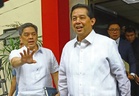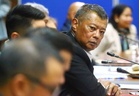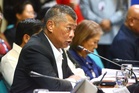
THE arrest of former House speaker Martin Romualdez and the filing of a plunder case against him, led by Ombudsman Crispin “Boying” Remulla Jr., could become a watershed moment in our nation’s history, a decisive break with our culture of impunity.
The Ombudsman has made accusations; Romualdez is entitled to the presumption of innocence and to test every allegation in court. The Sandiganbayan’s warrant reflects a finding of probable cause, not a final judgment. But just a year ago, Romualdez was considered the second most politically powerful man in the land
He was not only speaker of the House, but also President Ferdinand Marcos Jr.’s first cousin and principal political lieutenant. Many claimed he was Marcos’ hatchet man, undertaking such projects as revising the Constitution to enable the president to remain in power after 2028 and pushing the impeachment of Vice President Sara Duterte. Representatives Joel Chua, Gerville Luistro, Leila de Lima, Bienvenido Abante, Ace Barbers and Paolo Ortega — the public faces of the prosecution — are political pygmies compared with the forces arrayed behind Vice President Sara Duterte. Only somebody with Romualdez’s wealth and power could have mounted such an undertaking.
Romualdez’s arrest and jailing is therefore good news for Sara. The congressmen who pursued the impeachment as well as the expensive private prosecutors they hired, my sources claim, will be losing the alleged Romualdez financial support, which had made the project possible.
Since we became a nation, corruption has operated not simply as the private theft of dishonest officials but as a political operating system. Money from public works, procurement and discretionary budgets sustains contractors, local machines, elections and the officials who protect them. When the system works, those at the center are rarely touched. When scandal erupts, the usual response is to sacrifice lower officials or a few contractors while leaving the machinery intact.
Even in the case of former president Joseph Estrada, who was convicted of plunder and jailed, we back-pedaled. He was pardoned, released and later elected Manila mayor; his two sons became senators, largely on the strength of the Estrada name and his de facto proxies.
We have lagged behind our Asian neighbors not only in economic performance but in purging our nation of corruption. Indonesia’s Setya Novanto, also a speaker of the House and chairman of the powerful Golkar party, was sentenced to 15 years for corruption in 2018. Malaysia’s former prime minister Najib Razak began serving a corruption sentence in 2022. Thailand’s Thaksin Shinawatra was convicted in a corruption case in 2008. In China, former security chief Zhou Yongkang, once a member of the politburo standing committee, was sentenced to life imprisonment in 2015.
That is why the indictment and arrest of a former House speaker who is the president’s cousin and once his most important ally in the House could be a turning point.
Extraordinary
It would be an extraordinary irony if the very presidency that many Filipinos now judge harshly — a period marked by incompetence, disastrous flooding, public disgust and allegations of corruption on an unprecedented scale — were to change the course of our nation’s history, toward the light. The historical judgment would then be not that of a reforming administration, but of one whose mammoth failures made reform unavoidable.
History has produced such reversals. Nixon’s Watergate scandal, one of the great disgraces of the American presidency, helped produce campaign-finance reforms, financial-disclosure requirements and the Office of Government Ethics. Hong Kong’s police-corruption crisis, crystallized by senior police officer Peter Godber’s escape while under investigation, led in 1974 to the Independent Commission Against Corruption (ICAC). In neither case did scandal magically purify the country. Public anger was converted into institutions.
The comparisons with Singapore, Hong Kong and China must be used carefully, however. None became prosperous because it put one prominent politician in handcuffs. Their experience shows that an anti-corruption drive matters economically only when it changes the expected rules of public life. Investors, businesses and ordinary citizens must come to believe that permits, contracts, courts and public money will no longer be controlled by personal access. That belief comes from institutions, credible enforcement and cases reaching people once considered untouchable.
Hong Kong is perhaps the clearest illustration. In the early 1970s corruption in its police force was so entrenched that Godber was able to flee while under investigation. The outrage helped produce the ICAC, deliberately placed outside the police. Hong Kong’s industrial and commercial rise had begun earlier, but the ICAC helped provide a cleaner, more predictable official environment in which a trading and financial center could deepen.
Singapore’s Corrupt Practices Investigation Bureau was created in 1952, and the People’s Action Party government after taking office in 1959 strengthened anti-corruption law and enforcement as part of a wider reconstruction of the state. The lesson is that impunity can be broken, but selective prosecution and bureaucratic fear are no substitutes for transparent institutions.
Precedent
There is also a useful American precedent. The United States Senate’s Pecora investigation — named after the prosecutor who led the investigations — in 1933 exposed conflicts of interest, deceptive securities practices and reckless conduct by major Wall Street institutions before the Great Depression. Congress followed with the Securities Act of 1933 and Securities Exchange Act of 1934, creating the Securities and Exchange Commission. An investigation became rules, disclosure and an institution intended to outlast the scandal.
That is the standard by which the Romualdez case should be measured. There are three tests.
The first is whether investigators follow the money. If the allegation concerns a network of kickbacks, the inquiry cannot stop with the politician alleged to have received them. It must identify contractors, intermediaries, corporations, bank transactions and officials who made the scheme possible; determine how projects were selected and costed; identify who benefited from winning companies; and establish whether the public works were actually delivered.
The Estrada episode failed this test. He alone was convicted, while those allegedly involved in the surrounding transactions — intermediaries, businessmen, bankers and others who facilitated the movement or concealment of money — largely escaped serious accountability.
The second test is whether the case produces safeguards rather than headlines. Procurement data should be promptly public and searchable, with beneficial ownership of contractors disclosed. Bid documents, project locations, progress reports and final inspections should be open to scrutiny. Budget amendments must leave a trail showing who requested them and why. Cases involving powerful defendants must move fast enough that delay does not become another form of acquittal.
The Priority Development Assistance Fund (PDAF) pork-barrel scandal during the Aquino III administration plainly failed this test. This produced no permanent cleansing of the political machinery. Three senators accused in connection with PDAF were eventually acquitted, only six congressmen were convicted, while Janet Lim-Napoles, a small businesswoman, became the enduring symbol of the scandal, sentenced practically to a lifetime imprisonment. The PDAF scam involved fictitious nongovernmental organizations and at most P10 billion in stolen government funds; the present flood control allegations are vastly larger, up to P56 billion, by the Ombudsman’s reckoning. Worse, the PDAF scam stole funds from small-time projects such as livelihood seminars or construction of basketball courts. The current scandal resulted in hundreds of thousands of Filipinos’ homes flooded.
Equality
The third test is equality. If Romualdez alone falls while other actors are protected, the case will be understood as a controlled sacrifice within a ruling coalition. If evidence is pursued against whoever is responsible — regardless of surname, office or present political usefulness — it can begin to establish a different norm: the state is not a private business and public money is not the prize awarded to the winner of an election.
That is why this may be a historic moment. But we have had false starts before. EDSA I was supposed not only to end the Marcos dictatorship but to usher in genuine democracy and end corruption. Decades later, corruption has spread beyond small circles of cronies to the House of Representatives and the Public Works department, and who knows what other government agencies. The Estrada episode and the PDAF scandal have become little more than memories.
There are not a few who think that Romualdez’s arrest is some part of an elaborate moro-moro, that the case against him, as what happened in the graft cases against his aunt Imelda, will be dismissed, and much, much sooner than the three decades it took the former dictator’s widow to do so. But the big difference is that the plunder charge requires Romualdez to be in jail, in a cell smaller than one of his maid’s room, until he is proven innocent; Imelda never spent a day or an hour in jail.
I can dream, can’t I? I am hoping that it will be our history’s bittersweet irony that from the rot, something new takes root. I do hope this will not be known in history as the “Romualdez case” but mirroring the US episode in the 1930s, the “Remulla investigations,” after the Ombudsman who appears to be determined in prosecuting the formerly second most powerful politician in the country.
Facebook: Rigoberto Tiglao
X: @bobitiglao
Website: www.rigobertotiglao.com