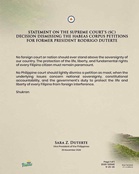
SOME judicial decisions may be technically correct yet profoundly unsettling in their constitutional, moral and political implications. The Supreme Court’s dismissal of the consolidated habeas corpus petitions challenging the arrest and surrender of former president Rodrigo Roa Duterte to the International Criminal Court (ICC) is arguably one of them.
On Nov. 24, 2026, the Supreme Court announced its decision to dismiss the petitions by a 9-4 vote, with one justice not participating. Penned by Associate Justice Japar Dimaampao, the ruling essentially rests on the doctrine of mootness rather than a definitive adjudication of the constitutional merits of Duterte’s arrest, detention and surrender. In fairness to Senior Associate Justice Marvic Leonen, although he concurred in the dismissal, he challenged the majority’s failure to resolve fundamental constitutional questions.
With Duterte already detained in The Hague and his ICC trial scheduled to commence on Nov. 30, the majority held that the writ of habeas corpus could no longer serve its intended purpose because Duterte was beyond the territorial jurisdiction and coercive authority of Philippine courts.
Technically defensible? Perhaps. Constitutionally satisfactory? Hardly. Morally reassuring? Certainly not.
There is a profound difference between what is technically correct and what is substantively right. The dismissal does not make right what happened to Duterte on March 11, 2025. Neither does it establish that his arrest and surrender were constitutional, or that his fundamental rights as a Filipino citizen were adequately protected. Indeed, the Supreme Court itself clarified that the dismissal does not necessarily mean that Duterte’s arrest and transfer were lawful or that his constitutional rights were not violated. That distinction speaks volumes.
The tyranny of technicality
What saddens me most is that some of the finest legal minds in the Philippines chose to dispose of an extraordinary constitutional controversy through procedural technicality rather than comprehensively confront its substantive merits.
There is no question about the intellect, competence, experience and legal sophistication of the nine justices who voted for dismissal. They represent the cream of the Philippine legal profession. Precisely because of this, one would have expected greater constitutional imagination, judicial courage and appreciation of the far-reaching consequences of their decision.
Never before has a former Philippine president been arrested on Philippine soil and surrendered within hours to an international criminal tribunal without first being brought before a competent Philippine judicial authority to contest the legality of his arrest and surrender. If this unprecedented controversy does not warrant exceptional constitutional scrutiny, one wonders what does.
The Supreme Court may lack the coercive authority to compel the ICC to release Duterte. But surely, it retains the constitutional authority to scrutinize the actions of Philippine government officials who facilitated his arrest and surrender, for they are not above the law, more particularly the Constitution. This distinction is fundamental. The inability to enforce a particular remedy should not necessarily prevent the judiciary from determining whether Marcos Jr.’s government violated the Constitution in creating the circumstances that rendered that remedy ineffective.
Due process
cannot be optional
Article III, Section 1 of the 1987 Constitution guarantees that no person shall be deprived of life, liberty or property without due process of law. Duterte is not above the Constitution, but neither should he be placed beneath its protection. Regardless of the allegations against him, he remains a Filipino citizen entitled to constitutional safeguards, the presumption of innocence and meaningful access to judicial remedies.
Justice Leonen’s separate opinion is particularly compelling. He maintained that the Philippines could not enforce an ICC warrant domestically without judicial intervention. He also invoked Article 59 of the Rome Statute, which provides for domestic judicial scrutiny of an arrest, compliance with proper procedures and respect for the rights of the arrested individual. Although the continued applicability of treaty obligations after the Philippines’ withdrawal remains legally contested, the constitutional obligation of Philippine officials to respect fundamental rights is not extinguished by that withdrawal.
How ironic that a government purportedly acting in the interest of international justice appears to have disregarded the procedural safeguards associated with the very international legal framework it invoked.
Moreover, beyond the constitutional rights owed to every Filipino, Duterte deserved the elementary dignity and institutional courtesy befitting a former head of state and head of government. Such courtesy is not immunity from prosecution. It reflects respect for the office, the republic and the electorate that once entrusted him with the presidency. Insofar as many Filipinos are concerned, the manner of his surrender was extraordinarily degrading and constitutionally indefensible, even if the majority of Supreme Court justices declined to make a definitive finding on its legality, and most of all, it created a dangerous constitutional precedent.
The separate opinions of Justices Leonen, Amy Lazaro-Javier, Ramon Paul Hernando, Henri Jean Paul Inting and Antonio Kho Jr. deserve serious consideration. Lazaro-Javier’s position is especially instructive: Philippine government officials cannot escape constitutional accountability merely because the consequences of their actions extend beyond Philippine territory. Hernando likewise challenged the invocation of mootness in a controversy of such extraordinary public importance. Their arguments expose the danger of what might be called “executive-created mootness,” which should alarm every Filipino, regardless of political affiliation, because it concerns personal liberty, separation of powers, judicial independence and the constitutional sovereignty of the republic. Regrettably, most Supreme Court justices have left much of this constitutional terrain unresolved.
Conclusion
The Constitution is not moot. As a Filipino, I find it profoundly saddening that a former president seeking constitutional relief from the highest court of his own country should find the principal remedy invoked unavailable because the government had already surrendered him abroad. What reassurance does this offer ordinary Filipinos?
The Supreme Court has left other legal avenues for accountability open, but its failure to settle the substantive constitutional questions remains a monumental missed opportunity. Yes, the majority of the Supreme Court justices answered whether habeas corpus remained an enforceable remedy under the circumstances. But it did not conclusively answer whether the Philippine government acted constitutionally in creating those circumstances. That is the central weakness of the Supreme Court ruling.
Ultimately, the Duterte controversy is no longer simply about Duterte, for it is transcendental.
It is about the kind of republic we aspire to be, the integrity of our constitutional institutions and the limits of governmental power.
A petition may become moot and academic. The Constitution must never become so. Constitutional rights do not expire at the airport. Executive accountability does not disappear at our borders. And national sovereignty must never become collateral damage in the name of the ICC (an external body) and domestic political expediency. History will judge not only those who exercised power but also those entrusted with the constitutional responsibility of restraining it.
As for President Ferdinand Marcos Jr., he has created, in my view, a deeply troubling legacy that may haunt him long after his presidency ends. It is a legacy defined not merely by a former president’s surrender, but by how that surrender was accomplished and the constitutional questions it exposed.
Ultimately, national sovereignty is not simply about defending territorial boundaries. It is also about preserving the Constitution’s supremacy, the judiciary’s independence and the people’s fundamental liberties.