.png)
WHEN news broke that Tun Dr Hasmah Mohd Ali had passed away, social media filled with grief.
Not just from politicians, former colleagues or those who had known her personally. Ordinary Malaysians mourned too.
That is perhaps the most remarkable thing about Dr Hasmah. Millions felt they knew her, even though most had never shaken her hand, shared a meal with her or exchanged a single word with her.
In a country where public figures are often viewed through political lenses, Dr Hasmah somehow transcended politics.
Scroll through the thousands of tributes and a pattern emerges. People rarely spoke about her titles or achievements.
They remembered her smile. Her laughter. The way she looked at her husband of 70 years, Tun Dr Mahathir Mohamad, whenever he spoke.
They remembered her gentle teasing, her warmth and the sense that she was entirely comfortable being herself.
Many called her "Ibu Negara" — the mother of the nation — or simply a national treasure.
Affection like that cannot be conferred by office or status. It has to be earned.
Throughout my journalism career, I have interviewed ministers, business titans and royalty. But only once did I sit down with the wife of a Prime Minister.
That singular honour belonged to Dr Hasmah.
The interview took place in 2019, a year into Tun Dr Mahathir's unexpected return as Malaysia's seventh Prime Minister.
I remember the moment clearly.
My notebook remained blank throughout — not because I had forgotten my job, but because I simply wanted to listen.
There was something captivating about her.
She spoke about her childhood, her medical training and life beside one of Malaysia's most consequential leaders with the ease of someone having a conversation, rather than giving an interview.
Her intellect was undeniable, but never intimidating.
Her sincerity was immediate.
And her presence stayed with you long after the conversation ended.
At one point, she reflected on Tun Mahathir's decision to return to office after retiring in 2003.
"I was happy," she told me, when he stepped down.
Then came the question she posed with a mixture of honesty and amusement:
"But why, in the goodness of everything, does he want to become Prime Minister again?"
She understood better than most what public office demanded — the sacrifices, scrutiny and endless demands it placed on family life.
Yet when Tun Mahathir told her he was returning out of duty, she stood beside him once again.
As she always had.
That determination remained evident even in her later years.
When I met her at Yayasan Al-Bukhary, her eyesight had already deteriorated significantly. The notes on her desk were printed in extra-large font.
A small detail, perhaps. But one that revealed much about her character.
Nothing — not even failing eyesight — seemed capable of slowing her down.
Perhaps that was part of her quiet appeal.
She was a trailblazer long before she entered public life, among the earliest Malay women to study medicine and one of Malaya's pioneering female doctors.
Yet she wore those accomplishments lightly.
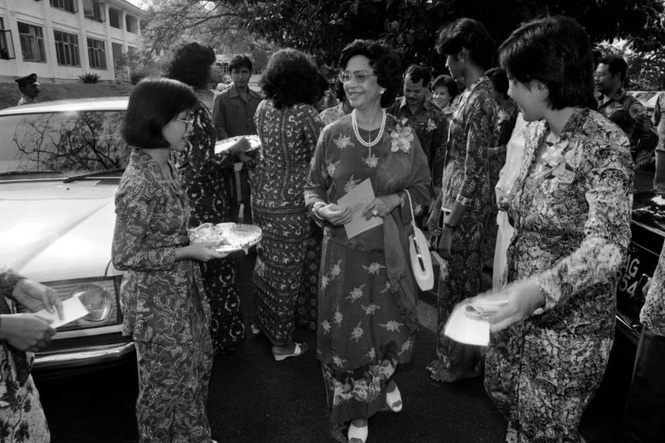
For decades, Malaysians watched her move through history without ever demanding centre stage.
She was there when Tun Mahathir first became Prime Minister in 1981. She was there when he left office in 2003. And she was there when he made his improbable return in 2018.
While governments rose and fell, Dr Hasmah remained a reassuring constant.
She reminded people of someone familiar.
A mother. A grandmother. A favourite aunt.
Someone whose wisdom came without judgement and whose kindness expected nothing in return.
That is why the tributes feel so personal.
People are grieving not because they knew Dr Hasmah personally, but because, in some quiet way, she felt like part of their lives.
History will remember her as a pioneering doctor, a devoted wife and a national figure in her own right.
But many Malaysians will remember her more simply as the woman who brought warmth and humanity to public life.
The woman they never really knew, yet somehow felt they did.