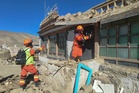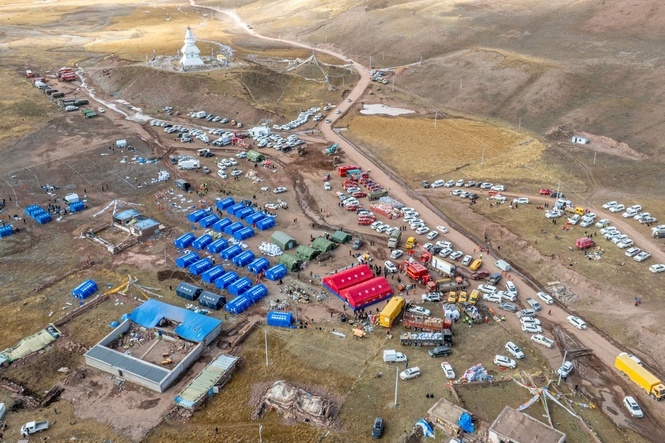
A large-scale rescue operation is underway near the epicentre of a deadly earthquake that struck China's southwestern Tibet region, killing 16 people and injuring 76 others.
A magnitude-7 earthquake struck Tibet on Thursday, with its epicentre in Maru Township in Drachen County, Nagqu, a high-altitude region. It was the strongest earthquake to hit China since January 2024.
Nearly 400 aftershocks have been recorded since the earthquake, including several tremors ranging in magnitude from 4.3 to 5.2, causing further damage and increasing the number of injured people, the China Earthquake Networks Centre said on Friday.

Freezing temperatures, expected to drop to around –9°C, and possible snowfall on Saturday are complicating rescue efforts and raising fears of further building collapses and rockslides.
More than 5,000 people, including personnel from three local counties, police forces and the military, have been deployed for search and rescue operations.
Rescue teams had completed three rounds of house-to-house searches across every village by Friday night, Nagqu's acting mayor, Dunzhu, told a news conference.
The scale of destruction caused by the deadly earthquake has begun to emerge, with at least 339 homes collapsed or severely damaged. Officials have expressed concerns about further structural damage from aftershocks, as well as the risk of casualties from rockslides.
The earthquake severely disrupted power supplies and communications and damaged several roads, including sections of a national highway affected by rockfalls.

Electricity was restored to nearly 2,000 households by Friday morning.
A resident near the epicentre said her family was preparing to sleep when their home began shaking, knocking over objects and forcing them to rush outside "without even taking the time to get dressed".
"My legs were shaking the entire time I was heading downstairs, and by the time I reached the bottom, I was so terrified that I burst into tears," the unnamed woman told local media.
She said residents "are afraid to return to their homes", adding: "They set up tents along the roadside or spent the night in their cars."
Another resident told the Beijing News: "I was asleep when it hit. Everyone has run outside now and is too afraid to go back in. I'm currently driving to an open area to sleep in my car."

Footage of the rescue operation showed the difficult conditions in the high-altitude region, with local journalists reporting from the scene while wearing nasal oxygen tubes.
Other footage showed officers loading supplies onto a truck in the dark and inspecting damaged buildings and rubble using flashlights.
Relief supplies, including 2,000 prefabricated housing units, around 3,400 tents, 2,000 folding beds, flashlights and winter clothing, have been dispatched to the region.
The US Geological Survey said the earthquake struck at 10.33pm local time, with its epicentre 191km (119 miles) east-northeast of Nagqu, in a sparsely populated, high-altitude area of northern Tibet. It recorded the quake at a depth of 18km (11 miles).
Nagqu is more than 300km (186 miles) north of Tibet's capital, Lhasa.
Tibet has experienced deadly earthquakes before. At least 126 people were killed in January 2025 when an earthquake struck Tingri County, on the northern side of Mount Everest.
In 2010, a magnitude 7.1 earthquake in Yushu, in neighbouring Qinghai province, killed at least 2,698 people and left nearly 300 others missing.