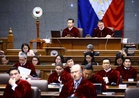
THERE is an old joke about statistics: With the right denominator, you can make almost any number tell the story you want. The Philippine Senate, sitting as an impeachment court in the trial of Vice President Sara Duterte, has now given that joke a constitutional sequel.
On Sept. 23, the Senate impeachment court voted 13 to 1 to overturn presiding officer Sen. Francis “Chiz” Escudero’s earlier ruling that conviction required 16 votes — the traditional arithmetic of two-thirds of a 24-member Senate. Instead, the court ruled that the denominator should consist only of senators who are legally and factually capable of participating in the impeachment proceedings.
For people understandably allergic to legal mathematics, here is the issue in plain language. The Constitution says: “No person shall be convicted without the concurrence of two-thirds of all the Members of the Senate.” With 24 senators, two-thirds is 16. That was the original rule announced at the start of the trial. The constitutional text itself uses the phrase “all the Members of the Senate.” But four senators have largely been unable to participate: Ronald “Bato” de la Rosa is at large amid an International Criminal Court (ICC) arrest warrant; Jinggoy Estrada and Rodante Marcoleta are detained while facing separate plunder cases; and Loren Legarda has been abroad on extended medical leave. Remove those four from the denominator, and you are left with 20 participating senator-judges. Two-thirds of 20 is 13.33, which must be rounded up to 14 votes.
So, the Senate did not simply change 16 to 14. It did something much more consequential: It made the denominator movable. And that is where the constitutional headache begins.
When does ‘all’ mean all?
If “all the Members of the Senate” does not necessarily mean all sitting senators, who decides who disappears from “all”?
For me, this is no longer simply about Sara Duterte. The far bigger question is what happens to constitutional government when the meaning of “all the Members” becomes flexible precisely when the political arithmetic becomes politically inconvenient.
Today it is Sara Duterte. Tomorrow it could be another vice president, president, chief justice — or any constitutional officer facing an impeachment court controlled by a different political configuration.
That is why I regard this not merely as another twist in an impeachment trial, but as a deeply troubling moment for Philippine constitutional democracy. When constitutional safeguards become moving targets, the precedent can outlive the personalities who created it.
Sara Duterte and the Dutertes will eventually come and go, politically speaking. So will Marcos, the senators, and everyone now fighting over political power.
But the 1987 Constitution is supposed to remain standing after all of them are gone, though that seems uncertain too. For me, this is what makes it profoundly sad for Philippine democracy.
Supermajority
The purpose of a supermajority is precisely to make certain decisions difficult. Impeachment is not supposed to operate like ordinary legislation, where whoever can assemble a working majority wins the afternoon.
Removing an elected constitutional officer is intentionally harder. The two-thirds requirement forces broader agreement before the Senate can impose the most severe political judgment available, protecting impeachment from being easily controlled by politics and manipulation.
That is why this controversy is larger than the difference between 14 and 16. The problem is not necessarily that 14 is an inherently illegitimate number. The problem is that once the denominator becomes conditional, the threshold can shift depending on who is regarded as capable of participating at a given moment.
Today, four senators are unavailable. Suppose another senator later becomes legally incapacitated. Does the denominator become 19? Suppose one returns. Does it become 21?
Suppose several senators refuse to participate. Are they absent, disqualified, voluntarily unavailable — or still constitutionally part of “all”? Still, the central issue remains: A constitutional number intended to constrain political power has itself become dependent on a political institution’s interpretation of who counts.
Hence, the difficult question is not whether exceptional circumstances deserve consideration. It is how much discretion the Senate has to redefine the constitutional provision mid-trial. This is far more serious than a dispute over calculators.
The strangest part
Perhaps the most revealing feature of the ruling is the Senate impeachment court’s declaration that its interpretation applies “pro hac vice” — for this occasion only — and will not bind future impeachment courts. Escudero, despite dissenting, said the majority ruling must be respected, while also hoping the extraordinary circumstances would never recur.
Institutionally, however, the reassurance is less comforting. Because precedents are not influential only when courts declare them formally binding. Political institutions remember what previous political institutions did. The next impeachment court confronted with inconvenient numbers will know that a previous Senate reinterpreted the denominator in the middle of an ongoing trial.
The words “this case only” do not erase the institutional memory of the maneuver. You cannot un-invent a constitutional technique simply by attaching a label saying “Do not reuse”!
This is bigger than Sara Duterte
And this is precisely why the issue should not be reduced to whether one supports/likes or dislikes/opposes Sara Duterte. Her guilt or innocence must depend on the articles of impeachment, the evidence presented by both the defense and prosecution, and the senator-judges’ assessment of this evidence. The denominator controversy is different. It concerns the legitimacy of the machinery deciding the case.
If Duterte is ultimately convicted with 14 votes because the denominator stands at 20, critics of the ruling will inevitably argue that the Senate lowered the numerical barrier after the trial began. If she is acquitted, supporters of the flexible-denominator rule can argue that insisting on an unreachable fixed 16 might have distorted the trial in the opposite direction. Either way, the Senate has ensured that the arithmetic itself will become part of the verdict’s political legacy.
Indeed, the controversy has already moved beyond the Senate: On Sept. 24, a petition was filed asking the Supreme Court to nullify the impeachment court’s Sept. 23 threshold ruling. Perhaps that was inevitable. Because the real constitutional question is no longer simply: How many votes does it take to convict? It is: Who gets to decide how many senators count when we calculate those votes?
Conclusion
Impeachment is supposed to be one of the rare occasions when senators cease behaving primarily as legislators and assume something closer to the role of judges. The high constitutional threshold is part of what makes that extraordinary exercise different from everyday political horse-trading.
That threshold is supposed to discipline power. But a threshold loses some of its disciplining force when the institution being restrained can also redefine the number beneath it.
The Constitution says two-thirds. The Senate has now said: yes — but first, let us discuss two-thirds of what. And in Philippine politics, whenever the denominator starts disappearing, it is probably wise to keep one hand on the Constitution — and the other on the calculator.
Filipinos should never forget that the Constitution should govern the arithmetic, not the arithmetic rewrite the Constitution. The Constitution should discipline political power, not be disciplined by it.