A GEOPOLITICAL analyst has questioned whether the United States is obligated to defend the Philippines if China used force in removing the BRP Sierra Madre from Ayungin Shoal, citing a 1975 US diplomatic communication that distinguished territorial defense from support for Philippine military deployments in disputed areas.
Adolfo Quizon Paglinawan, a former diplomat, said in an interview that the historical US position raised questions about the scope of Washington’s commitments under the Mutual Defense Treaty (MDT), despite more recent American assurances of support for the Philippines in its maritime dispute with China in the South China Sea.
His remarks followed Defense Secretary Gilberto Teodoro Jr.’s warning on Oct. 23 that any use of force by China to tow away the grounded Philippine Navy vessel would constitute an act of war against the Philippines.
Teodoro said the Sierra Madre is a ship of the Republic of the Philippines, and that “if anything is attempted against it, or anything happens to it through the use of force, that is an act of war against the Republic of the Philippines.” Teodoro also said the possibility of invoking the MDT remained open, but stressed that the decision would ultimately rest with President Ferdinand Marcos Jr.
Paglinawan cited a June 9, 1975, diplomatic communication from then-US secretary of state Henry Kissinger discussing the treaty’s application to Philippine military garrisons in the Spratly Islands.
According to excerpts reproduced by Paglinawan, Kissinger said the MDT did not obligate Washington to support Philippine deployments intended to establish sovereignty over openly disputed territory.
The communication distinguished between defending territory covered by the treaty and supporting military deployments aimed at advancing territorial claims in disputed areas. Kissinger also expressed doubts that the US Congress and American public would support intervention in the Spratly dispute.
Paglinawan argued that this historical position cast doubt on whether an attack on the Sierra Madre would necessarily compel US military intervention.
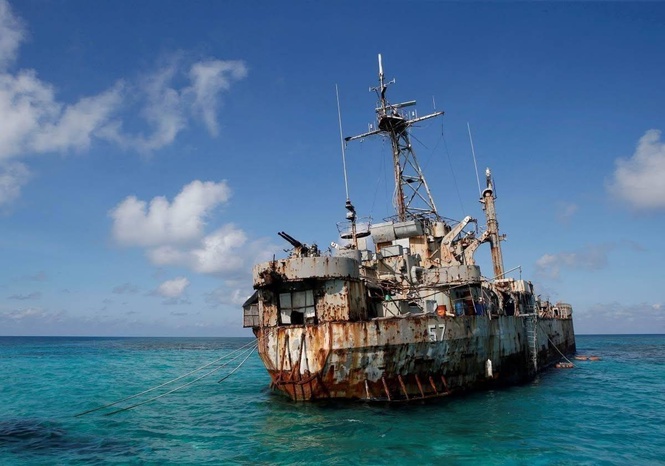
The World War II-era landing ship was deliberately grounded at Ayungin in 1999 and now serves as a Philippine military outpost in the West Philippine Sea.
Filipino troops stationed aboard it have been at the center of repeated confrontations with Chinese coast guard and other vessels.
The MDT, signed in 1951, provides that the Philippines and the US act to meet common dangers in the event of an armed attack in the Pacific against either party’s metropolitan territory, island territories under its jurisdiction in the Pacific, or armed forces, public vessels or aircraft.
The US has repeatedly affirmed that an armed attack on Philippine armed forces, public vessels or aircraft in the South China Sea would trigger its mutual defense commitments.
The 1975 communication cited by Paglinawan addressed Philippine deployments in the Spratlys and reflects a historical US interpretation of the treaty. It does not, by itself, establish how Washington would respond to a present-day attack on the Sierra Madre.
Paglinawan, vice president for internal affairs of the Asian Century Philippines Strategic Studies Institute, has also questioned the legal implications of the vessel’s deteriorating condition and its location at Ayungin Shoal.