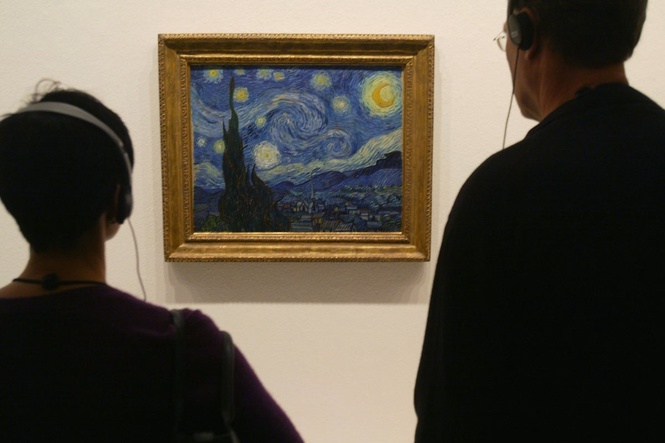
Scientists have made a surprising revelation about Vincent van Gogh’s 1889 painting ‘The Starry Night’ – and claim that it does not depict neither the stars or the night that we thought.
Researchers used a variety of techniques to establish the night sky that the painting actually depicts and claim that it shows the pre-dawn sky over Saint-Rémy around 22 July 1889.
Astronomers have been trying to understand the painting through their understanding of the night sky for years, with two major studies produced in the mid-1980s. But they came to conflicting conclusions, and viewers have tended instead to focus on the symbolic interpretations of the painting.
But the new work was inspired by seeing the painting and finding the prevailing understanding of which part of the sky it depicts unsatisfactory, said its lead author.
“To an observational astronomer, the cluster of stars in The Starry Night is the Hyades in Taurus,” said Elijah Jeong-hyun Kim, a PhD candidate at Kyung Hee University in South Korea. “But the moment I read the earlier studies explaining it as Aries, I heard the painting calling to me.”
He conducted detailed research and found that in the early hours of that July night, a waning crescent moon, Venus and the Hyades star cluster in Taurus appeared close together, as they are shown in the painting. It was based on field trips to France as well as additional evidence and data that helped cement the conclusion.
Typically, the painting is dated using a letter that Vincent sent to his brother Theo on 18 June, 1889. But the Moon does not match up with that time: the painting shows it as a slender crescent, but at that time it was actually waning gibbous.
On 22 July of the same year, however, the night sky matched up and the Moon was much closer to how it appears in the actual painting. Researchers have previously suggested that it might be a difficult date because it was thought to come alongside one of the painter’s seizures – but further scientific work that used the letters as well as weather records and remarks about insects suggests that it actually came in late July.
The researchers found the spot where the painting was made and analysed the shapes in the painting to confirm that its five central stars would have matched the sky that night.
The pen drawing that Van Gogh made after he had made the famous painting is an even closer match, the researchers say.
“I hope this work prompts a renewed, multidisciplinary look at the sequence and working methods of the Saint-Rémy paintings, and at Van Gogh’s movements that summer,” Mr Kim said. “Our conversation with Van Gogh’s other skies is still ongoing.”
The work is reported in a new paper, ‘The actual sky of Van Gogh’s Starry Night: a multidisciplinary reconstruction’, in the journal Scientific Reports.
Read MoreMartian moon space mission hopes to solve mystery of landing on Mars
The Orionid meteor shower peaks today in the UK. Here’s how to catch a glimpse