
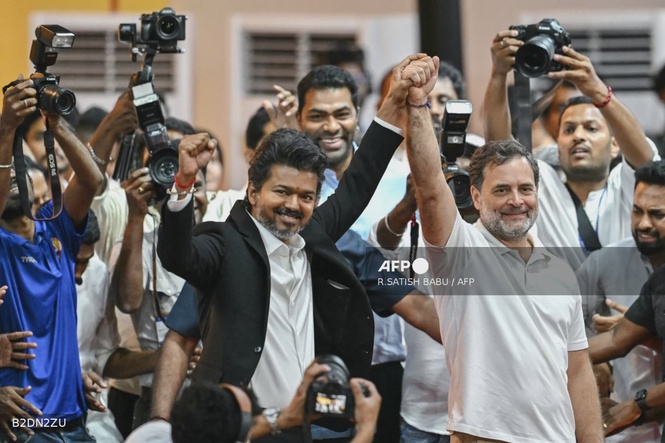
Vijay’s breakthrough victory highlights how Gen Z voters are reshaping modern politics through personality, relatability and online influence rather than traditional party loyalty.
BY now, somewhere in Tamil Nadu, a man is probably still setting off fireworks next to a 40ft-cut-out of C. Joseph Vijay while another is crying into a plate of biryani because the Dravida Munnetra Kazhagam (DMK) machine they thought would rule forever has just been politically body-slammed.
And honestly? Nobody should pretend this was just another election. Tamil Nadu did not merely elect a movie star as chief minister; it detonated nearly six decades of political predictability.
Most of the modern Indian political parties inherit loyalties the way Malaysians inherit opinions about nasi lemak stalls. You supported who your parents supported and the political script rarely changed.
Then came Vijay – not cautiously and not gradually. Tamil Nadu revolved around two giants – the DMK and the All India Anna Dravida Munnetra Kazhagam (AIADMK) – family-inherited.
ALSO READ: Vijay: From reel hero to real force
Vijay walked into politics with fan clubs, cinematic swagger, meme power, Gen Z appeal and enough emotional capital to make veteran politicians sweat through their white shirts. And in his very first election, he pulled off what many thought was impossible.
The old order cracked. Somewhere, political strategists across Asia probably sat upright at 2am clutching polling data like horror movie victims hearing a suspicious noise downstairs. Because this victory was not really about cinema; it was about exhaustion.
Young voters, especially Gen Z, are tired – tired of recycled slogans, tired of political dynasties, tired of speeches that sound like they were drafted by a committee trapped in 1998 and tired of politicians speaking at them instead of to them.
Vijay understood something many traditional politicians still do not. Gen Z does not consume politics the old way; they experience it emotionally, through reels, clips, moments, personality, relatability and who feels authentic enough to screenshot and share.
That terrifies old political parties because they are still campaigning like people are patiently watching a two-hour ceramah under a leaking tent.
Today’s young voters are scrolling while brushing their teeth. A politician now has about eight seconds before somebody swipes away to a cat video. And somehow, Vijay mastered that ecosystem better than political veterans who have spent decades in power.
His speeches became viral clips. His image was carefully built as anti-establishment yet accessible. His fan clubs evolved into grassroots machinery long before he officially entered politics.
He already had something every political party desperately wants but cannot manufacture overnight – emotional loyalty.
Not ideological loyalty; emotional loyalty and that distinction matters. Because this election was not won on machinery alone; it was won on connection.
And before Malaysian politicians dismiss Tamil Nadu as a distant political theatre, they should look closer to home. Because the same undercurrents are already present.
In Malaysia, politics is never far from anticipation. The question of when the next general election will come is almost permanent background noise in the system – part speculation, part strategy and part psychological positioning. But while the timeline remains uncertain, voter sentiment is not. It is already shifting.
Younger Malaysians are increasingly politically unanchored. Party loyalty is weaker, coalition branding is less emotionally binding and historical political narratives carry far less weight than they once did.
Many are not asking who governed before but who understands what it feels like to live now with rising costs, stagnant wages and a constant sense of policy fatigue.
Even Prime Minister Datuk Seri Anwar Ibrahim operates in this new reality where reformist credibility, communication style and digital presence matter almost as much as policy itself. But goodwill in this climate is not permanent capital; it is something that must be repeatedly earned.
At the same time, the opposition is not simply competing against the government; it is competing against attention spans, cynicism and a generation that no longer sees political anger as a long-term ideology. Outrage may still trend but it no longer guarantees loyalty.
Which is why Tamil Nadu’s political shock is not a distant theatre. It is a preview of how quickly political inheritance can collapse when younger voters stop feeling emotionally represented by the system they were born into.
And perhaps the most uncomfortable truth for traditional parties everywhere is this: younger voters are no longer asking which side they are supposed to be on. They are asking whether the sides still matter at all.
This is what makes Vijay’s rise is more than an Indian political story. It’s a warning shot across systems built on legacy, loyalty and repetition. Because when voters stop inheriting politics and start curating it, even the strongest machines can begin to look fragile.
Tamil Nadu may have elected a movie star but beneath the whistles, giant banners and celebratory noise was something far more serious – a generation quietly announcing that political loyalty is no longer inherited; it must now be earned, one scroll at a time.
Tamil Nadu may have elected a movie star but the real verdict is not about Vijay; it is about every political party still assuming loyalty is permanent. Because it isn’t.
In the age of Gen Z politics, irrelevance doesn’t arrive loudly; it arrives subtly as a quiet swipe.
Hashini Kavishtri Kannan is the assistant news editor at theSun.
Comments: letters@thesundaily.com


.jpg?width=1200&auto=webp&trim=26%2C0%2C27%2C0)