By a margin of two to one, British voters now say they would vote to rejoin the European Union in a new referendum. A new opinion poll from Ipsos asked adults in Great Britain: “If a new referendum was held on whether the UK should apply to join the EU or to stay out of the EU, how would you vote?”
Excluding those who are unlikely to take part in such a referendum, 63 per cent said “join the EU”, while 34 per cent said “stay out”, and 3 per cent said they did not know.
The poll confirms the trend since the last election of increasing support for EU membership, to the point where the will of the people is now clear.
Of course, there will be complications in practice. We would have to persuade our European partners that it is worth their reopening negotiations with a country that finally rejected them less than six years ago – the transitional period during which Britain was still treated as a member ended only on 31 December 2020.
That would mean, in practice, that they would need to be reasonably sure that the election of a British government committed to leaving was unlikely. That is one good reason for giving the process some time.
But that time can be used productively to prepare. The next stage of that preparation is to continue the work of repairing the worst damage of Boris Johnson’s hard Brexit. That will be the agenda for the EU-UK summit on 20 November.
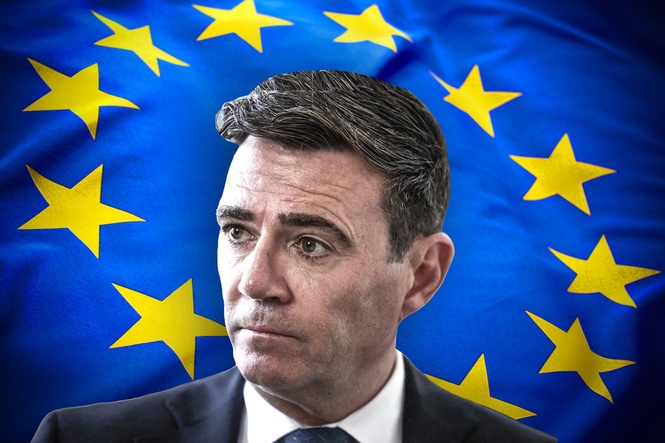
And Andy Burnham is right to raise the nation’s eyes to the middle distance; he is right to ask the country to think about the options for our long-term relationship with the rest of Europe. He was brave and right to say that, while the 2016 referendum and Labour’s 2024 manifesto must be respected, neither binds us for all time – and it is only prudent to start thinking about what the parties might offer at the next election.
Given that the British people are moving in only one direction on this issue, with younger cohorts overwhelmingly committed to a reunited Europe, Mr Burnham is right to lead the debate.
If only all his cabinet colleagues could be persuaded to do the same. We observed the unhelpful tone of John Healey, the chancellor, in making a macabre remark about not rejoining the EU in his lifetime because he is 10 years older than the prime minister.
All ministers should contribute constructively to the debate about the options for the next parliament, now that Mr Burnham has liberated them from the straitjacket of the red lines of the 2024 manifesto.
If a customs union is a possibility, for example, it is worth examining in some detail. There are still many Labour MPs who regret voting down Theresa May’s deal, which was built on the idea, in effect, of a customs union. That could still be the next logical big step after the next election, either on its own or as an explicit staging post on the road to full EU membership.
Sir Tony Blair, who was one of the most eloquent opponents of Brexit, is right to point out that Britain would be seeking to rejoin an EU that had changed since our departure, and that we should try to do so from a position of strength.
That means that the discussions about our future relationship with the rest of Europe will not be dominated by the issues that were settled during our time as a member, such as the euro and the Schengen passport-free area, but by the issues of the future, such as the regulation of artificial intelligence, competition policy and defence.
These are important issues for our nation on its own and as part of a reunited Europe, and Mr Burnham – with the support of all of his ministers – should set out a blueprint for them as part of our common European future.
The Budget was a political triumph – just listen to the dogs that didn’t bark
Meet the former Tesco manager giving Burnham all his best ideas
John Healey is putting the brakes on Andy Burnham’s European ambitions
Burnham and Healey are learning the wrong lessons from New Labour
Britain needs a bolder approach to growth, not a Budget of short-term fixes