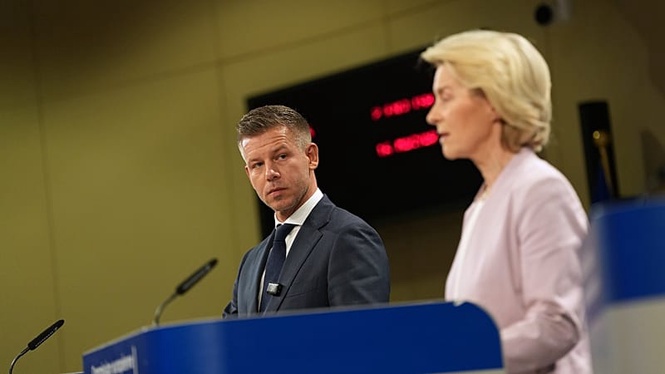
The European Commission has unfrozen €4.2 billion in previously blocked cohesion funds for Hungary, judging that Budapest has addressed earlier rule-of-law breaches. The move also clears the way for Hungary to rejoin the Erasmus+ student exchange programme and the Horizon Europe research funding initiative.
In 2022, the EU suspended €6.3 billion in cohesion funding to Hungary under the conditionality mechanism, citing shortcomings in the country's anti-corruption framework, conflicts of interest, and systemic irregularities in public procurement.
Prime Minister Péter Magyar, who won a landslide election victory in April, had campaigned on a promise to unlock EU funds suspended during Viktor Orbán's 16-year rule.
"Hungary has taken important steps to strengthen the rule of law and protect the Union's financial interests," European Commission President Ursula von der Leyen said in a statement.
"Today, we are proposing to unlock €4.2 billion and reopen the doors of Erasmus+ and Horizon Europe to Hungarian students and researchers. I am glad that they will once again fully benefit from the opportunities our Union creates. This shows that reforms deliver results."
In May, Magyar and von der Leyen agreed to release €16.4 billion in EU funding on the condition that the country met key rule-of-law milestones. In total, Hungary was required to deliver on 27 so-called "super milestones" and more than 100 others.
In late August, Hungary announced it had met all of the conditions, including resolving the situation surrounding public interest trusts (KEKVA) — a legal structure the previous government had used to take control of public institutions such as universities.
Beyond the €4.2 billion released, Hungary is also seeking to withdraw €10 billion in recovery funds; the Commission's assessment of that request is ongoing.
A further €2.2 billion in cohesion funding remains blocked over concerns about academic freedom, bringing the total held up under the agreement between von der Leyen and Magyar to €16.4 billion.
Hungary could unlock even more money from the cohesion funds: a further €500 million is frozen over the country's "child protection law", which Brussels regards as anti-LGBTIQ+, and €31 million over restrictions on the right to asylum. Another €800 million is blocked because of thematic enabling conditions related to social inclusion and poverty.
Should the Hungarian government meet all the criteria, Budapest could unlock a total of €17.31 billion. Magyar has pledged to address the LGBTIQ+ issue and the asylum law by the end of the year.
Releasing the current €4.2 billion also requires a positive decision from the Council, which EU sources say is highly likely. The General Affairs Council could vote on the matter by qualified majority on 13 October.
That date could also mark the start of Hungary's participation in the Erasmus+ and Horizon Europe programmes.