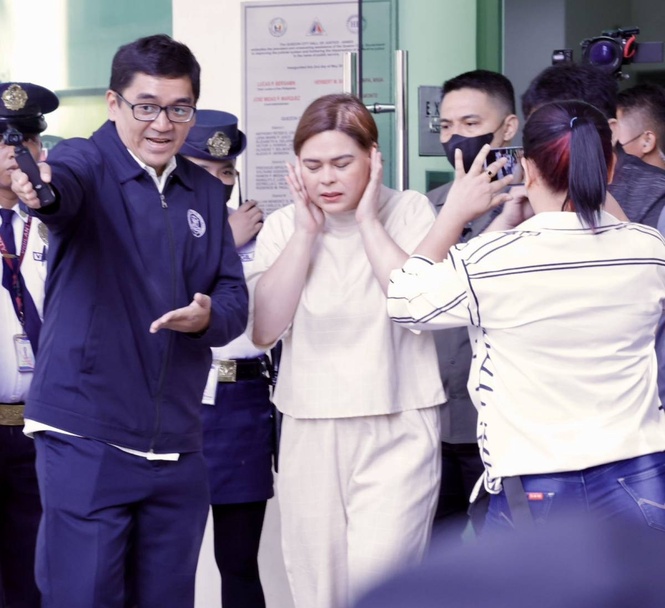
THE Department of Justice (DOJ) on Sunday said it would be up to the Quezon City court to determine whether to proceed with Vice President Sara Duterte’s arraignment on three counts of grave threats.
“That matter is ultimately for the court to determine,” DOJ spokesman Polo Martinez said when asked whether the trial court would wait for a Supreme Court ruling before proceeding with the arraignment.
“The DOJ respects the legal remedies available to the parties and will continue to discharge its prosecutorial mandate in accordance with law,” Martinez said.
On Oct. 9, the Quezon City Regional Trial Court Branch 98 deferred the vice president’s arraignment once more.
Her counsel, Paul Lawrence Lim, said the judge rescheduled the hearing to allow sufficient time to evaluate a pending motion for partial reconsideration.
It was the second postponement of the arraignment, which was originally scheduled for Sept. 11.
At the heart of the latest delay is a motion asking Judge Maria Angelica De Ramos to reconsider her previous denial of a request to inhibit herself from the case.
Duterte’s defense team is also pursuing a petition at the Supreme Court to stop the trial altogether.
On Aug. 11, the DOJ filed three counts of grave threats against Duterte. These charges stem from a November 2024 online press conference, where she claimed to have instructed an associate to kill President Ferdinand Marcos Jr., first lady Liza Araneta-Marcos, and then-House speaker Martin Romualdez should she be harmed.
The court issued an arrest warrant for Duterte on Sept. 4, having determined probable cause to hold her for trial.
She posted bail at P120,000 per count, totaling P360,000, on Sept. 5.
Challenging the authority of the DOJ and the RTC, Duterte’s camp argued that her status as an impeachable official provides her with procedural immunity.
To that end, her counsel has petitioned the Supreme Court for certiorari and prohibition, explicitly requesting injunctive relief to suspend the ongoing criminal case.
While the alleged threats also form part of the impeachment complaints before the Senate, the criminal case and the impeachment proceedings remain legally distinct.